
Choosing a dimmable LED grow light for a cannabis room looks like a one-line decision on a quote sheet: dimmable or not. In practice the word "dimmable" describes a family of very different behaviors. Two fixtures that both say 0–10V dimming on the label can behave differently at the bottom of the dial: one fades to dark with the knob, the other holds a faint glow all night until someone opens a breaker. And the fixture that dims beautifully may be the one that never needed dimming at all, while the small light that genuinely needs a low output sits locked at 10% above a propagation tray. This guide separates the two decisions, gives you the field tests that settle each one, and ends with a page of questions to take back to any supplier.
The Short Answer: Two Numbers, Not One
When you evaluate a dimmable LED grow light, two numbers decide the purchase. The first is the floor: the lowest stable output the driver holds before it flickers, drops out or shuts down, expressed as a percentage of rated output. The second is the need: the lowest light level your crop actually asks for at the height you can realistically hang the fixture. If the floor sits at or below the need, the dimming range is real money spent well. If the floor sits above the need, the range is a spec-sheet ornament, and no amount of knob travel fixes it.
Everything else on the dimming line of a datasheet, the protocol, the connector and the curve shape, changes how the range is delivered, not whether it exists. That is why this guide spends its first half on the floor and its second half on the plumbing. A buyer who knows their floor and their need can read any quote in about five minutes, whatever protocol the fixture speaks.
Why "Dimmable" on a Spec Sheet Tells You Nothing
The word "dimmable" states that output can be reduced. It does not state how far, how smoothly, or whether the fixture goes dark at the end. In horticultural lighting the label is usually attached to the control input, and the control input is the part of the system with the least standardization behind it. A U.S. Department of Energy study of 0–10V control puts the problem precisely: the dominant protocol, defined in IEC 60929 Annex E and carried into ANSI C82.11, specifies maximum output at 10 V and an unspecified minimum at 1 V, and it does not define an off state at all. Because the protocol never promised darkness, installers switch line voltage to guarantee an off state.
Two consequences follow, and both land on the buyer. First, two drivers that accept the same 0–10V signal can legitimately stop at different points: most hold about 10% of rated output at the bottom of the signal, some stop at 30%, a few reach 1% or lower. Second, the phrase "dim to off" that appears on some datasheets is a driver feature, not a protocol property, and the DOE report notes that the phrase itself says nothing about the minimum output before the lamp goes dark. Neither of these is a defect. They are simply not covered by the word "dimmable", which is why the word deserves no trust until the two numbers behind it are confirmed.
Is 0–100% Dimming the Same as Dim-to-Off?
No, and the difference is exactly where buyers get burned. "0–100%" describes a dial that travels from nothing to rated output, which implies the driver can hold a stable output at every point between and go dark at the bottom. "Dim-to-off" is the driver capability that makes the bottom of the dial genuinely dark rather than a standing minimum. A fixture can carry a 0–10V input and a 0–100% dial graphic and still hold 10% at the bottom, because the input range and the output floor are specified by different parties: the protocol defines the wire, the driver designer defines the floor.
The distinction matters most in small rooms, where the fixture dial is also the most convenient switch. In a 3×3 ft tent nobody wants to unplug a driver twice a day; a dial that reaches dark turns the light switch into one motion. In larger rooms the opposite trade appears: a wall controller with a relay does the switching, and the dial's bottom position matters less than the floor it protects. Ask one question and the ambiguity disappears: with the knob at its minimum, does the fixture emit light? If the answer is yes, the honest spec is "10–100%", whatever the dial graphic shows.
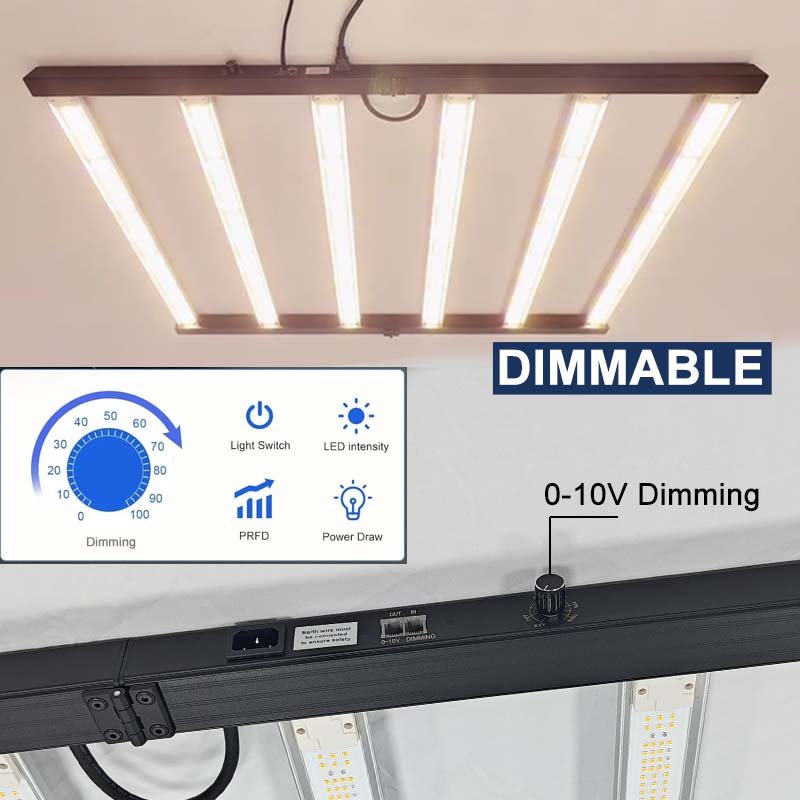
Our own line takes the dim-to-off side deliberately: every fixture we ship dims to dark at the bottom of the dial, on the same 0–10V input and RJ12 daisy chain that carries the control signal, so a single knob covers the whole path from rated output to a dark room. We explain why that design choice pays for itself in the commissioning test below.
Four Labels, Four Different Products
By the time a quote reaches your desk, the dimming line has collapsed into four recognizable shapes. They all ride the same two wires, which is why they look identical on a spec sheet and behave nothing alike in the room.
Read the table as a translation sheet. The left column is what the quote says; the last column is the one-sentence test that separates a real capability from a graphic.
| What the Quote Says | What It Usually Means | Where Off Lives | One-Sentence Test |
|---|---|---|---|
| 0–100% dimming, dim-to-off driver | Continuous range; stable output all the way down; fades to dark | On the dial | Turn the dial to minimum: the room goes dark |
| 0–10V dimming, floor not stated | Most drivers hold about 10% at the bottom; some stop at 30%, a few reach 1% | On the line-voltage switch or a control relay | Turn the dial to minimum: a glow remains |
| Stepped dial, 25/50/75/100 | Fixed levels, repeatable and crew-proof; some include an OFF detent | On the dial, if an OFF detent exists | Count the detents and ask what level each one holds |
| Digital control (DALI, DMX, RS-485) | Addressable levels, schedules and logging; the floor is still set by the driver | Wherever the schedule or the relay puts it | Ask which driver floor sits behind the address |
Do You Need Dimming on a 240W or 320W Light?
The honest answer is not about wattage. A 240W fixture does not need dimming because it is small; it needs dimming if, and only if, the lowest light level your crop asks for cannot be reached by raising the fixture alone. That single test settles the question for every size of light, and it explains why the answer flips from room to room.
Run the test on the small-fixture cases that actually occur. A 240W or 320W set covering a 3×3 ft tent through a full cycle sits over seedlings for two or three weeks, and a seedling's target sits far below a flowering canopy's. In a tent the hanging height has a few centimeters of travel, not the meter or more a large room can spare, so height alone cannot bridge the gap: the dial has to. The same arithmetic makes dimming indispensable on under-canopy bars, which hang 10 to 20 cm from the lower foliage and would scorch it at rated output. Now run it the other way: a 320W fixture in a dedicated flowering room, correctly sized, hung at its working height, running the same photoperiod every day, never needs a level it cannot reach. There the dimming option is dead weight on the quote.

The table turns that test into a checklist. Find the row that matches the fixture's job, not its wattage.
| Fixture Role | Can Height Alone Reach the Lowest Target? | Dimming Verdict |
|---|---|---|
| Tent or closet set, 240W–320W, over a full cycle | No: hanging travel is short and seedling levels sit far below flower | Necessary; the dial carries the early weeks |
| Under-canopy bars 10–20 cm from lower foliage | No: rated output at that distance would scorch the leaves | Necessary; the highest-value dimming in the room |
| Propagation or mother shelf | No: targets sit at the bottom of the scale all cycle | Necessary, or a dedicated low-output bar |
| Dedicated flowering room, correctly sized | Yes: one working height, one recipe | Optional; buy efficacy or uniformity instead |
| Greenhouse supplement under daylight | Mostly: daylight sets the level most of the year | Useful for seasonal trimming; verify floor stability |
One more trap hides in this section, and it is the reverse of the usual upsell. Buyers who know they need a low output sometimes buy the dimming option on an oversized fixture instead of buying the right fixture. Dimming corrects output at the wall; it does not correct a beam angle that piles photons in the center, or a form factor that cannot hang low over a shelf. When the mismatch is size, fix the size, and keep the dimming budget for fixtures whose range you will genuinely operate.
The Lowest PPFD You Can Hold, Not the Watts You Save
If one sentence survives this article, make it this: the value of a dimmer is the lowest PPFD it can hold at the height you can actually hang the fixture, not the watts it saves on the bill. A dimming range converts a fixture from a single-point light source into a scale, and the scale's bottom step is what propagation, transition weeks and mixed-stage rooms live on. Energy savings are real but secondary, and they are covered honestly in a later section, because the wall watts do not track the dial in a straight line all the way down.
To place the floor against a need, you need the need in numbers. Targets by stage, the DLI arithmetic behind them and the uniformity ratios a layout must hold are covered in our guide to PPFD and DLI targets by stage; the short version is that a flowering canopy and a rooting cutting sit at opposite ends of the scale, with transition weeks in between. When a supplier quotes a dimming floor, convert it: floor percentage × rated PPFD at working height gives the lowest level the fixture can hold where the plants actually are. If that number sits above the seedling target, the fixture cannot serve propagation no matter what the dial says, and the room needs a separate low-output bar, as our one-light-for-every-stage guide lays out.
Five Dimming Interfaces You Will Meet at a Quote
The dial is only the visible end of a signal chain, and the quote usually names the chain in an abbreviation. Five interfaces cover effectively everything shipped today.
Integral knob (potentiometer). A small dial on the driver itself. Simple, wire-free, and the only interface where the adjustment point is the fixture. Its limits are reach and record-keeping: nobody walking past can see the setting, and settings drift between crews. Best for single-fixture rooms and tents.
0–10V analog. The industry workhorse: a separate low-voltage pair carries a DC level that the driver reads, standardized across decades and understood by every electrician. It is cheap, robust and universal, which is why our fixtures and controller speak it natively. Its costs are wiring (a dedicated pair, shielded, kept apart from mains) and distance behavior covered below.
Stepped dial. A detented knob that jumps between fixed levels, commonly 25, 50, 75 and 100, sometimes with an OFF position at the end. Repeatable and crew-proof, at the cost of resolution between steps. Perfectly adequate where the recipe calls for two or three known levels rather than continuous tuning.
Digital protocols (DALI, DMX, RS-485 families). Addressable control that scales to large rooms, logging and recipes that change by hour. More capability, more configuration, and a commissioning step that analog does not have. Worth it when fixtures number in the dozens or schedules differ by zone; our channels and schedules guide covers when the control layer starts to pay.
Phase dimming (TRIAC and friends). The household wall-dimmer family, which chops the mains waveform itself. On a constant-current LED driver it is the wrong tool: flicker, audible noise and erratic floors are the documented results, and the pairing of a phase dimmer with a 0–10V driver is a classic commissioning failure. If a quote lists a "wall dimmer compatible" fixture, ask which signal the driver actually accepts. The vocabulary behind these labels is unpacked in our grow light terms glossary.
Off Is a Switch, Not a Dimming Level
Even on a dim-to-off driver, treat the bottom of the dial as an operating position, not as a service disconnect. Maintenance on a fixture, a driver swap, wiring work in the canopy zone: all of it demands that the circuit be opened and locked, because a dimming input is a signal, and signals fail in the direction of default. The default for a 0–10V driver with its control pair open is full output, which is the last thing a technician expects in a room he believes is dark.
For the same reason, do not use a circuit breaker as the daily on-off control for a bank of fixtures. Breakers are protective devices; frequent manual switching of a large load belongs on a contactor or on a controller with a built-in relay, which is how proper 0–10V wall controls solve the off problem the protocol leaves open. The pattern to spec is simple: the controller or contactor owns on/off, the dimming system owns level, and the two never substitute for each other.
Three Reasons Dimming Fails After Installation
When a dimming system misbehaves in a finished room, the cause is almost always one of three, and none of them is the driver being defective.
Sink versus source mismatch. The 0–10V world has two polarities of control device: current-sinking controls, the commercial standard, and current-sourcing controls, common in theatrical gear. Pair a sourcing control with a sinking driver and the result is erratic dimming, no dimming, or three fixtures out of twelve responding. This is a purchasing error, not a wiring fault, and it cannot be chased with a meter because the parts are each correct in isolation. Read both datasheets before the order ships.
Control current budget. Each driver on a 0–10V circuit draws a small control current, typically around half a milliamp under ANSI C137.1. The control device can only sink so much, commonly 50 to 100 mA on commercial gear. Divide one by the other and you get the real fixture count per control, a number nobody calculates before the order and everybody calculates after the third row refuses to dim. Twenty fixtures on a controller rated for twelve is not a borderline case; it is a return trip.
Analog run length. A 0–10V signal is a voltage, and voltage drops over distance. With 18 AWG shielded pair, dimming accuracy holds to roughly 60 m; beyond that the far end of the run sits at a lower level than the near end, and a room that was commissioned uniform drifts non-uniform by geometry. Longer runs call for heavier wire, a signal repeater, or a move to a digital protocol. Mixed-brand rooms add a fourth failure mode: fixtures that agree on the protocol but not on the curve, so one dial position yields two outputs. Our controller addresses this by trimming each channel independently, which is also the practical fix when a room accumulates fixtures from more than one purchase, a situation the fixture-count guide runs into often.
The 30-Second Test at Commissioning
Whatever the datasheet said, the fixture tells the truth in half a minute on install day. Two checks, no instruments.
Check one: the floor. With the fixture lit and warmed up, turn the dial, or the controller's master level, smoothly to its minimum. Watch what the fixture does at the bottom. If it fades to dark and stays dark, the driver dims to off and the dial is the switch. If it settles at a visible glow, note the level: that glow is the real floor, and the honest spec is "10–100%" whatever the label claims. Either result is workable; only the unexamined one is dangerous.
Check two: the signal path. With the fixture running at a reduced level, disconnect the control pair at the driver. A healthy current-sinking input springs to full output, which proves the driver's control electronics are alive and any problem lives upstream in the wiring. (The mirror image is worth knowing too: short the control pair and the fixture drops to its minimum.) This is the fastest isolation test in the trade, and it doubles as a demonstration of why the open-wire default is full output, the behavior the safety section above asks you to respect.
Record both results on the commissioning sheet with the fixture serial. When a crew reports "the dimming is broken" eight months later, the sheet distinguishes a drifted dial from a failed control pair in one visit.
What Dimming Does to Efficacy and Heat
A dimmed fixture is not a scaled copy of a full-output fixture, and the difference runs in two directions at once. The driver is less efficient at light load: its control circuitry draws a share of power that grows as output falls, so a driver that holds its efficiency from rated output down to half may give back several points by the time it runs at a fifth. The LEDs move the other way, converting current to photons slightly more efficiently as drive current falls. The two effects partly cancel, which is why measured fixture efficacy at half output typically lands within a few points of the full-output figure rather than far below it.
The practical consequences are two, and both are conservative. First, do not model energy savings by multiplying the full-load efficacy number by the dial position; at deep dim levels the wall watts per photon creep up, so savings per hour are slightly less than the dial suggests. Second, treat the datasheet's efficacy figure as a full-output property and ask for part-load data if the fixture will live at half output or below, which propagation and mother rooms do. Suppliers who test at part load will send the curve; suppliers who do not will send adjectives.
What Dimming Cannot Fix
Because the dial is the most accessible control in the room, it absorbs blame for problems that live elsewhere. Four of them recur.
Height. A fixture hung too close bleaches the top of the canopy at any dial position that flowers the rest of the room, and the fix is distance, not level; our guide to light burn versus deficiency shows the symptom pattern. Distribution. A beam that piles photons in the center leaves edges dim no matter where the dial sits; uniformity is a layout property, priced in overlap and spacing. Climate. If the room's vapor pressure deficit is wrong, dimming changes the heat load slightly and the plant's stress not at all. Spectrum. A dimmer changes how many photons arrive, never which kinds; spectral work happens at the fixture or channel level, not the level control.
The discipline that follows is to diagnose before dimming. If a symptom responds to distance, spacing or climate, the dial was never the problem, and turning it down to mask a layout fault converts a visible problem into an invisible one.
What the Option Actually Buys You
Priced honestly, the dimming option buys four things: a driver with a wider stable control range, a control device, the wiring pair, and the commissioning time to set and record levels. Against those sit two costs that never appear on the quote: one more connector and one more failure mode in the signal path, and a settings discipline, because an unrecorded dial is a variable nobody can reproduce next cycle. None of this argues against dimming; it argues for buying it where the range will be operated, which is the same conclusion the floor-versus-need test reached from the other direction.
The purchasing sequence that falls out of this guide is short. Size the fixture to the room first, with the layout math from our buying checklist. Then decide the dimming question per fixture role, using the table above. Then specify the interface the room can actually operate, and put the two commissioning tests in the purchase order as acceptance criteria. A buyer who works in that order pays for control exactly once, in the place it returns value every cycle.
One Page to Take to the Quote
The table below is the whole guide compressed into the eight questions that separate a real dimming capability from a label. Any supplier who answers them without hesitation has already done the engineering; any answer that circles back to "it's dimmable" has answered too.
| # | Question for the Supplier | A Good Answer Sounds Like |
|---|---|---|
| 1 | What is the lowest stable output the driver holds? | A percentage, stated, with the test condition behind it |
| 2 | Does the fixture emit light at the bottom of the dial? | Yes, at about 10%, or no: it dims to off |
| 3 | Is dim-to-off a driver feature on this model? | A straight yes, with the driver series named |
| 4 | What switches the fixture off: dial, relay or breaker? | A named device, and the breaker is not it |
| 5 | How many fixtures can one control dim? | Sinking capacity divided by per-driver control current |
| 6 | Are your drivers current-sinking or current-sourcing? | Sinking, read from the datasheet, without checking |
| 7 | What efficacy do you measure at half output? | A part-load figure or a curve, not a repeat of the headline |
| 8 | What happens on site if the control pair opens? | Full output, and the commissioning sheet says so |
Three Decision Paths
Small room, one fixture, full cycle (tent or closet). Take the dim-to-off driver, because the dial is the switch and the seedling weeks are unavoidable. A 240W to 320W set with a floor low enough to hold seedling levels covers the cycle; verify the floor at commissioning, and add a low-output bar only if the floor test fails.
Dedicated flowering room, fixed recipe. Size correctly and treat dimming as insurance rather than equipment: a fixture with a modest floor and a controller relay covers the rare off-normal day. Spend the difference on efficacy or uniformity, which this room consumes daily.
Multi-room or mixed-stage operation. Central control earns its cost: zones that hold different levels, schedules that follow each canopy, and recorded settings that survive crew changes. Specify per-channel trim, confirm the control current budget, and keep analog runs inside their distance envelope. This is the case our grow light controller was built for, and the layout service behind the quote form plans the channel split before the order, not after.
Frequently Asked Questions
Does 0–10V dimming turn a grow light off?
Not by itself. The 0–10V protocol defines maximum output at 10 V and an unspecified minimum near 1 V, and it does not define an off state. Whether the fixture goes dark at the bottom depends on the driver: most hold about 10% of rated output, some hold more, and drivers built with a dim-to-off feature fade to dark at the bottom of the range. If off matters to your operation, confirm the driver feature and, in larger rooms, the relay in the control device.
Why does my grow light stay on at the lowest dimmer setting?
Because the driver's floor sits above dark. Most 0–10V drivers hold roughly 10% of rated output at the bottom of the signal, so the fixture glows faintly no matter how far the dial turns. That behavior is normal and safe; it simply means off lives on the line-voltage switch, not on the dial. If the glow is brighter than about a tenth of full output, or the level drifts, have the control pair and the driver floor checked.
Is a 0–100% dimmer better than a 10–100% dimmer?
Better depends on the job. A 0–100% range with a true dim-to-off driver puts darkness on the dial, which is valuable in tents, propagation shelves and any room where the fixture is the switch. A 10–100% fixture with a relay-controlled circuit does the same job in larger rooms where the controller owns switching anyway. The specifications that always matter are the stability of the floor and whether the stated minimum matches what the fixture does; the top of the range is rarely in dispute.
Do I need a dimmable LED grow light for a 240W or 320W fixture?
Run the height test before deciding. If the fixture serves a full cycle in a tent or a shelf where hanging height cannot travel far enough to reach seedling light levels, dimming is necessary, and it is often the feature that makes one small fixture serve the whole cycle. If the fixture lives in a dedicated flowering room at a fixed height and recipe, it will never run below its working level, and the dimming option is unnecessary cost. Wattage alone answers nothing; the gap between the fixture's lowest reachable level and the crop's lowest target answers everything.
Does dimming save electricity in proportion to the dial?
Approximately in the upper half, less so near the bottom. Wall watts track output closely through the middle of the range, but the driver's own consumption takes a growing share as load falls, so a fixture dimmed to a fifth of output draws somewhat more than a fifth of its rated watts. Savings remain real and worthwhile; they are just not linear all the way down, which is why energy models built on full-load efficacy overstate deep-dim savings.
Can I use a household wall dimmer with an LED grow light?
Only if the driver is built for phase dimming, which horticultural fixtures almost never are. Household dimmers chop the mains waveform, while grow light drivers expect a 0–10V signal on a separate control pair or a digital protocol. Pairing the two produces flicker, noise and unreliable floors. If wall control matters, use a 0–10V wall station with a built-in relay, matched to sinking drivers, and keep the mains switching on the relay rather than on a phase-cut dimmer.
What happens if the dimming wires come loose?
On the standard current-sinking input, a disconnected control pair sends the driver to full output, not to dark, which surprises everyone the first time it happens in a dark room. The mirror behavior is the useful one: shorting the control pair drives the fixture to its minimum. That is why the disconnection test doubles as a commissioning check, and why maintenance in a room that "should be dark" demands a locked line-voltage disconnect rather than trust in a signal.
How many fixtures can one 0–10V controller dim?
Divide the controller's sinking capacity by each driver's control current. A typical driver draws around half a milliamp, and commercial controllers sink on the order of 50 to 100 mA, so counts between one and two hundred are theoretically available, but the honest number comes from the two datasheets in your quote, not from this sentence. Exceeding the budget shows up as a group of fixtures that dims partially or not at all, usually discovered after installation.
How far can 0–10V dimming wire run?
With 18 AWG shielded pair, accuracy holds to roughly 60 m before voltage drop starts biasing the far end of the run downward. Heavier wire extends the envelope, and beyond about 90 m the reliable answers are a repeater or a digital protocol. Keep the control pair separated from mains conductors, and treat a long unshielded run next to power as a future flicker complaint waiting to be filed.
Can I mix dimmable fixtures from different brands on one controller?
Electrically, usually yes, if every driver is a current-sinking 0–10V input and the controller's budget covers the combined count. Behaviorally, check the floors: fixtures that dim on different curves produce different outputs at one dial position, which shows up as a room that cannot hold one recipe. Per-channel trim on the controller, or fixtures specified to the same minimum, resolves it; our controller exists largely because rooms accumulate brands across purchases.
Is dimming a safe way to shut down a room for maintenance?
No. A dimmed fixture is a powered fixture, and a dimming signal fails toward full output, the opposite of what a maintenance procedure assumes. Open and lock the line-voltage circuit, or use a controller relay rated for switching the load, and treat the dial as an operating control only. The thirty seconds it takes to throw a locked disconnect is the cheapest insurance in the building.
Do dimmable drivers lose efficiency at low output?
Some, modestly. Driver efficiency holds near its peak from rated output down to roughly half, then gives back a few points as fixed internal consumption takes a larger share, with the decline becoming noticeable at deep dim levels. The LEDs move slightly the other way, converting current to photons more efficiently at lower drive, so fixture-level efficacy at half output typically lands within a few points of the full-output figure. Ask for part-load data if the fixture will live below half output, as propagation and mother rooms do.