Multi channel grow lights are the fastest moving feature in the cannabis lighting market, and single channel full spectrum fixtures still outsell them by a wide margin. Both facts are correct, and the gap between them is not a technology question. It is a question about who operates the light. A channel is a degree of freedom, and a degree of freedom only pays off if someone in the building has the time and the discipline to use it well.
This guide is written for buyers deciding how many channels to pay for. It covers what a channel actually is, what a single channel fixture runs, what each additional channel adds, where the 2026 market is heading, the mistakes that show up in real rooms, and five questions that settle the decision before you order. The short version: a professional team running a tuned room should buy channels, because the recipes are worth more than the premium. A team without spare hours should buy one good channel and spend the difference on coverage and uniformity, because a fixture nobody schedules is an expensive way to grow worse plants.
A channel is a group of LEDs whose electrical input can be dimmed separately from the rest of the fixture. A single channel fixture has one dimming input and one fixed spectrum: whatever mix of diodes is on the board, the plant receives that mix at every hour of every day. A three channel fixture might carry white diodes, UV diodes and far-red diodes on three separate inputs, and each input can be scheduled on its own timer and dimmed to its own level.
Two things a channel is not are worth clearing up early. A channel is not a plug: a fixture that ships with two power cords still runs one spectrum if both cords feed the same board. And a channel is not a spectrum on its own: the value is not in owning UV diodes, it is in being able to run them for two hours at the end of the photoperiod in the last part of flower and keep them dark the rest of the cycle. The channel is what makes that schedule possible. The recipe is what makes it useful.
That distinction drives the whole purchase. Channels buy the ability to change the spectrum over time. If your plan uses one spectrum from clone to harvest, extra channels are idle hardware. If your plan changes the spectrum between vegetative and flower, between varieties, or between morning and night, channels are the only way to run it.
| Layout | Channels | What it can run | Who it fits |
|---|---|---|---|
| Single channel | White, fixed | One spectrum all cycle; dimming and hours are the only controls | First rooms, high staff turnover, proven stable recipes |
| Two channel | White + far-red | Adds stretch control and canopy penetration through early flower | Dense canopies, tall cultivars, the first step into recipes |
| Three channel | White + UV + far-red | Adds a UV finishing window in the last weeks of flower | Experienced teams with batch records and safety discipline |
| Four channel | Red + blue + white + far-red | Adds energy steering toward cheaper red photons | Greenhouse vegetables and cost-driven contracts |
A single channel full spectrum fixture runs a fixed recipe engineered at the factory. Modern white LED boards already deliver a workable spectrum for cannabis: enough blue for compact vegetative growth, a strong red peak for photosynthesis, and a small far-red tail that keeps the two photosystems balanced. The manufacturer has locked the ratios, tested the fixture, and published a PPFD map. What the grower controls is intensity and hours, nothing else.
That constraint is also the selling point. A single channel fixture cannot be misconfigured in the ways that hurt crops, because there is nothing to configure. Nobody can switch on a UV channel in week one, spill far-red into the dark period, or dim the red channel to a fraction of its rating because a knob looked interesting. The fixture produces the same spectrum whether the person watching it is a head grower with ten years of experience or a new hire on their first cycle.
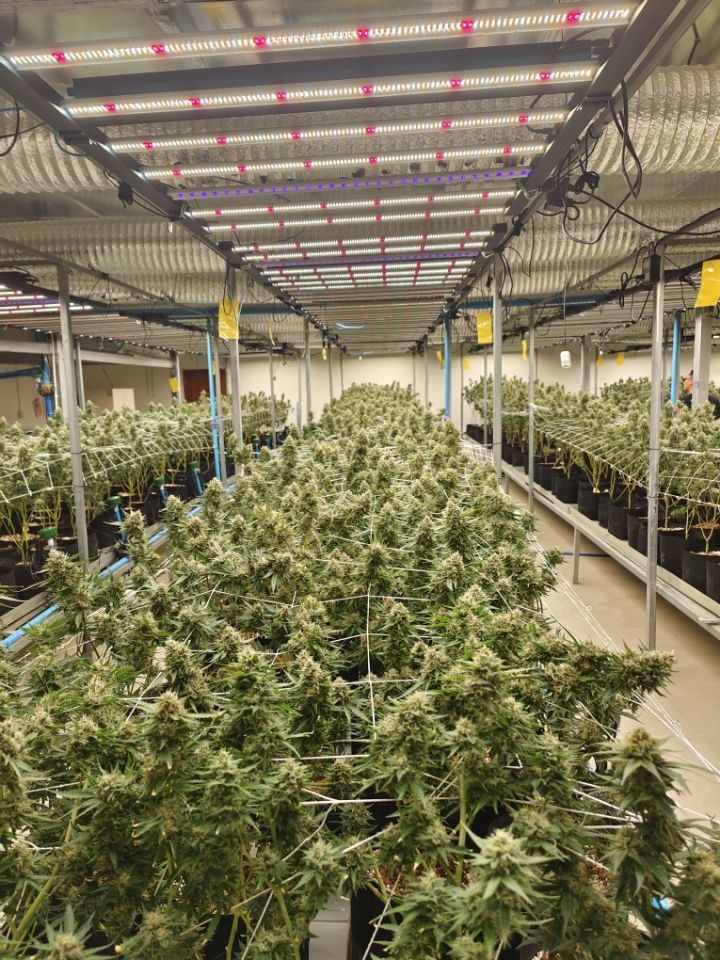
The limitation is just as plain. The plant gets the same signal at every stage, and there are stages where a different signal would work better. Vegetative plants would accept a touch more blue. Late flower would respond to a small far-red share and, in rooms set up to measure it, a controlled UV finishing window. A single channel fixture gives all of that up in exchange for never getting it wrong.
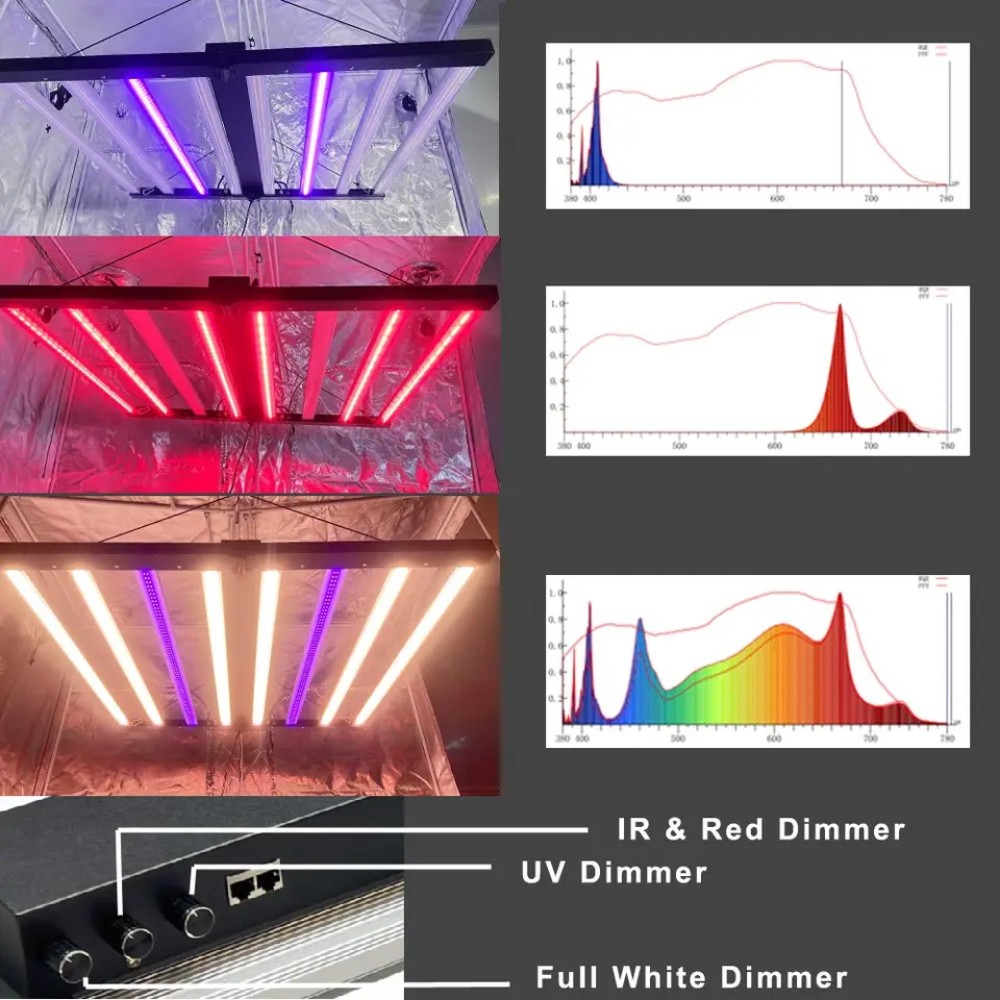
A multi channel fixture turns the spectrum from a constant into a variable, and variables support recipes. The common layouts are two channels, white plus far-red; three channels, white plus UV plus far-red; and four channels in greenhouse vegetable style, red plus blue plus white plus far-red. Each layout supports a different depth of control, which the next section grades.
With channels, a room can run white only through vegetative and early flower, add a far-red share through the stretch, open a UV finishing window in the last weeks, and cut everything except white during the dark period. Growers who track their batches can also vary the recipe by cultivar, because a dense indica-dominant plant and a lanky sativa-dominant plant answer morphological signals differently.
The honest arithmetic is that the gain is real but moderate. The photosynthetic improvement from a small far-red share in a dense canopy is a few percent, the UV quality premium exists only where a room can measure an endpoint, and none of it rescues a room that is short on PPFD, uneven, or starved of CO2. Channels are a late-stage refinement. They sit on top of a base layer that has to be correct first.
Here is the part supplier pages leave out, and the reason this guide exists. A channel is a tool, and tools in untrained hands produce different results than tools in trained ones. Every multi channel buyer should be honest about who will actually run the schedules before paying for them.
A grower we work with bought a three channel fixture for the UV option and switched the UV channel on in week one of his first cycle, at full output, with no schedule. The plants grew tighter and darker than he expected and the run finished below his previous batch. A follow-up call found the problem: the UV channel had been on from the start of flower. The channel was fine. The recipe was wrong. He moved the UV window to the second half of the cycle, shortened it to a couple of hours at the end of the photoperiod, and the next batch finished clean. Nothing about the fixture had changed between the two runs. The schedule had.
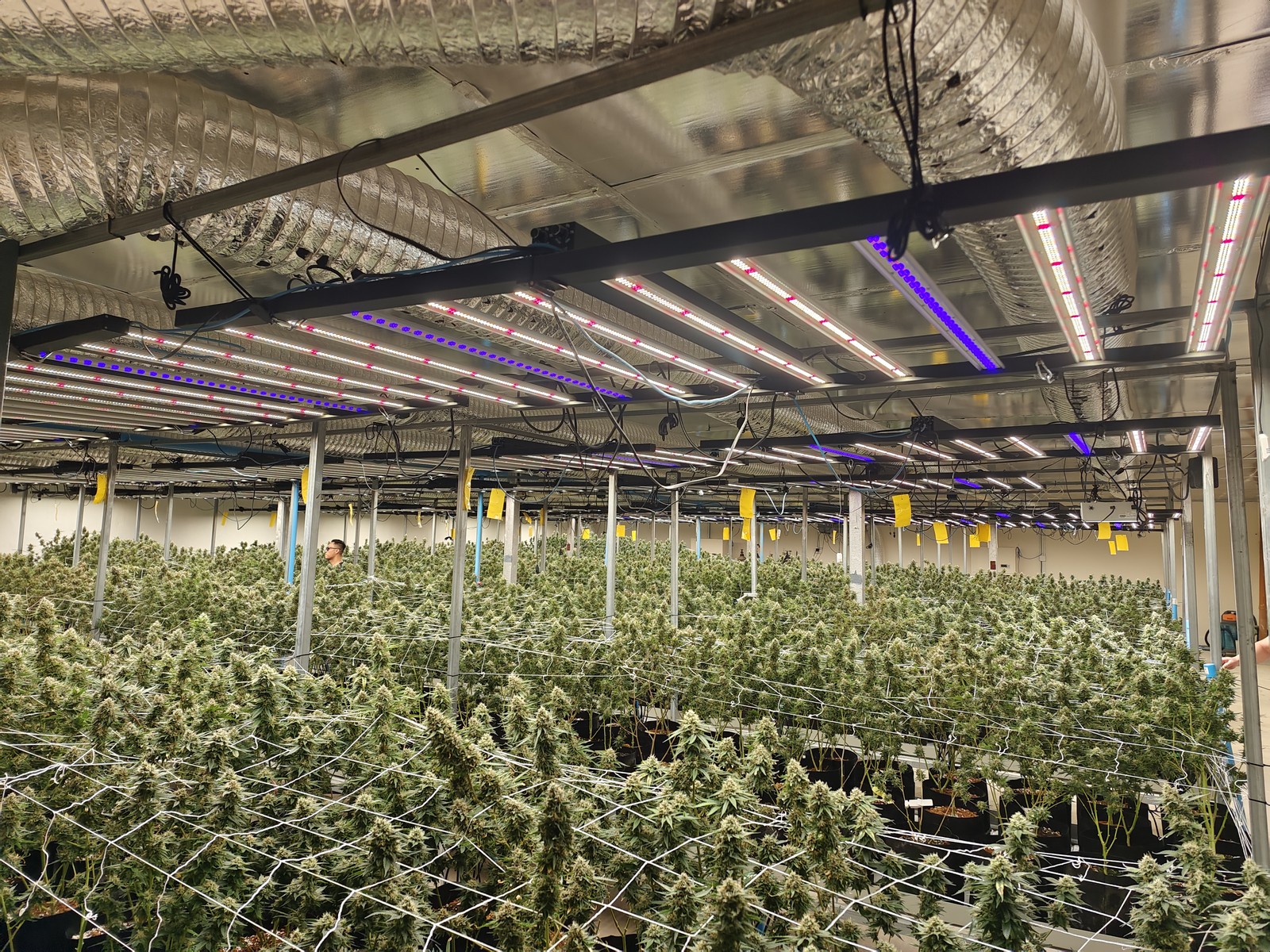
That story repeats across the market in different forms. Far-red left on around the clock stretches plants and costs flower sites. Spectral knobs turned mid-cycle turn a diagnosis into a guessing game, because nobody can tell which change produced which result. None of these are design flaws in the fixtures. They are the cost of handing a variable-spectrum tool to a room that cannot yet hold a constant-spectrum one steady.
The practical reading is not that beginners should avoid channels forever. It is that the fixture should match the operator. A room with an experienced grower, a written recipe and batch records should buy channels and use them. A room where lighting adjustments happen when someone remembers should buy one channel, and it will not be leaving much on the table, because the base layer of PPFD, uniformity and climate does more for harvest quality than any spectral recipe.
Single channel is the right answer more often than supplier trend pieces admit. The clearest cases: a first commercial room where the team is still learning the crop; a facility with high staff turnover and no dedicated grower; a mixed-use room where several people adjust the lights; any operation where the difference between batches is not yet measured, because unmeasured recipes cannot be evaluated; and buyers whose capital is constrained, where the same money spent on a second single channel fixture buys more coverage than the premium on one multi channel fixture.
| Your situation | Better fit | Why |
|---|---|---|
| First commercial cycle | Single channel | Learn the crop on a fixture that cannot be misconfigured |
| No dedicated grower on site | Single channel | Recipes need an owner, not just a fixture |
| Batch records, one change per cycle | Multi channel | Measured results are what make recipes evaluable |
| Canopy at target PPFD, even coverage | Either - channels first | The base layer is done, so refinement starts to pay |
| Room short of PPFD or CO2 | Single channel | Fix the base layer; spectral recipes cannot rescue it |
There is also a quiet argument for single channel in rooms that already perform. If the canopy runs at target PPFD with even coverage, CO2 is managed, and harvests are consistent, the remaining upside from spectral recipes is smaller than the risk of disturbing a working system. A proven stable recipe running on one channel is worth more than a richer recipe nobody has time to validate.
Channels earn their premium under specific conditions, and they are worth listing plainly. The room has an experienced grower who owns the lighting decision. The facility keeps batch records and changes one variable at a time, so a recipe change can be judged. PPFD, uniformity, CO2 and climate are already at target, meaning the base layer is done. The canopy is dense and tall enough that penetration and morphology actually limit the harvest. And the cultivar line is stable enough that a recipe tuned this cycle applies to the next one.
Under those conditions the gains come from three places. A far-red share in early flower improves canopy penetration in dense, tall crops. A UV finishing window, in rooms that can measure or at least observe an endpoint, supports the quality traits the market pays for. And stage-based dimming of the main channel can trim energy use in hours where the plants do not use the extra photons well. None of these are dramatic. Together they are the difference between a fixture that works and a system that improves.
For cannabis rooms the practical choice sits between two and three channels. The two channel layout, white plus far-red, covers morphology and canopy penetration, costs the least premium, and has the simplest recipes to run. The three channel layout adds UV for finishing, which is the channel cannabis buyers ask about most and the one with the strongest discipline requirement, because UV has safety rules and dose windows that far-red does not.
| Channel added | What it unlocks | Discipline required | Premium direction |
|---|---|---|---|
| Far-red | Stretch control, canopy penetration, an Emerson gain in dense canopies | A timer and a share target; the lowest of the three | Lowest |
| UV | A finishing window for the quality traits the market pays for | Dose windows, safety interlock, dark-period cut, a measured endpoint | Medium |
| Red split | Energy steering toward cheaper red photons | Energy price data and a control platform | Highest, greenhouse oriented |
Four channel fixtures in the greenhouse vegetable style, with red and blue split out as separate channels, exist for a different workflow. Splitting red from white lets an operator chase energy efficiency, because red photons are the cheapest to produce, and trade spectral nuance for cost in hours where morphology does not matter. That trade is easier to defend with vegetable crops and fixed contracts than with cannabis, where the market pays for quality traits that are harder to re-derive once a spectrum has been optimized for watts. For most cannabis buyers, four channels buy flexibility they will not schedule.
A channel without control is a diode bank that is always on. Before comparing channel counts, check how each channel is driven: a 0 to 10 V dimming input per channel is the minimum, a digital protocol is better for recipes that change often, and each channel needs its own timer or controller address so it can be scheduled independently. UV channels need an interlock or at least an indicator that shows when they are energized, because a maintenance person walking into a lit room should not need to guess.
| Layout | Dimming input | Schedule needs | Safety needs |
|---|---|---|---|
| Single channel | One 0 to 10 V input or digital | One photoperiod timer | None beyond the fixture listing |
| Two channel | Two independent inputs | Far-red timer, a share target, a dark-period cut | None beyond the listing |
| Three channel | Three independent inputs | UV window, far-red timer, dark-period interlock | UV indicator, eyewear protocol, interlock |
| Four channel | Four inputs or a digital bus | A control platform with recipes by stage and price | Platform dependent |
Ask one question that catches most of the market out: when the fixture is off or the schedule is dark, can any channel leak? The dark period is when flowering is maintained, and far-red or UV spilled into it is a light leak with consequences. The controller, not the fixture, is what keeps the recipe honest, and a fixture with three channels and a shared dimming input is worth less than a single channel fixture with a proper controller.
The market context matters, because it explains why multi channel is everywhere in supplier marketing right now. The large horticultural manufacturers released four channel toplighting and dynamic control platforms through 2025 and 2026, positioned around steering crops and managing energy costs. Component makers describe dynamic spectral control as moving toward standard configuration. In greenhouse vegetables, published trials have shown real money: one commercial winter trial in Finland reduced far-red photon delivery by 17 to 30 percent, held cucumber yield steady, and saved around 5,000 euros per hectare over eight weeks of monitoring, with the savings coming from replacing far-red hours with cheaper red light.
Two cautions keep that news honest. First, the trial was cucumbers under greenhouse toplighting with a control platform and measured production data, not a cannabis room with a wall dimmer. The mechanism transfers; the numbers do not automatically. Second, the fixture efficiency race is settling: red LED wall-plug efficiency is pushing into the mid-eighty percent range and white fixtures sit around three micromoles per joule, so as hardware converges, suppliers differentiate on control. That is why every catalogue suddenly has channels. The buyer's question does not change with the marketing: does your room have someone who will run the schedules, and can you measure the result?
For cannabis buyers the honest summary is that dynamic control is real, proven in adjacent crops, and only valuable once a room has the discipline to use it. The trend is a reason to make sure the fixture you buy at least has the channel capacity you will grow into, with firmware or wiring that can accept another channel later. It is not a reason to buy channels you cannot schedule this year.
These are the failures that show up in real rooms, collected roughly in order of how often they happen. Each one has a fix that costs nothing but discipline.
| Mistake | What it does | The fix |
|---|---|---|
| UV on from week one | Stresses young tissue and costs vegetative growth and early flower | Move the window to the second half of the cycle, 2 to 4 h at the end of the photoperiod |
| Far-red around the clock | Signals shade continuously and stretches stems in sparse canopies | Limit far-red to the stage and the share your cultivar tolerates |
| UV or far-red into the dark period | A light leak with extra risk; can delay or disrupt flowering | Interlock both channels with the photoperiod and any curtain |
| Several knobs changed in one week | Nobody can tell which change produced which result | One variable per cycle, and a control zone if the room allows |
| No written schedule | The recipe depends on memory and breaks at every staff change | Write the recipe, laminate it, keep it at the controller |
The pattern behind all of them is the same: the buyer paid for degrees of freedom and then used them without a plan. A channel run without a written schedule, a dimming level and a reason is not a feature. It is a variable nobody controls, and uncontrolled variables are what turn a good room into an average one.
Honesty requires the other side of the ledger. A single channel room gives up real things. It gives up the far-red share that improves light penetration in dense canopies, which matters most in tall crops and multi-tier rooms. It gives up a UV finishing window and whatever quality premium a measured one would produce in a given market. It gives up the ability to trim energy by dimming spectral components in hours where they are wasted. And it gives up cultivar-specific recipes, because a fixed spectrum treats every variety as the same plant.
Those are real costs, and for a professional operation they compound over cycles. The point of this guide is not that they are small. It is that they are only collectable by an operator who can spend them, and that the worst outcome in lighting purchases is paying for capability that the room cannot convert into results. A single channel fixture with excellent uniformity at target PPFD will outperform a multi channel fixture in the same room run badly, and that comparison happens in real facilities more often than any spectral trial.
The decision compresses to five questions, and the answers are more reliable than any trend piece, including the market shift described above.
| Question | Why it matters |
|---|---|
| Who owns the lighting decision? | Recipes need an owner; without one, channels sit at a fixed setting |
| Do you keep batch records? | Unmeasured recipes cannot be judged or improved |
| Is the base layer at target? | PPFD, uniformity, CO2 and climate come before any spectral recipe |
| Is the canopy dense and tall? | Morphology gains concentrate where penetration limits the harvest |
| Is your cultivar line stable? | A tuned recipe only carries to the next cycle on stable genetics |
Score the answers honestly. Three or more yes answers to the operational questions point to multi channel, and the two channel layout is the sensible entry. Two or more no answers point to single channel, ideally the best uniformity and coverage the budget allows. And whichever way the decision lands, buy from a supplier who asks about the room and the team rather than one who only quotes the channel count, because the channel count is the cheapest part of the answer.
Since 2010 we have built fixtures on both sides of this line, and the honest position is that we would rather sell a grower the fixture their room can run than the one their budget can stretch to. Send us the room dimensions, the PPFD at canopy, the team situation and the stage you finish at, and we will recommend a channel count with the reasoning attached, even when the answer is one.
It means the fixture carries two or more groups of LEDs whose electrical input can be dimmed and scheduled separately. A three channel fixture commonly runs white, UV and far-red on three independent inputs. The channel count says nothing about quality by itself; it says how many spectra the room can combine, and only a schedule turns that capability into results.
Yes. A modern full spectrum board runs a complete cannabis cycle at target PPFD, and most of what determines harvest quality, including coverage, uniformity, CO2 and climate, sits outside the spectrum question. A single channel fixture gives up stage-specific recipes in exchange for having nothing to misconfigure, which is the right trade for many rooms.
For most rooms the practical choice is one or two. Two channels, white plus far-red, cover morphology and canopy penetration with the simplest recipes. A third channel for UV makes sense for experienced teams that keep batch records and can respect dose windows and safety interlocks. Four channel layouts in the greenhouse vegetable style mainly serve energy steering, which is a harder trade to defend in cannabis.
They are worth it when the room has an experienced grower who owns the lighting decision, batch records that make recipe changes measurable, and a base layer of PPFD, uniformity and climate already at target. Without those, the channels idle at a fixed setting and the premium buys nothing. The fixture does not decide this; the operator does.
Only as separate retrofit bars with their own drivers, timers and interlocks, never by modifying the fixture. The retrofit must be scheduled independently of the main light and cut during the dark period. If there is any chance of adding channels later, it is cheaper to buy the capacity now, in a fixture whose wiring and controller accept a second channel, than to rewire a room afterwards.
Late in the cycle, and never from week one. A room that opens its UV window in the second half of flower, for a couple of hours at the end of the photoperiod, at a modest canopy irradiance, follows the pattern the published work supports. A grower we work with ran UV from the start of flower on his first cycle with a three channel fixture and finished below his previous batch; moving the window later and shorter fixed the next run without changing anything else.
Far-red signals shade, and a share above what the canopy and cultivar tolerate produces longer internodes, smaller leaves and fewer flower sites, worst in sparse canopies. Reduce the share, or limit far-red to the early stretch window where longer internodes still help, and change one variable at a time so the response can be read.
Only when they are on. A UV or far-red channel at idle draws nothing, so a two channel fixture dimmed identically to a single channel one costs about the same to run. The honest comparison is by function: a far-red hour costs more per photon than a red hour, which is exactly why four channel energy steering exists in greenhouse vegetables.
Each channel needs its own dimming input and its own schedule: a 0 to 10 V input per channel is the minimum, a digital protocol handles recipes that change often, and UV channels need an interlock or a visible indicator for the dark period. Ask what happens when the photoperiod ends; if any channel can leak into the dark, flowering is at risk.
Single channel, for most first rooms. It cannot be misconfigured in the ways that cost cycles, such as UV from week one or far-red into the dark period, because there is nothing to configure. The experience gained on hours, dimming and batch records is exactly what makes a multi channel purchase succeed later.
Not by default. The fourth channel in vegetable-style fixtures splits red from white, which serves energy steering and spectral fine-tuning at a level most cannabis rooms never schedule. Cannabis gains concentrate in the far-red and UV channels. Buy the fourth channel for a documented reason, such as measured energy pricing and a control platform, not because a bigger number sounds better.
Send the room dimensions, PPFD at the canopy, cultivar, team situation and the stage you finish at. We answer with a channel count, the reasoning behind it, and a recipe outline you can run or hand to the team you have - even when the right answer is one.
