
The 60-Second Answer
Carbon is 45 percent of the dry matter in a flower, and every gram of it has to come out of the air. Under ambient air a working canopy strips its own room of carbon within the hour, which is why a sealed room that is not enriched spends part of every photoperiod carbon-starved. Enrichment solves that. What it does not do is make a weak light plan work, and it does not make flowers stronger: it buys biomass, not potency.
| Canopy PPFD | What is limiting the crop | Practical CO₂ target | Why that number |
|---|---|---|---|
| Below 400 | Light | No enrichment needed | Leaf area is small and light is the bottleneck; ventilate instead |
| 400–700 | Light | 400–800 ppm, and only if the room is already sealed | Seedling and low-light crops are run at the low end of the horticultural band |
| 700–1,000 | Carbon begins to bind | 800–1,000 ppm | The rule of thumb across greenhouse research: raising the level to 1,000 ppm lifts photosynthesis by roughly 50 percent over ambient |
| 1,000–1,500 | Carbon | 1,000–1,300 ppm | Saturation for most horticultural crops sits in this band; the curve keeps rising, but each further 100 ppm buys less |
| Above 1,500 | Carbon, then climate | 1,200–1,500 ppm, with the cooling to match | This is the ceiling we specify, and it is only worth spending on once the gas supply and the tonnage to remove the extra heat are engineered |
The ppm figures in the right column come from two places: the CO₂ best-practice guidance published by AHDB Horticulture, and the Ontario greenhouse production guide. The PPFD bands in the left column are the ones published in our PPFD and DLI targets, so the two pages read as one specification.
What CO₂ Buys, and What It Does Not
Greenhouse horticulture has been enriching for decades, so the effect sizes are well measured in vegetables and cut flowers, and much less well measured in cannabis. Sorting the two kinds of claim apart is the whole game, because the marketing version of this topic promises both more weight and higher potency, and only one of those holds up.
What it buys: dry matter. The published ranges are consistent once you separate the two operating strategies. Holding a room merely at background, to stop the crop from depleting its own carbon, typically returns 5 to 15 percent more marketable yield. Running enrichment year-round at the top of the band returns roughly 20 to 30 percent across fruiting vegetables and cut flowers, with individual tunnel trials reporting 20 to 32 percent in cucumber, squash and tomato. The honest upper bound comes from open-field work rather than chambers: a fifteen-year meta-analysis of free-air enrichment experiments across 124 papers and 40 species found C3 crop yields rising about 17 percent at 550 ppm, which is well below what enclosure studies had predicted.
What it buys for free: water. This is the part growers underrate. In cannabis leaf measurements, raising CO₂ from the ambient level of the time, 350 ppm, to 750 ppm cut transpiration by 29 percent and stomatal conductance by 42 percent, while water use efficiency more than doubled. A room that transpires less is a room that condenses less, and the dehumidification plant is sized against exactly that number.
What it buys in heat tolerance: the same set of free-air experiments found that light-saturated carbon uptake rose 19 percent at temperatures below 25 °C but 30 percent above it. Enrichment is worth more in a warm room than a cool one, which is the physiology behind the warmer setpoints enriched rooms are run at.
What it does not buy: potency. This is where we part company with most of the pages ranking for this topic. The largest controlled indoor cannabis light trial, run at the University of Guelph and published in Frontiers in Plant Science in 2021, pushed canopy intensity from about 120 to 1,800 µmol/m²/s and found inflorescence dry yield climbing in a straight line from 116 to 519 grams per square metre, with terpene concentration up about 40 percent. Cannabinoid potency did not move at all. A 2024 review of the phytocannabinoid literature makes the same point from a different direction: higher carbon assimilation does not automatically translate into more cannabinoids, because the plant can route the extra carbon into stem, leaf and root instead of into resin, and enrichment is known to shift the secondary metabolite profile in ways that are not yet well mapped. Decide to spend on CO₂ because you want more grams from the same room. Do not spend on it expecting stronger flower.
Why Your Light Level Sets Your ppm Target
Photosynthesis consumes carbon dioxide and releases it back through respiration and photorespiration, and the balance between the two is what the room has to hold. Push more photons at a leaf and its internal carbon concentration falls, because the fixing enzyme is running faster than the air can resupply it through the stomata. In the cannabis gas-exchange work, intercellular CO₂ and the ratio of intercellular to ambient CO₂ declined steadily as both light intensity and temperature rose, with the decline easing only above about 1,500 µmol/m²/s. That measurement is the mechanism behind everything else on this page: a bright canopy is a canopy that is short of carbon.
The same study puts a number on the shortfall. Moving from 350 ppm, the ambient concentration when it was run, to 750 ppm raised the rate of photosynthesis by 50 percent and cut transpiration by 29 percent. Read that as a statement about what ambient air is worth to a high-light crop, not as a target: 750 ppm is roughly half of what a commercial sealed room runs.
So the ppm question is really a paired question, and the pair reads in both directions. Going one way: pick the canopy PPFD you intend to run, and the table above gives the CO₂ band that keeps carbon from becoming the limit. Going the other way: if the room cannot be sealed, or the gas supply cannot hold a number, then the honest PPFD ceiling is the ambient one, and buying fixtures sized for the enriched band means buying photons the crop cannot use. Our PPFD and DLI guide carries both ceilings in full, along with the season-long photon budget that goes with them.
The Daily Carbon Budget
Ppm tells you what the air is doing this second. It does not tell you what to buy, because a cylinder, a bulk tank and a burner are all sold by how much carbon they can deliver over a day. Converting the target into kilograms is a short piece of arithmetic, and it can be done two ways that check each other.
Route one: from the crop you expect. Take a room running 900 µmol/m²/s on a 12-hour photoperiod, which is the middle of the commercial flowering band. The Guelph trial measured inflorescence dry yield against canopy intensity across the range it tested and found it rising in a straight line, from 116 grams per square metre at the lowest intensity tested, 120 µmol/m²/s, by about 0.24 grams per square metre for every additional µmol/m²/s, so 900 µmol/m²/s points to roughly 303 grams per square metre per cycle. Dry flower is about 45 percent carbon, so that crop fixes about 136 grams of carbon per square metre, which is 500 grams of CO₂ once you allow for the mass of the oxygen it carries. Over a 70-day cycle that is 7.1 grams of CO₂ per square metre per day, and across a 30 by 40 foot room, 111.5 square metres of canopy, it is 0.80 kilograms per day in the flowers alone.
Flowers are not the whole plant. Stems, leaves and roots are built from the same carbon stream, and in a crop harvested for its inflorescence the flower fraction is the smaller part of what the canopy fixed. Published harvest indices for cannabis flower typically land around a third, which puts whole-plant fixation near 2.4 kilograms of CO₂ per day for this room.
Route two: from the leaf. Cannabis leaf measurements under elevated CO₂ and about 1,500 µmol/m²/s report a maximum photosynthetic rate near 38 micromoles of CO₂ per square metre per second. Carbon dioxide weighs 44 grams per mole, so that is 6.0 grams per square metre per hour at peak. A three-dimensional canopy never runs at its leaf peak everywhere: shaded interior leaves, the boundary layer on every surface, and the drop-off between fixtures all pull the canopy average down. Take 30 to 40 percent of the leaf maximum as a working canopy figure and a 12-hour day delivers 21.7 to 28.9 grams of CO₂ per square metre, or 2.4 to 3.2 kilograms per day for the room.
The two routes were built from different measurements and share no inputs: one starts from the yield you expect and the carbon content of that yield, the other from a leaf's gas exchange and a canopy discount. They land in the same place. That agreement is the reason we quote a crop draw of 2 to 3 kilograms of CO₂ per day for a 1,200 square foot flowering room at 900 µmol/m²/s, and it is the number to hold on to when a supplier sizes a system for you.
What Dominates the Bill: Feeding or Holding
Now the number that surprises people. Crop draw is not what you pay for.
Horticultural practice sizes gas supply against a capacity figure rather than a crop figure, because the room leaks. The working numbers from greenhouse practice are 70 to 130 kilograms of CO₂ per hectare per hour to hold 900 ppm with vents shut, and 190 to 580 kilograms per hectare per hour once vents start opening. Converted to a single square metre, that is 7.0 to 13.0 grams per hour, and across our 111.5 square metre room it is 0.78 to 1.45 kilograms per hour, or 9.4 to 17.4 kilograms per day over a 12-hour photoperiod.
Set that beside the 2 to 3 kilograms the crop actually consumes and the picture clarifies: holding the number costs roughly three to eight times more gas than feeding the crop. The crop is the smaller line item. The envelope is the larger one.
The first charge is smaller still, and this is where most calculators mislead. Raising our room from 420 to 1,200 ppm is a change of 780 ppm, and one ppm of CO₂ weighs 1.80 milligrams per cubic metre, so a room of 340 cubic metres, the volume a 30 by 40 foot space holds under a ten foot ceiling, needs 477 grams: about half a kilogram, roughly 3 to 5 percent of a single day's demand. A calculator that stops at the first charge is answering a question nobody has. What you are buying is a supply rate, sustained, against a leak rate you have not measured.
Which means the first thing to fix is not the setpoint. Seal the room, then measure how fast it gives the gas back. Our grow room terms page covers air exchange rate, the derating a carbon filter and duct bends impose on a fan, and why enrichment and continuous exhaust are mutually exclusive by construction. Enriching a room with an open exhaust plan is a subscription to the outdoors.
Sensors: Why Your ppm Reading Can Be Wrong
Every number on this page depends on one instrument, and the instrument most rooms use is quietly configured to lie in exactly the situation this article is about. Carbon dioxide sensors based on infrared absorption are accurate when they are properly referenced. The trouble is what many of them do to stay that way.
The baseline assumption. Most low-cost NDIR modules ship with an automatic baseline correction routine, sometimes labelled ABC or ASC. The logic is that over a period of one to two weeks the measured space will at some point see fresh outdoor air at about 400 ppm, and the module quietly re-anchors its lowest reading to that value. That assumption is true in an office, a bedroom or a classroom. It is false in a sealed enriched grow room, which may never see 400 ppm again for the entire flower cycle. Under a false assumption the correction is not a correction: it is a slow drift downward, so a room genuinely sitting at 1,200 ppm reports something lower and keeps sliding. The sensor is not broken and the error will not announce itself.
How to check yours. Take the sensor outside, into moving air away from any exhaust or vent, and let it run for twenty to thirty minutes. It should settle between 400 and 420 ppm. If it does not, either the baseline has drifted or the automatic routine has already shifted the reference, and the fix is to disable the automatic correction and perform a manual calibration against outdoor air. In a sealed room, automatic baseline correction should be off. This is the one setting worth checking before you trust any reading in this article, and it is also why an enriched room benefits from a second, independent measurement during commissioning rather than a single panel number.
Watch for sensors that are not measuring CO₂ at all. Several popular low-cost modules report what their makers call equivalent CO₂, derived from volatile organic compounds rather than from absorption of infrared light. They respond to alcohol, citrus peel and cleaning products by jumping by hundreds or thousands of ppm. If a reading spikes when someone wipes down a bench, you are looking at a VOC estimate, not a carbon dioxide measurement, and no amount of calibration will make it a supply-rate instrument.
Mounting matters more than the spec sheet. A sensor in the middle of the room at chest height is reporting the room, not the canopy, and the two are not the same number. Keep probes out of supply and exhaust streams, away from heat sources and lights that warm the housing, and away from anywhere a person stands and breathes. Warm the unit before you believe it: infrared modules drift noticeably in their first minutes from cold, so allow a settling period before readings feed a control decision. Housing design matters as well, because the optical cell needs air moving through it: a sealed enclosure, or a probe buried under conformal coating, reads whatever is trapped inside it. Calibration intervals of six to twelve months are typical, and shorter in a humid, dusty or chemically active room.
Where the Carbon Actually Sits
The most repeated piece of CO₂ advice in cultivation writing is that the gas is heavier than air and therefore pools on the floor. It is heavier: the molecule weighs 44 grams per mole against roughly 29 for air, a ratio near 1.5. The conclusion is still mostly wrong, and the mistake leads people to put hardware in useless places.
Air in a working grow room is not still. Lights dump hundreds of watts per square metre into it, plants transpire, and every fan stirs the volume many times an hour. In a mixed room, thermal convection dominates density-driven settling, so the gradient that actually matters is not floor-to-ceiling: it is the still boundary layer of humid air that sits against every leaf, and the dead zones between and under the canopy where air simply does not move. That is the same failure mode our VPD guide describes for humidity, and it has the same fix, which is air movement through the crop rather than across the room.
The practical consequence is about where you measure and where you inject. Measuring at the sensor and declaring the room compliant is the carbon version of reading one PPFD spot under a fixture and calling it the canopy average. Injection points should be distributed so that the gas reaches the canopy rather than the ceiling or one corner, and the reading that matters is taken where the flowers are. A room can hold 1,200 ppm at the wall panel while the flowers sit in air that has already given up its carbon.
Generators or Bottles: A Heat Load Question
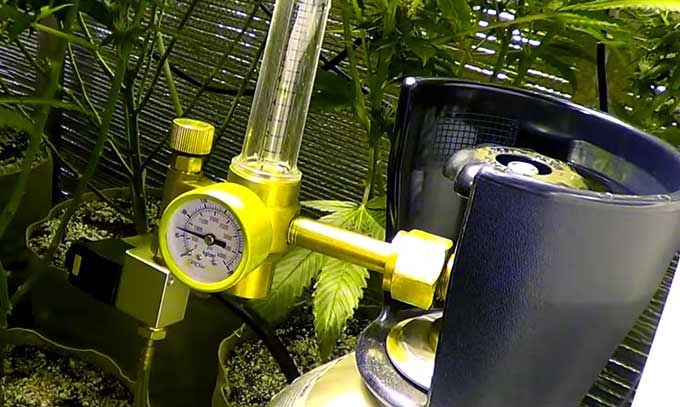
The choice between a compressed supply and a combustion generator is usually argued on gas price. The larger difference is physics, because a burner is a heating appliance that happens to make CO₂, and its by-products land directly in the load calculation you already ran for the room.
The stoichiometry is fixed and easy to check. Burning propane, C₃H₈ plus five O₂ gives three CO₂ and four H₂O. One kilogram of propane is therefore 2.99 kilograms of CO₂ plus 1.63 kilograms of water vapour, which means every kilogram of CO₂ you produce arrives with about 0.55 kilograms of water: 1.2 pounds, or 1,200 BTU of latent load that the dehumidification plant has to condense. Add the heat of combustion, at 46.35 megajoules per kilogram of propane, and each kilogram of CO₂ carries roughly 15,900 BTU of load: about 1.3 ton-hours of cooling to remove. A room drawing 10 kilograms of CO₂ a day from a burner is therefore carrying an extra 159,000 BTU per day, roughly 13 ton-hours, that a bottled supply would not have added at all.
That is not automatically an argument against generators. In a cold climate, heat you have to remove in July is heat you would otherwise buy in January, and the exhaust stream is delivered straight to the canopy where it is useful. In a warm climate or a sealed room with a tight cooling budget, the same burner charges you twice: once for the fuel, once for the electricity to take the heat back out. The water is the part people forget, and it is the part that shows up as a bigger dehumidifier. Our terms page works through sensible heat ratio and latent load for the same room, which is where this arithmetic belongs. Bottled and bulk liquid supply carries no heat and no water at all, and no risk of carbon monoxide from incomplete combustion.
Acclimation: Why the Gain Fades
Enrichment is usually described as if the response were permanent. In greenhouse research it is not, and the effect has a name. Photosynthetic acclimation is the gradual loss of the enrichment advantage over weeks of continuous exposure, and it is well documented in tomato, cucumber and other glasshouse crops.
The mechanism is a mismatch. Carbon supply stops being the limit, but the plant's investment in the machinery that fixes carbon does not stay constant: Rubisco content declines in some crops under long exposure, leaves accumulate starch and sugars in ways that interfere with chloroplast function, and the carbon-to-nitrogen balance inside the leaf shifts. In severe cases leaves turn chlorotic, become deformed or rolled, and turn brittle. Higher concentrations bring acclimation on faster.
Two practical responses come out of the same literature. First, nitrogen nutrition matters: crops grown with generous nitrogen show less acclimation than the same crop grown with less, which means enrichment and a lean feed program work against each other. Second, the response recovers when the gas is interrupted, and a gap of a few days is enough to restore the advantage. That turns enrichment from a background setting into a schedule: rooms that run the top of the band continuously for a whole cycle are paying for a response that is fading, and could hold a lower band most of the time and spend the top of the range where the crop can actually use it.
Running It: Setpoints, Timing and the Lights-Off Signal
Four operating rules cover most of what goes wrong.
- Enrich only while the lights are on. Carbon uptake requires active photosynthesis, so gas released in the dark is simply vented. Most controllers tie the gas valve to the lighting schedule for this reason.
- Read the overnight rise as a seal test. With photosynthesis stopped, the crop respires and the room should gain CO₂ overnight. A room that climbs steeply in the dark is holding its gas; a room whose overnight reading barely moves is leaking, and no setpoint will fix that. Run this check before commissioning.
- Expect a warmer setpoint, and understand why. Enriched rooms are commonly run several degrees warmer than ambient rooms, and that is not an error: photorespiration, the wasteful reaction that costs a warm leaf carbon, is suppressed when CO₂ is abundant, which is also why the free-air data show a bigger enrichment response above 25 °C than below it. Warming the room and enriching the air are one decision, not two.
- Raise the humidity target with the CO₂. Partially closed stomata mean less transpiration, so an enriched room runs comfortably at a higher vapour pressure deficit than an ambient one. Our VPD guide carries the offset and the reasoning; the point here is that a controller should store two climate specifications, an ambient one and an enriched one, rather than one that is adjusted by feel.
One counterintuitive scheduling detail: the enrichment target should ease back when light is low. Carbon demand falls with the photon supply, and stomatal closure during overcast conditions is more pronounced than in bright weather, so a room that holds its full target through a grey afternoon is spending gas on nothing. A controller that follows the light rather than the clock will spend less and lose nothing.
Safety: What 1,200 ppm Is, and What 5,000 ppm Is
This section exists because a widely repeated claim about this topic is simply wrong. Several cultivation sites state that CO₂ above 1,500 ppm is hazardous to people. It is not, and the published limits are easy to check.
| Reference level | Concentration | What it means |
|---|---|---|
| Outdoor background | about 420 ppm | The reference point your sensor should see outdoors |
| Typical enriched room target | 1,000–1,500 ppm | 20 to 30 percent of the eight-hour workplace limit |
| OSHA permissible exposure limit, 8-hour average | 5,000 ppm | The legal workplace ceiling for a full shift |
| NIOSH short-term limit, 15 minutes | 30,000 ppm | A brief ceiling, not a target anywhere near a grow room |
| NIOSH immediately dangerous to life or health | 40,000 ppm | Based on acute inhalation data in humans |
Between a working target and the first workplace limit there is a margin of more than three to one, so the hazard in an enriched room is not the setpoint. It is loss of control: a valve stuck open, a regulator knocked off a cylinder, a controller failing in the wrong state, or a burner's exhaust path changing. Reported human effects begin in the range of 20,000 to 40,000 ppm, where breathing rate increases, and progress through elevated blood pressure and dizziness at higher concentrations. A working room is nowhere near those numbers, but a malfunction can be.
- Monitor, and alarm. A room running enrichment should have a CO₂ reading that someone watches, with an alarm above the working band. This protects people and it protects the gas budget.
- Ventilate before you enter, and do not treat an enriched room as a workspace. Long occupancy in a sealed enriched room is the exposure scenario the workplace limits are written for.
- Treat generated CO₂ as combustion exhaust. A burner that is not burning cleanly produces carbon monoxide, which is odourless and does not show up on a CO₂ sensor at all. Flame integrity and the exhaust path belong on a maintenance schedule.
- Remember that the gas is invisible. Neither CO₂ nor CO has any smell. Everything above depends on instruments, which returns you to the sensor section: a monitor that has drifted downward is a safety device that is quietly not working.
Common Mistakes We See
- Chasing a ppm number with a leaky room. A room that cannot hold its gas spends its budget on the outdoors. Seal first, then set a target, then size supply.
- Sizing supply from the first charge. The charge to lift a room from 420 to 1,200 ppm is a few hundred grams. The daily demand is kilograms. They are not the same question.
- Leaving automatic baseline correction on. The sensor re-zeros against a 400 ppm outdoor reference it never sees, and the error runs downward without any warning.
- Trusting a room-average reading as the canopy value. The number at the wall and the number inside the crop are different measurements, and only one of them describes the flowers.
- Adding CO₂ to a room that stayed on a ventilation schedule. Continuous exhaust and enrichment cancel each other, and the gas leaves with the air it was meant to enrich.
- Turning the gas up instead of turning the light up. Enrichment raises the ceiling on the light the crop can use. It does not raise the light, and a room at 500 µmol/m²/s gets very little from a rich atmosphere.
FAQ
What CO₂ ppm should I run in flower?
Match it to your canopy PPFD rather than to a stage chart. A sealed room at 700–1,000 µmol/m²/s holds 800–1,000 ppm; above 1,000 µmol/m²/s most horticultural crops saturate somewhere in the 1,000–1,300 ppm band, and 1,200–1,500 ppm is the practical ceiling we specify. Below about 400 µmol/m²/s the room is light-limited and enrichment buys very little.
Is CO₂ worth it in a grow room?
It is worth it in a sealed room running high light intensity, and it is close to worthless in a ventilated one. Published results for horticultural crops range from 5–15 percent more yield where enrichment only prevents carbon depletion, to roughly 20–30 percent where the room runs the top of the band all season. The deciding question is not the price of gas: it is whether the room can hold a number at all.
Does CO₂ increase THC or potency?
There is no good evidence that it does. The largest controlled indoor cannabis light trial found that pushing canopy intensity far higher raised dry yield in a straight line while cannabinoid potency did not move, and a 2024 review of the phytocannabinoid literature concludes that higher carbon assimilation does not automatically increase cannabinoid production, because the extra carbon can go to stems, leaves and roots instead of resin. Buy CO₂ for biomass, not for potency.
How much CO₂ does my grow room use per day?
Work it from the crop. A 1,200 square foot flowering room at 900 µmol/m²/s draws roughly 2–3 kilograms per day into plant tissue. Holding the room at its setpoint, however, costs far more, because supply has to keep pace with leakage and exchange: greenhouse practice sizes for 7–13 grams per square metre per hour, which is 9–17 kilograms per day for the same room over a 12-hour photoperiod.
Why does my CO₂ reading keep dropping?
Two likely reasons, and they need different fixes. The room may be leaking faster than the supply can replace it, which shows up as a fast fall after the valve closes and a weak overnight rise. Or the sensor's automatic baseline correction is dragging the reading downward against an outdoor reference the room never sees. Check the sensor outdoors first, because it is the cheaper test.
Can I run CO₂ in a room that is not sealed?
You can release the gas, but you will not hold a concentration, and continuous exhaust removes it as fast as you add it. Enrichment and ventilation are alternatives, not partners. A room needs recirculating cooling and dedicated dehumidification before a CO₂ setpoint is holdable, which is why enrichment and sealing are priced as one decision.
Do I need to run CO₂ at night?
No. Carbon uptake depends on active photosynthesis, so gas released in the dark is vented unused. Tie the supply to the lighting schedule. The dark period still tells you something useful: with photosynthesis stopped the crop respires, so a sealed room should gain CO₂ overnight. A room that hardly rises is leaking.
What CO₂ level is safe for people in a grow room?
The OSHA permissible exposure limit is 5,000 ppm as an eight-hour average, with a NIOSH short-term limit of 30,000 ppm over fifteen minutes and an immediately-dangerous threshold of 40,000 ppm. A working target of 1,200–1,500 ppm sits at roughly a quarter to a third of the eight-hour limit, so the setpoint is not the hazard. Loss of control is: a stuck valve, a falling cylinder or a failed controller. Monitor, alarm, and ventilate before entering.
Is a CO₂ generator or a bottled supply better?
It depends on the climate you are in, because a propane burner adds load. One kilogram of CO₂ from a burner arrives with about 1.2 pounds of water vapour and roughly 15,900 BTU of heat that the cooling and dehumidification plant has to remove. In a cold climate that heat is useful; in a sealed warm-climate flower room it is an extra bill, and a bottled or bulk liquid supply carries no heat and no water at all.
What CO₂ level do I need for 900 µmol/m²/s?
Roughly 800–1,000 ppm is the band that keeps carbon from becoming the limiting factor at that intensity, and that is the band our own specification pairs with a 900 µmol/m²/s canopy. What the room actually needs is a supply rate that can replace 9–17 kilograms a day against leakage, plus the 2–3 kilograms the crop itself consumes.