
How to Use This Page
The thirty terms run in the order a room is actually designed: what the air does to the plant, where the watts go after the fixture, how the carbon arrives, what holds the room on target, how light shapes the plant rather than feeding it, and where the limits sit. Start with the five that do most of the work, then take the groups in the order your own project runs. Where a number has already been settled elsewhere in this series, the entry links there instead of repeating it.
The 30 Terms at a Glance
The table below is the fastest way in: scan all thirty, then jump straight to the entry you need. Each row gives the full name, the unit it is stated in, and the one thing the term settles in a purchase.
| Term | Full name | Unit | What it tells you |
|---|---|---|---|
| VPD | Vapor Pressure Deficit | kPa | How hard the air pulls water out of the plant |
| Relative Humidity | how full the air is | % | Meaningless without the temperature next to it |
| Dew Point | condensation threshold | °C | The temperature where the room starts raining indoors |
| Transpiration | water the crop releases | L/day | The crop's hidden humidity generation schedule |
| Stomatal Conductance | leaf pore openness | mmol/m²/s | Whether CO₂ can get into the leaf at all |
| Sensible Heat | temperature-changing heat | BTU/hr | The watts that raise the room's temperature |
| Latent Heat | vapour-carried heat | BTU/hr | The energy hidden in the water the crop exhales |
| BTU per Hour | heat flow unit | BTU/hr | One watt of electricity equals 3.41214 of them |
| Ton of Refrigeration | cooling capacity unit | 12,000 BTU/hr | The unit cooling equipment is sold in |
| Heat Rejection | where the heat exits | none | Cooling moves heat; it does not delete it |
| CO₂ Enrichment | carbon above ambient | ppm | The lever that raises the light the room can convert |
| CO₂ Drawdown | daylight depletion | ppm/hour | How fast a sealed canopy strips the air |
| Photorespiration | wasteful fixation | % | The inefficiency enrichment suppresses |
| Air Exchange Rate | ventilation speed | volumes/min | How fast the room breathes |
| Sealed Room | no continuous exhaust | none | The precondition enrichment depends on |
| Psychrometrics | moist-air engineering | none | The shared language of growers and HVAC engineers |
| Sensible Heat Ratio | SHR | ratio | Why a standard AC satisfies the thermostat but not the room |
| Dehumidification Load | water to remove | pints/day | Your irrigation schedule, read as a machine rating |
| Setpoint and Deadband | target and tolerance | °C · %RH | What the controller holds, and how tightly |
| Environmental Controller | room automation | channels | What turns fixtures into an environment |
| Photomorphogenesis | light-shaped development | none | Light as instruction, not just fuel |
| Phytochrome (Pr / Pfr) | the red/far-red sensor | ratio | The switch that reads red against far-red |
| Red-to-Far-Red Ratio | R:FR | ratio | The plant's sun-versus-shade reading |
| Shade Avoidance | low-R:FR response | none | The race for light, expressed as shape |
| Stretch | internode elongation | cm | Early-flower height gain you must plan for |
| Light Saturation Point | ceiling of useful light | µmol/m²/s | Where more photons stop paying |
| Emerson Effect | far-red synergy | none | Why far-red channels can earn their watts |
| End-of-Day Far-Red | EOD-FR pulse | minutes | A dusk signal fired at lights-off |
| Crop Steering | environmental steering | none | Pushing the room to steer the crop |
| Water Use Efficiency | WUE | g/L | Carbon fixed per litre drunk; it changes with the lamp |
The Five Terms That Do Most of the Work
| Term | Unit | One line | Where it bites |
|---|---|---|---|
| VPD | kPa | The drying force the air applies to the leaf | Decides whether stomata stay open |
| CO₂ enrichment | ppm | Carbon raised above ambient in a sealed room | Raises the light the room can convert |
| BTU per hour | BTU/hr | Heat flow: one watt of power is 3.41214 of them | Decides the cooling bill behind the lighting bill |
| SHR | ratio | The temperature-versus-moisture split of the load | Decides whether standard air conditioning works at all |
| Light saturation point | µmol/m²/s | Where more photons stop adding photosynthesis | Decides where the dimmer should stop |
Everything else in this glossary either refines one of these five or describes the equipment that holds them on target. The pairs most often used interchangeably, and wrongly so, get their own table near the end.
Air and Water: The Evaporative Engine
VPD Vapor Pressure Deficit · kPa
The gap between the moisture the air holds and the moisture it could hold at the same temperature, stated in kilopascals. It folds temperature and humidity into a single number: the drying force acting on the leaf. Because warm air holds more water, the same 60% RH is a different room at 20 °C than at 28 °C. Industry practice runs cuttings and seedlings at 0.4–0.8 kPa, vegetative rooms at 0.8–1.2, and flowering at 1.0–1.5, with late flower allowed toward 1.6.
In a purchase conversation: state the stage targets before sizing climate equipment. A supplier who quotes temperature and humidity without VPD is quoting two numbers that decide nothing on their own; the controller's day and night setpoints are what hold VPD in band.
Relative Humidity how full the air is · %
How much water vapour the air carries relative to saturation at the current temperature. It is the number every sensor displays, and it is incomplete on its own: warming the room lowers RH without removing a gram of water, which is why a humidity target written without a temperature is not a specification.
In a purchase conversation: read RH only through VPD. Equipment chosen to hit an RH number at one temperature will miss it at another.
Dew Point condensation threshold · °C
The temperature at which the air's current moisture would saturate. Any surface colder than it collects condensation: ducting, structural steel, the outside of a cooled pipe. Lights-off temperature drops are the classic trigger, because RH rises as the room cools even though no water has been added.
In a purchase conversation: ask where the coldest surface in the room will be. A correctly sized dehumidifier can still lose to a cold water line running through the canopy zone.
Transpiration water the crop releases · L per plant per day
The water a plant draws from the root zone and releases as vapour through its leaves. It cools the leaf, carries calcium, and removes nearly all of the applied irrigation water during the photoperiod. To the climate engineer, your irrigation schedule is a humidity generation schedule.
In a purchase conversation: hand the irrigation figure to whoever sizes the dehumidification. A room planned around fixture watts alone will be dry on paper and wet at peak flower.
Stomatal Conductance leaf pore openness · mmol/m²/s
How open the leaf's pores are. Stomata admit CO₂ and release water vapour through the same opening, and light, VPD and CO₂ all move them. Push the air too dry and stomata close defensively: photosynthesis slows even though the photons keep arriving.
In a purchase conversation: when a bright room underdelivers, the limiter is often climate rather than light. A VPD reading belongs in the same diagnostic pass as the PPFD map.
Heat and the Room: Where the Watts Go
Sensible Heat temperature-changing heat · BTU/hr
Heat that shows up on the thermometer. In a sealed room, nearly all electrical input ends here: fixtures, drivers, fans, pumps and dehumidifiers all deliver their watts to the air. LED efficiency means fewer watts for the same photons, not photons without heat.
In a purchase conversation: the lighting quote and the cooling quote are the same money read twice. Ask for the full connected wattage, not just the fixture line.
Latent Heat vapour-carried heat · BTU/hr
Heat that hides in water vapour. Every gallon the canopy transpires absorbs roughly 8,849 BTU on its way out of the liquid, and a dehumidifier must pay all of it back to condense the vapour again. This is the load the thermostat never shows.
In a purchase conversation: the latent load comes from the crop, not the fixtures, which is why upgrading lights alone never fixes a humidity problem.
BTU per Hour heat flow · BTU/hr
The working unit of heating and cooling. One watt of electrical power is 3.41214 BTU/hr of heat, so 100 kW of lighting is about 341,200 BTU/hr before anything else in the room is counted. Every climate quote for the room should be traceable to this multiplication.
In a purchase conversation: a cooling quote that starts from floor area rather than connected watts is a guess with a price on it.
Ton of Refrigeration cooling capacity unit · 12,000 BTU/hr
The unit the cooling industry sells in. One ton is 12,000 BTU/hr, about 3.5 kW of heat moved. The 100 kW lighting load above is therefore about 28 tons of cooling before the crop, the envelope and the equipment are added.
In a purchase conversation: convert the lighting load to tons before the HVAC conversation starts, so the two trades argue in the same unit instead of past each other.
Heat Rejection where the heat exits · location
Cooling does not destroy heat; it pumps it somewhere else: a condenser outdoors, a water loop, a different zone. The location matters as much as the capacity, because heat rejected inside the envelope was never rejected.
In a purchase conversation: ask where the condensers and dry coolers physically go. A "sealed" room with its condenser inside the envelope is not sealed, it is an oven with a fan.
CO₂ and Air Exchange: Feeding the Canopy
CO₂ Enrichment carbon above ambient · ppm
Raising the carbon dioxide content of the air above ambient, about 420 ppm, so photosynthesis is not carbon-limited at high light. In controlled cannabis trials, a sealed room enriched to roughly 1,200 ppm lifted dry flower yield substantially, and most of the achievable gain was already captured there; above about 1,500 ppm, returns diminish.
In a purchase conversation: enrichment raises the PPFD the room can convert, and the target bands move with it. The adjusted numbers live on the PPFD and DLI page; buy fixtures against the band your room will actually run.
CO₂ Drawdown daylight depletion · ppm/hour
What an unenriched sealed room does to itself: a working canopy strips the carbon from the air during the photoperiod, and a mid-size room can fall from ambient toward 200–300 ppm within the hour, recovering only slowly overnight. Enrichment exists to fill that daytime hole, not to top up a nightly loss.
In a purchase conversation: a sealed room without enrichment spends part of every day carbon-starved. Decide between dosing and ventilation deliberately; do not let the room decide by default.
Photorespiration wasteful fixation · % of fixed carbon
At ambient CO₂ and high temperature, the fixing enzyme grabs oxygen instead of CO₂ and the plant spends energy undoing the mistake. Enrichment suppresses it, which is part of why CO₂ rooms run warmer on purpose: the same heat that would push an ambient room into waste becomes productive at 1,200 ppm.
In a purchase conversation: the 28–32 °C setpoints quoted for enriched rooms are not a typo. Ask whether the climate design was done for the ambient room or the enriched one.
Air Exchange Rate ventilation speed · room volumes per minute
How fast the room's air is replaced. Ventilated rooms conventionally exchange the full volume every 1–3 minutes; sealed rooms exchange on demand only. Ratings erode in the real duct run: a carbon filter costs 20–25% of rated fan flow and each 90-degree bend about 5%.
In a purchase conversation: fan sizing is room volume divided by exchange time, then derated for filter and duct. A fan quoted at free-air rating is sized for a room that does not exist.
Sealed Room no continuous exhaust · n/a
A room that does not vent continuously: temperature and humidity are handled by recirculating cooling and dedicated dehumidification, which is what makes a CO₂ setpoint holdable. A vented room and enrichment are incompatible by construction, because the gas leaves with the exhaust air.
In a purchase conversation: treat enrichment and sealing as one decision, priced once. Be suspicious of a quote that sells CO₂ equipment for a room with an open exhaust plan.
Load Design and Control: Holding the Room on Target
Psychrometrics moist-air engineering · n/a
The branch of engineering that describes moist air: dry-bulb temperature, humidity, dew point, enthalpy, and the energy carried in each. Every number in the air-and-water group above is a psychrometric quantity, and every disagreement between a grower and an HVAC contractor is usually two people reading the same room in different units.
In a purchase conversation: when the climate quote and the lighting quote disagree, ask both parties to state their assumptions in the same units. The contradiction usually dissolves.
Sensible Heat Ratio SHR · dimensionless
The share of the cooling load that is temperature work rather than moisture work. Grow rooms run near 0.5–0.6 by industry best-practice guidance, while standard commercial equipment is designed around 0.75–0.85. The mismatch is the reason a normal air conditioner satisfies the thermostat while the room is still wet.
In a purchase conversation: specify equipment built for the room's split, or pair a standard unit with dedicated dehumidification controlled independently. One oversized machine cannot do both jobs.
Dehumidification Load water to remove · pints/day
The water the room must condense per day, which is the irrigation schedule in disguise. A canopy that takes 350 gallons during a 12-hour photoperiod is asking a machine rated in pints per day to handle 2,800 of them inside the light window, not across 24 hours.
In a purchase conversation: sizing dehumidification from floor area instead of transpiration is the most common reason rooms go damp at peak flower. The irrigation figure belongs in the quote.
Setpoint and Deadband target and tolerance · °C · %RH
The value the controller holds and the tolerance band it is allowed to swing through. Tight deadbands cost equipment duty cycles; loose ones hand the room to the weather. Day and night need separate pairs, because the lights-off temperature drop moves VPD on its own.
In a purchase conversation: ask how many day/night setpoint pairs the controller keeps and whether transitions ramp. Abrupt jumps read to the plant as stress, whatever the average says: how our controller schedules them.
Environmental Controller room automation · channels
The device that holds the room on target: lighting channels, temperature, humidity, CO₂ interlocks and schedules. In a commercial room it is what converts a fixture purchase into an environment, which is why it belongs in the lighting conversation instead of after it.
In a purchase conversation: check signal compatibility (0–10 V or PWM), channel count and day/night scheduling before buying either device: the controller page.
Light and Plant Form: The Signals Behind the Shape
Photomorphogenesis light-shaped development · n/a
The developmental responses triggered by light quality and timing rather than by photosynthesis: node spacing, leaf angle and expansion, branching, flowering time. Light is simultaneously the fuel and the instruction set, and the two responses are measured by different experiments.
In a purchase conversation: two fixtures with identical PPFD can grow different plants. If architecture matters to the room, spectrum and schedule belong in the comparison, not just intensity.
Phytochrome (Pr / Pfr) the red/far-red sensor · ratio
The photoreceptor that reads red against far-red. Red photons around 660 nm convert it to the active Pfr form; far-red around 730 nm converts it back; darkness reverts it slowly through the night. The Pfr share at daybreak is how the plant estimates night length, and Pfr suppresses both stem elongation and flowering. Spectral work quantifies the same share as PSS (phytochrome photostationary state), so a far-red channel can be specified with a number instead of an adjective.
In a purchase conversation: anything that moves far-red in the spectrum or the schedule is moving this switch, and with it the plant's idea of the season.
Red-to-Far-Red Ratio R:FR · ratio
Red photons per far-red photon in the light the canopy receives. Sunlight sits near 1.2; light filtered through leaves falls well below it, because leaves absorb red and pass far-red. The ratio is how a plant knows there is a neighbour above it.
In a purchase conversation: adding a far-red channel lowers R:FR on purpose. Know which direction you are steering before the channel is bought, and see the Part 1 far-red entry for how the band sits outside every PPE figure.
Shade Avoidance low-R:FR response · n/a
The response package a plant runs when the ratio says "shaded": stem and internode elongation, altered leaf expansion, reduced branching, earlier flowering. It is an evolutionary race out of the shade, and blue light partially counteracts it through a separate receptor family.
In a purchase conversation: used deliberately, in small fractions, it opens a dense canopy. By accident, it grows tall, soft plants in a room with a fixed fixture height.
Stretch internode elongation · cm between nodes
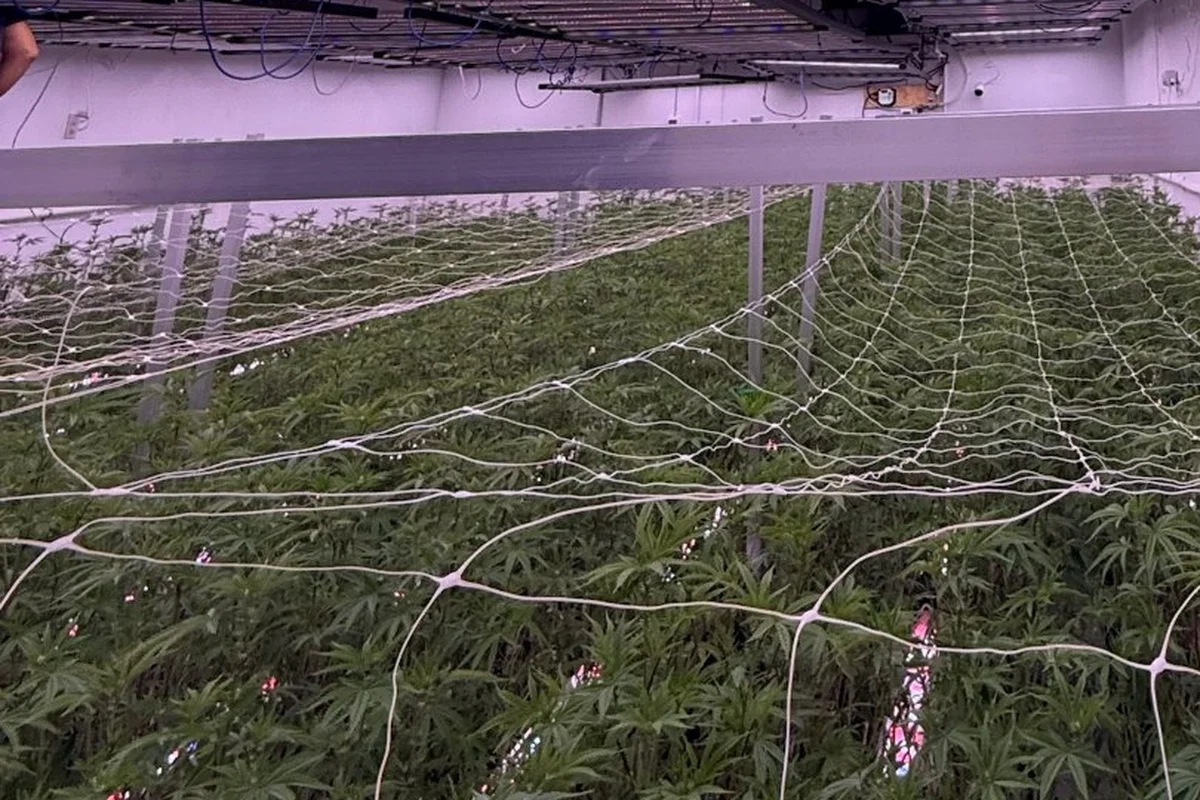
The grower's word for the rapid height gain in the first weeks of flower. It is driven by low R:FR, warm nights, crowding and vigour, and limited by the blue fraction and the day-to-night temperature difference. It is planned for with trellis, not hoped away.
In a purchase conversation: state the ceiling height and the trellis plan together with the spectrum. A cultivar stretched past the fixture height pays yield at the top for space it does not have.
Limits and Steering: How Hard to Push
Light Saturation Point ceiling of useful light · µmol/m²/s
The intensity beyond which more light stops adding photosynthesis. There is no single figure: a single leaf flattens somewhere between 1,000 and 1,500 µmol/m²/s depending on temperature, CO₂ and cultivar, while a whole canopy keeps responding further because deeper leaves receive the light. Canopy trials have read near-linear responses up to 1,800.
In a purchase conversation: the honest answer to "how high should I run" is a room question. The stage-by-stage bands, and the way they move with CO₂, live on the PPFD and DLI page.
Emerson Effect far-red synergy · n/a
Far-red photons, ineffective alone, add to canopy photosynthesis when mixed with PAR at up to roughly 30 percent of the photon flux, a planning range rather than a guarantee, because the two photosystems share the work. It is the physiological reason a far-red channel can justify its watts.
In a purchase conversation: it is also why PPE falls when the channel runs: the fixture is doing work the metric does not count. The channel state belongs on the test report.
End-of-Day Far-Red EOD-FR pulse · minutes
A short far-red pulse fired at lights-off, converting the day's remaining Pfr back to Pr and effectively moving dusk earlier. Trials have used it to hold yield on shortened photoperiods and to nudge flowering timing without touching the light-hours bill.
In a purchase conversation: this is a scheduling feature, not a fixture requirement: it needs a switchable far-red channel and a controller that can fire a short pulse at a precise minute.
Crop Steering environmental steering · n/a
Deliberately pushing the environment, VPD, substrate water, light dose, to move the crop between vegetative and generative behaviour through the stage. Late flower is the classic case: drier air and tighter water drive the finish, at the cost of a smaller margin for error.
In a purchase conversation: a steering plan raises the precision every component needs. If the plan includes late-flower pushes, dimming resolution and climate stability stop being nice-to-haves.
Water Use Efficiency WUE · grams of dry matter per litre
Dry matter built per litre of water transpired. LED rooms run higher WUE than HPS rooms at matched PPFD, because less radiant heat on the leaf means less water lost for the same carbon fixed; comparisons commonly read the transpiration saving at 15–30%.
In a purchase conversation: after an LED retrofit, retune the irrigation and EC programme, not just the dimmer. The crop drinks differently under the new lamp.
The Terms That Get Confused
Most environment arguments are two people using one word for two things. These five pairs cover most of them:
| The pair | The difference in one line |
|---|---|
| VPD vs RH | RH is how full the air is at one temperature; VPD is the pull on the leaf once temperature is included. |
| Sensible vs latent heat | Sensible changes the thermometer; latent hides in water vapour and comes back as humidity. |
| BTU/hr vs ton | BTU/hr is the load; the ton is how the equipment is sold, at 12,000 BTU/hr each. |
| R:FR vs blue-to-red ratio | R:FR reads neighbour shade through phytochrome; the blue-to-red ratio shapes compactness through a different receptor. Different sensors, different levers. |
| Light saturation point vs DLI target | Saturation is an instantaneous ceiling; the DLI target is the daily budget the room banks. |
How the Room Rewrites the Lighting Quote
This is where the vocabulary earns its keep. Five room decisions, each traceable to a line in a lighting quotation:
| The room decision | What changes in the lighting purchase |
|---|---|
| CO₂ enrichment confirmed | The useful PPFD ceiling rises, and the fixture count is sized for the enriched band: see the CO₂-adjusted targets on the PPFD & DLI page. |
| Sealed room | No air exchange to lean on: cooling is sized from connected watts at 3.41214 BTU/hr each, dehumidification from the irrigation schedule. |
| HPS-to-LED retrofit | Leaf temperature drops, so air temperature and humidity setpoints are retuned rather than copied over, and the irrigation programme follows. |
| A far-red or EOD channel | Buys morphology control at a small cost in measured PPE; the channel state belongs on the test report and in the controller schedule. |
| A crop-steering plan | Dimming resolution and climate-control stability stop being optional, and the controller moves up the quotation with the fixtures. |
What Comes Next
These thirty finish the environment and engineering half of the vocabulary, and the series runs in three parts. Part 1 is the language of the light: PAR, PPF, PPFD, DLI, PPE and the measurement and certification chain. Part 3 is live: Legacy Grow Light Terms, the HID-era words still on old spec sheets, translated for a retrofit conversation. The deep dives already published in this series cover PPFD and DLI targets by stage and grow light efficacy.
FAQ
What is a good VPD for cannabis?
Commercial practice runs cuttings and seedlings at 0.4–0.8 kPa, vegetative rooms at 0.8–1.2, and flowering at 1.0–1.5, with some rooms pushing late flower toward 1.6 to finish dense canopies. The number only means anything next to its temperature: 60% RH is a different room at 20 °C than at 28 °C. State the stage, the temperature and the humidity together, and let VPD judge the combination.
Why did my plants change after switching from HPS to LED?
HPS fixtures radiate infrared, which warms the leaf above air temperature; LED fixtures do not, so leaves run at or slightly below air temperature. The room's thermometer did not change, but the leaf's did, and with it the vapour pressure deficit the plant experiences. After a retrofit, expect to raise air temperature or humidity setpoints rather than copying the old ones, and retune irrigation and EC, since the crop transpires less for the same light.
Does CO₂ enrichment actually increase yield?
In controlled cannabis trials, raising a sealed room from ambient to about 1,200 ppm lifted dry flower yield substantially, and most of the achievable gain was already captured at 1,200 ppm; returns diminish above roughly 1,500 ppm. The gain is conditional: the room needs high light, elevated temperatures and the climate capacity to hold both. CO₂ grows more flower; it does not meaningfully change the percentage of cannabinoids in it.
Can I run CO₂ in a vented room?
Practically, no. A vented room replaces its air continuously, so injected CO₂ leaves with the exhaust and the dose never accumulates. Enrichment and sealing are one decision: compressed CO₂ on a sensor-driven controller in a room that only exchanges air on demand. In an open room, spend the money on lighting and ventilation first.
How do I calculate the cooling load for a grow room?
Start from the connected wattage of everything that runs during lights-on and multiply by 3.41214 to get BTU per hour; 100 kW of lighting is about 341,200 BTU/hr, or 28 tons of cooling. Add the crop's transpiration as latent load, roughly 8,849 BTU for every gallon the plants release, and add a buffer for envelope and equipment. A quote built from room area alone is a guess.
What is a sensible heat ratio, and why does a standard AC struggle in a grow room?
The sensible heat ratio is the share of the cooling load that is temperature work rather than moisture work. Grow rooms sit near 0.5 to 0.6; standard commercial units are designed around 0.75 to 0.85. In a grow room that mismatch shows up as a thermostat satisfied while the room is still wet, which is why grow-room designs pair cooling with dedicated dehumidification sized from the irrigation schedule.
How many air changes per hour does a grow room need?
Ventilated rooms conventionally exchange the full air volume every one to three minutes, which is 20 to 60 air changes per hour; sealed, CO₂-enriched rooms exchange on demand only and rely on recirculating cooling and dedicated dehumidification. Fan ratings drop 20 to 25% behind a carbon filter and about 5% per 90-degree duct bend, so size from the derated figure, not the free-air number.
Does far-red light cause stretching?
It can. Far-red lowers the red-to-far-red ratio the phytochrome system reads, and a low ratio is how a plant detects shade, to which it responds with internode elongation. Used deliberately in small fractions, far-red opens a dense canopy; used carelessly it produces tall, soft plants under a fixed ceiling. The morphology effect is well established; yield and chemistry effects are cultivar-specific and should not be assumed.
What is the light saturation point of cannabis?
There is no single number. A single leaf flattens somewhere between 1,000 and 1,500 µmol/m²/s depending on temperature, CO₂ and cultivar, while a whole canopy keeps converting more light further, because deeper leaves receive it; canopy trials have read near-linear responses to 1,800. The useful ceiling in your room depends on CO₂ and climate capacity, which is why target bands are stated by stage and CO₂ condition.