
The 60-Second Answer
Relative humidity describes how full the air is. VPD describes how hard the air is pulling. They are not the same measurement, and only one of them tells you what a plant is doing.
The reason is that warm air can hold far more water than cold air. At 20 °C the air is saturated at 2.34 kPa of water vapour pressure. At 28 °C it is saturated at 3.78 kPa. So the same 60% relative humidity describes a completely different atmosphere at those two temperatures: 0.94 kPa of drying force in the first room, 1.51 kPa in the second. Same humidity reading, 61% more pull on the leaf. This is why a humidity setpoint written without a temperature beside it is not a specification.
VPD folds those two numbers into one. In commercial cannabis practice the working bands run like this:
| Stage | VPD band | What the band buys you |
|---|---|---|
| Cuttings and seedlings | 0.4–0.8 kPa | Root systems are small, so the pull on them stays gentle. Transpiration is enough to move water and calcium upward without outrunning supply. |
| Vegetative | 0.8–1.2 kPa | Roots are established and the canopy is building. Stomata stay open through the photoperiod and carbon keeps arriving. |
| Flowering | 1.0–1.5 kPa | A stronger pull feeds the flowers and keeps the canopy surface drier than the air around it. |
| Late flower | 1.3–1.6 kPa | The drier end is aimed at the last two weeks: dense calyxes plus still air is how grey mould gets started. |
Those bands are the same ones carried in our grow room terms glossary, and they are working ranges from commercial practice rather than results from a single trial. What matters is that they are stated at leaf temperature, which is the subject of the correction in the middle of this guide and the single most common reason a grower's chart and a grower's plants disagree.
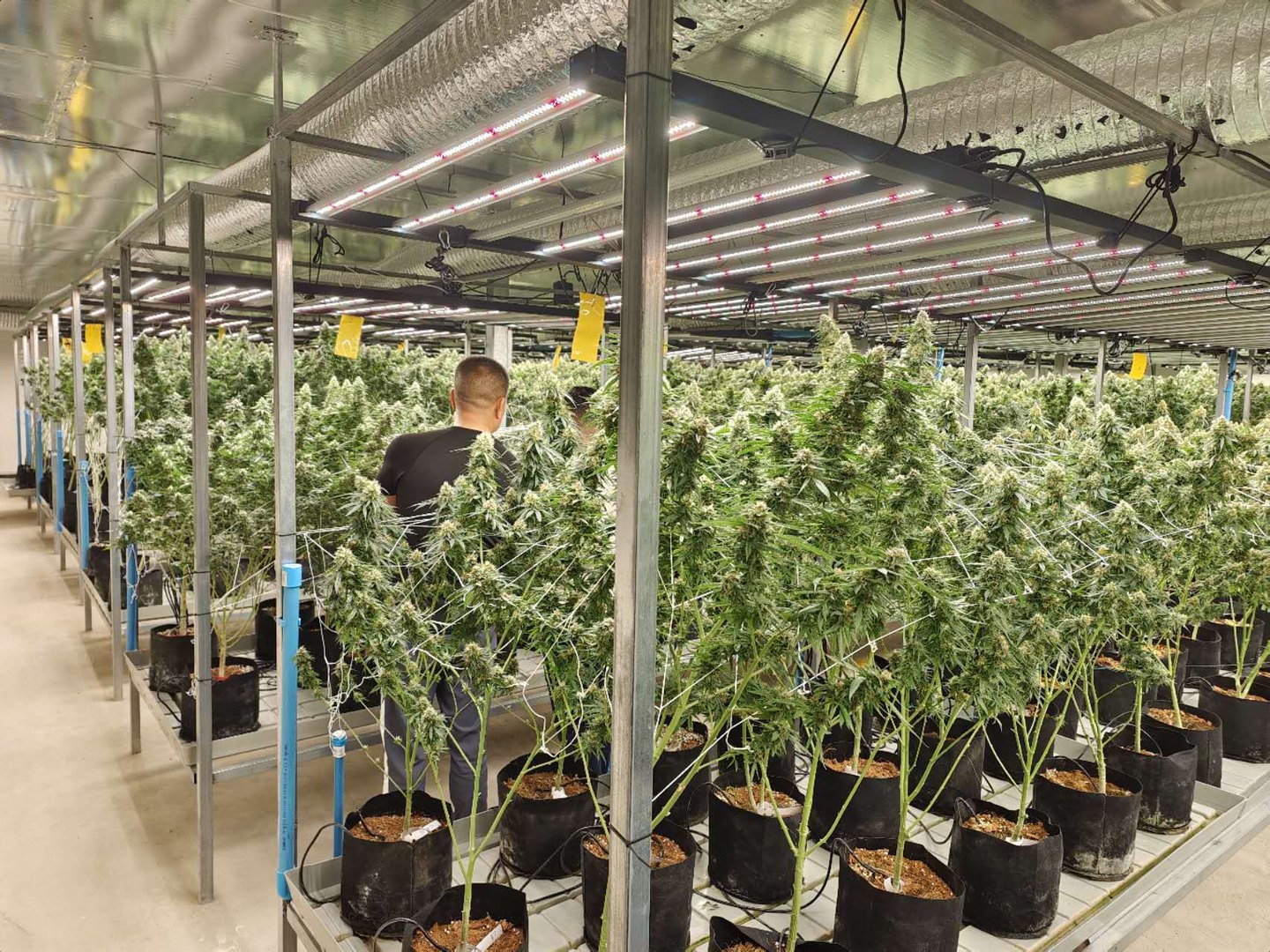
What Vapor Pressure Deficit Actually Measures
Air holds water vapour. There is a ceiling on how much it can hold at any given temperature, and that ceiling is called the saturation vapour pressure. VPD is the distance between the ceiling and what the air is actually carrying, expressed as a pressure in kilopascals.
A large deficit means the air is far from saturated and can absorb a great deal more water, so water leaves the leaf quickly. A small deficit means the air is nearly full, so water leaves slowly. Both extremes are problems. Too much pull and the plant closes its stomata to protect itself, which also shuts off the carbon dioxide it needs. Too little pull and water stalls in the plant: nutrients that travel in the transpiration stream stop arriving, and the canopy stays wet enough for pathogens.
The important consequence is that VPD is a function of temperature first and humidity second. The chart below plots VPD against temperature at three fixed humidity settings. Each curve is a constant humidity reading, and each one still spans a wide range of drying force:
Read the three curves together and a practical rule falls out. Temperature is the coarse control on VPD and humidity is the fine control, because a one-degree temperature change moves the deficit more than a one-point humidity change does at the same starting point. Growers who tune VPD by humidity alone are working with the smaller of their two levers.
How to Calculate VPD: The Formula, Done Properly
Most guides stop at the definition, that VPD is saturation vapour pressure minus actual vapour pressure. That statement is true and it is not usable, because it does not tell you how to obtain either quantity. Here is the whole chain, with the constants included.
| Step | Formula | Inputs and units |
|---|---|---|
| 1. Saturation vapour pressure | SVP = 0.61078 × e^(17.27 × T / (T + 237.3)) | T is temperature in °C. The result is in kPa. |
| 2. Actual vapour pressure | AVP = SVP × RH / 100 | RH is relative humidity in percent, measured in the same air whose temperature you used. |
| 3. Air VPD | VPD = SVP × (1 − RH / 100) | Equivalent to step 1 minus step 2. The result is in kPa. |
| 4. Leaf VPD | VPDleaf = SVP(Tleaf) − SVP(Tair) × RH / 100 | Same as step 3, except the saturation term is evaluated at leaf temperature instead of air temperature. |
Worked example. Air at 26 °C and 60% relative humidity, with leaves assumed to be at air temperature:
- SVP = 0.61078 × e^(17.27 × 26 / (26 + 237.3)) = 0.61078 × e^1.7054 = 3.361 kPa
- AVP = 3.361 × 60 / 100 = 2.017 kPa
- VPD = 3.361 − 2.017 = 1.345 kPa
That room is inside the flowering band and just under the late-flower target. Notice that the answer has a value and a unit, which is more than the conceptual version of the formula can give you.
Three practical notes on applying it. First, use one consistent temperature source: the RH your sensor reports was computed against the air temperature at the sensor, so mixing a canopy temperature with a wall humidity reading produces a number that belongs to no real place. Second, keep the decimal places. Rounding 1.345 to 1.3 puts a late-flower room apparently inside the vegetative band. Third, work in kPa throughout. Converting to millibars or inches of mercury partway through is the fastest way to lose a factor of ten.
Air VPD and Leaf VPD: The Correction Almost Every Chart Skips
Transpiration happens at the leaf surface, so the temperature that belongs in the formula is the leaf's, not the room's. Most published charts are drawn on air temperature, and most growers read them with a sensor hanging on a tent pole. The gap between those two assumptions is where charts quietly mislead.
The size of the gap can be written exactly. Subtracting air VPD from leaf VPD, the actual vapour pressure term cancels, because both share the same air:
The correction depends only on the temperature difference between the leaf and the air. It does not depend on relative humidity at all. A two-degree colder leaf shifts VPD the same amount in a humid room and a dry one.
Because the correction is a difference of two saturation pressures, it grows as the room gets warmer. The table gives the shift directly, so the arithmetic does not have to be repeated in the room:
| Leaf minus air | at 18 °C air | at 22 °C air | at 26 °C air | at 30 °C air |
|---|---|---|---|---|
| −3 °C | −0.36 kPa | −0.45 kPa | −0.55 kPa | −0.68 kPa |
| −2 °C | −0.25 kPa | −0.31 kPa | −0.38 kPa | −0.46 kPa |
| −1 °C | −0.13 kPa | −0.16 kPa | −0.19 kPa | −0.24 kPa |
| 0 °C | 0.00 | 0.00 | 0.00 | 0.00 |
| +1 °C | +0.13 kPa | +0.17 kPa | +0.20 kPa | +0.25 kPa |
| +2 °C | +0.27 kPa | +0.34 kPa | +0.42 kPa | +0.51 kPa |
| +3 °C | +0.42 kPa | +0.52 kPa | +0.64 kPa | +0.79 kPa |
Take the worked example again. Air at 26 °C and 60% RH gives an air VPD of 1.345 kPa. If the leaves are running two degrees cooler, which is a normal reading for a well-watered canopy under LED, the real leaf VPD is 1.345 − 0.38, or 0.967 kPa. That is a 28% error, and it moves the room from the middle of the flowering band down into the vegetative band. A grower following an air-temperature chart would believe the room was on target while the plant experienced something gentler.
This is where the widely repeated retrofit advice needs a correction of its own. The common claim is that LED leaves run two to four degrees Fahrenheit cooler than the air and high pressure sodium leaves run warmer, so a grower should subtract or add a fixed offset. The direction is right. The magnitude is usually overstated, and the reason matters.
A leaf energy balance study from Utah State University measured radiation absorbed by leaves under clear sky sunlight, greenhouse sunlight, high pressure sodium and LED at matched photon flux. When plants had adequate water, leaves under all four sources sat within about 2 °C of air temperature. The dominant driver of leaf temperature was not the lamp but the water status of the plant and the evaporative cooling that follows from it. Under water stress with low wind the model put leaves 6, 8, 10 and 12 °C above air for the field, LED, greenhouse and HPS cases respectively.
Two conclusions follow for a commercial room. The lamp-specific offset is a real but modest effect, so a blanket rule of thumb is a starting guess rather than a measurement. The large correction is the one produced by a canopy that cannot keep up with the demand you have placed on it, and it appears on the same day the irrigation schedule falls behind. If your leaf-to-air gap has suddenly widened, check the substrate before you check the fixture.
The VPD Chart: Reading It, and the Version That Fits Your Room
Charts exist because nobody wants to run the exponential by hand every time a room drifts. The two tables below are generated from the formula above, computed at leaf temperature, and rounded to two decimals. The first sweeps the full working range of a cannabis room.
| Leaf temp | 40% RH | 50% RH | 60% RH | 70% RH | 80% RH |
|---|---|---|---|---|---|
| 16 °C | 1.09 | 0.91 | 0.73 | 0.55 | 0.36 |
| 18 °C | 1.24 | 1.03 | 0.83 | 0.62 | 0.41 |
| 20 °C | 1.40 | 1.17 | 0.94 | 0.70 | 0.47 |
| 22 °C | 1.59 | 1.32 | 1.06 | 0.79 | 0.53 |
| 24 °C | 1.79 | 1.49 | 1.19 | 0.90 | 0.60 |
| 26 °C | 2.02 | 1.68 | 1.34 | 1.01 | 0.67 |
| 28 °C | 2.27 | 1.89 | 1.51 | 1.13 | 0.76 |
| 30 °C | 2.55 | 2.12 | 1.70 | 1.27 | 0.85 |
Zone shading: under 0.4 kPa is a rooting environment, 0.4–0.8 kPa suits cuttings and young plants, 0.8–1.5 kPa covers vegetative growth through flowering, 1.5–2.0 kPa is late-flower territory and above band for most stages, and above 2.0 kPa is air that will start closing stomata.
The ten-point humidity steps are convenient but coarse for the decisions that matter, so here is the same chart narrowed to the window where most commercial rooms actually live. Five-point steps put the target bands within reach of a setpoint change rather than a redesign.
| Leaf temp | 50% RH | 55% RH | 60% RH | 65% RH | 70% RH |
|---|---|---|---|---|---|
| 20 °C | 1.17 | 1.05 | 0.94 | 0.82 | 0.70 |
| 22 °C | 1.32 | 1.19 | 1.06 | 0.93 | 0.79 |
| 24 °C | 1.49 | 1.34 | 1.19 | 1.04 | 0.90 |
| 26 °C | 1.68 | 1.51 | 1.34 | 1.18 | 1.01 |
| 28 °C | 1.89 | 1.70 | 1.51 | 1.32 | 1.13 |
| 30 °C | 2.12 | 1.91 | 1.70 | 1.49 | 1.27 |
Three points on using either table. The columns are leaf temperature, so take your air reading and apply the correction from the previous section before you look anything up. The values are rounded for reading, which means a room at 1.48 kPa is on target and a room at 1.52 kPa is not a crisis, so treat the band edges as soft. And the table cannot tell you which combination to choose, because 1.2 kPa is reachable at 20 °C with 60% humidity or at 30 °C with 68%, and those two rooms differ in temperature by ten degrees, which the plants will notice in ways VPD does not capture.
VPD Targets for Cannabis by Stage
The band table from the top of this guide is worth repeating with the arithmetic attached, because a band is only actionable once you know which pair of setpoints lands inside it. The combinations below are stated at leaf temperature and each one sits inside its band.
| Stage | Target band | One combination that lands in band | What it produces |
|---|---|---|---|
| Cuttings and seedlings | 0.4–0.8 kPa | 24 °C at 75% RH | 0.75 kPa. Gentle pull, no demand the new roots cannot meet. |
| Vegetative | 0.8–1.2 kPa | 26 °C at 70% RH | 1.01 kPa. Stomata open through the photoperiod, calcium moving to new growth. |
| Flowering | 1.0–1.5 kPa | 26 °C at 65% RH | 1.18 kPa. Strong pull for flower bulk, canopy surface still drier than the room. |
| Flowering, warmer room | 1.0–1.5 kPa | 28 °C at 65% RH | 1.32 kPa. The same band held by a warmer room with the same humidity. |
| Late flower | 1.3–1.6 kPa | 28 °C at 60% RH | 1.51 kPa. Drier air and denser flowers, the standard mould-prevention move. |
Note what the fourth row does. Raising temperature from 26 to 28 °C at an unchanged 65% humidity moves the room from 1.18 to 1.32 kPa, which is most of the distance to the late-flower band without touching the dehumidifier. In a room where dehumidification is already at capacity, heat is often the cheaper lever, and the interaction with light is the reason: cannabis photosynthesis peaks near 30 °C, so a modest temperature rise in a high-light room is usually productive rather than costly.
The reverse also holds, and it is the trap in dry climates. Dropping temperature to reduce VPD works, but in a sealed high-light room the load you are removing has to go somewhere, and the cooling equipment pays for it. Neither lever is free. The decision table further down sets out which one to reach for by symptom.
What Happens When VPD Leaves the Band
Most VPD guides describe the consequences in general terms: growth slows, stress rises. There is now direct experimental evidence in cannabis, and it is more severe than the general language suggests.
A controlled study at the Institute of Cannabis Research, Colorado State University Pueblo, grew a CBD-dominant chemotype at two humidity regimes and measured the outcome. The low-humidity group ran at 37–58% relative humidity. The high-humidity group ran at 78–98%, which produced a canopy-level VPD of 0.62 kPa falling to 0.25 kPa through flowering. Both groups had ten plants and the differences were significant at p < 0.001. The high-humidity group, in the paper's own words, sat below optimal VPD thresholds for 89% of the vegetative stage and 75% of flowering. The results:
| Measured outcome | High-humidity group against low |
|---|---|
| Whole-plant biomass | down 75.3% |
| Flower biomass | down 71.0% |
| Node count | down 29.3% |
| Stem length | up 9.7%, which is stretch rather than vigour |
| Time to flowering | delayed by three weeks |
| CBD-A concentration | down about 4.9-fold |
| CBD concentration | down about 3.2-fold |
| CBC-A concentration | down about 13-fold |
The mechanism the authors describe is the one set out earlier in this guide. Sustained low VPD limits transpiration, and reduced transpiration impairs the movement of nutrients, with phosphorus and magnesium named specifically, which in turn delays reproductive development. Taller plants with fewer nodes and less flower is exactly the signature of a canopy that was never made to work for its water.
Read that table as a warning about the wet direction, because that is the direction a humid climate, an undersized dehumidifier or a closed canopy pushes a room. The dry direction has its own signature, and it usually appears first as a nutrient complaint.
| What you observe | VPD direction | The mechanism |
|---|---|---|
| New growth pale, leaf edges and tips browning, with the substrate correctly fed | Too dry | Calcium travels in the transpiration stream. Reduce transpiration and the tissues that transpire least, which are the young leaves and flower tips, are the first to be under-supplied. |
| Leaves cupping or rolling, margins curling upward | Too dry | Stomata close defensively and evaporative cooling falls away, so leaf temperature climbs further, which narrows the margin still more. |
| Soft, stretched stems and wide internode spacing | Too wet | Low deficit, high humidity and reduced transpiration produce elongation, which the cannabis humidity study measured as a 9.7% stem length increase alongside a 29.3% node reduction. |
| Slow dryback, substrate staying wet between irrigations | Too wet | The crop is not drawing water, so the medium does not dry. This is the earliest visible sign of a low-VPD room and it needs no leaf symptoms to confirm. |
| Water beading on leaf margins overnight, or condensation on calyxes | Too wet | Water that cannot leave as vapour has to go somewhere. Guttation at the leaf edge is the plant's overflow, and condensation on flower tissue is the beginning of grey mould. |
| Powdery mildew appearing without an obvious humidity spike | Too wet at the surface | Leaf surface microclimate, not room averages, decides infection. A room reading inside the band can still hold saturated air inside a dense canopy. |
Two of those rows deserve emphasis. The first is that a calcium-looking deficiency in a high-light room with a dry atmosphere is frequently an environment problem wearing a nutrient costume, and adding calcium to the feed does not fix it because the delivery mechanism is transpiration rather than concentration. The second is that substrate dryback is the cheapest VPD instrument in the room. It responds before the leaves do, and it costs nothing to read.
Why Stomata Close, and Why Calcium Follows the Water
Everything above rests on one physical fact: carbon dioxide and water vapour pass through the same opening. A stoma that opens to admit CO₂ necessarily releases water, so the plant cannot take carbon without paying water for it. VPD is the price of that transaction, and the plant adjusts its aperture as the price moves.
The relationship has been quantified. A survey of stomatal response across a large range of species found that conductance falls as a near-logarithmic function of VPD, described by the relation below, where the sensitivity term works out to roughly 0.6 at the reference conductance for mesic species.
Follow the two curves and the bands make sense. Below 1 kPa the stomata are essentially wide open and transpiration rises with the gradient, so a plant in humid air moves water readily. Above 1 kPa conductance begins to fall, and the decline is steep enough that it outpaces the growing gradient. Transpiration therefore peaks near 1.95 kPa and falls away beyond it. Drier air past that point does not dry the crop out faster. It closes the plant down.
Stated per doubling, the relation gives a number worth remembering: moving from 1.0 to 2.0 kPa reduces stomatal conductance by roughly 42%. Since carbon dioxide enters through the same pore, that is also roughly 42% less carbon available for photosynthesis at a moment when the light has not changed at all. A room can be delivering a full photon load to a canopy that has stopped accepting it.
The calcium consequence follows from the same physics. Calcium is effectively immobile in the phloem, which means it cannot be redistributed from old leaves to new ones the way nitrogen and potassium can. It arrives at a tissue only if the transpiration stream carries it there. Tissues that transpire least, the young expanding leaves at the top and the tips of developing flowers, therefore depend on a functioning transpiration stream for their calcium supply. Narrow that stream by running a dry room and those tissues are the first to run short, whatever the feed tank contains. This is the mechanism behind the classic pattern of tip burn and brown spotting in a room where every input looked correct.
VPD Does Not Work Alone: PPFD, CO₂ and DLI
VPD sets the ceiling on how much carbon a canopy can take up, but it does not set the amount of carbon on offer. Those are different questions, and a room can be excellent at one and poor at the other.
| Variable | How it interacts with VPD | What to do about it |
|---|---|---|
| PPFD | Light drives stomatal opening, so a bright canopy transpires more and can hold a slightly higher deficit without closing down. Bright light also raises leaf temperature, which raises leaf VPD. | Set the deficit against the canopy temperature you actually run at full light, not the temperature the room shows at dawn. |
| Photoperiod and DLI | A 12-hour photoperiod concentrates the same daily light into fewer hours, which raises instantaneous intensity and the transpiration load. | Recalculate both after a flip. The PPFD and DLI targets and the daily light integral guide carry the numbers. |
| CO₂ enrichment | Raised CO₂ lets stomata partly close while photosynthesis continues, so transpiration falls and the plant tolerates a higher deficit. Industry practice runs enriched rooms modestly drier, commonly on the order of 0.2 to 0.4 kPa above ambient targets. | Treat the enriched target as a different specification from the ambient one, and write both into the controller rather than adjusting by feel. |
| Air movement | VPD as your sensor reports it is a bulk-air figure. A still boundary layer of saturated air sits against every leaf and the real gradient the leaf sees is smaller. Moving air thins that layer. | Keep air moving through the canopy rather than across the room. Airflow changes the effective deficit without changing the reading. |
| Spectrum | Far-red and the wider spectrum change how leaves are built and how much light reaches lower nodes, which changes where transpiration happens in the canopy. | Read the spectrum guide before treating a spectrum change as a climate change. |
The airflow row is the one most often missed, and it explains a contradiction growers run into regularly. A room can hold a textbook VPD at canopy height while the flowers inside the canopy sit in still, near-saturated air and develop mould. The room's number was correct and the plant's experience was not, for the same reason a still afternoon feels hotter than a breezy one at identical temperature.
What ties the light variables and the climate variables together is that they are bought as one system. A high-PPFD room needs a climate plant that can move the water that light makes the crop transpire, and the load calculation belongs in the same conversation as the fixture count. Our page on sizing a room carries that arithmetic, and the controller is the device that actually holds both against their targets overnight.
Measuring VPD So the Number Means Something
A VPD figure is only as good as the two readings behind it, and the two readings are usually taken in the wrong place.
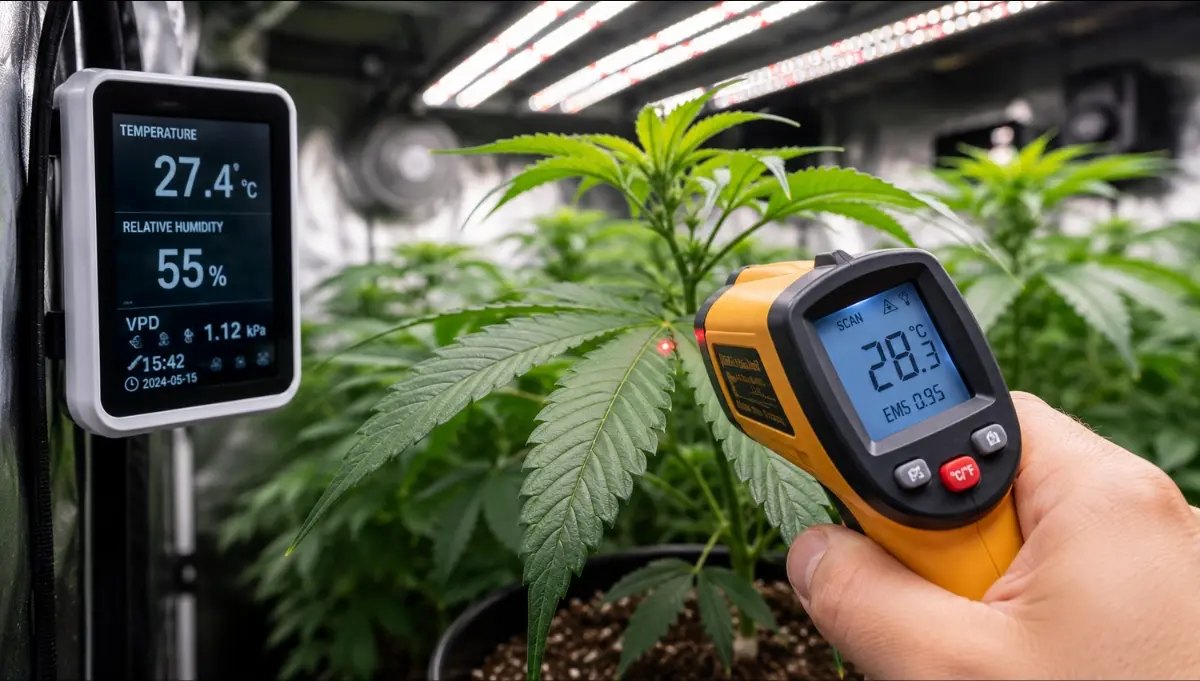
- Put the sensor at canopy height, in the canopy. A probe clipped to a wall or a tent pole in the walkway reports the air you walk through, not the air the plants use. Canopy temperature and humidity can differ enough from walkway conditions that the computed VPD is a different band.
- Shield the probe from direct radiation. A sensor in direct light reads its own surface temperature rather than the air's, which corrupts the humidity calculation even when the probe is otherwise accurate.
- Take leaf temperature with an infrared thermometer. Aim at a healthy, fully lit leaf in the upper canopy, avoid wet leaves and reflective surfaces, and average several readings. Mid-photoperiod is the right time.
- Check the sensor against a reference. Humidity sensors drift, and a drifted sensor produces a plausible wrong number rather than an obvious one. A saturated salt reference or a second known-good meter is enough to catch it.
- Log rather than spot-check. A single reading at one moment cannot show you the lights-off crash, the dryback curve or the swing between irrigation events. Trends are where the diagnosis lives.
The distinction that matters most is between room VPD and plant VPD. Everything a sensor can tell you is a property of the air somewhere. The number that governs the crop is a property of the boundary between a leaf and the air immediately around it, and the only way to close that gap is to measure the leaf and keep the air moving. Position sensor placement and airflow as part of the first thirty days after any light change, because both the leaf temperature and the water demand move at once when the lamp moves.
Lights-Off: The VPD Crash, the Dew Point and Botrytis
VPD is a daytime metric in most growers' heads, which is unfortunate, because the largest swing in the twenty-four hours usually happens after the lamps go out.
Take a flowering room running 26 °C and 60% relative humidity on a 12/12 schedule. Its daytime deficit is 1.345 kPa, comfortably inside the band. When the lights switch off, the heat load disappears and the room cools; the crop keeps transpiring for a while into air that is now cooling and therefore less able to hold vapour, so relative humidity rises. Land at 20 °C and 70% and the deficit has fallen to 0.70 kPa, half the daytime figure and below the band for a flowering room. The swing is 0.644 kPa inside one cycle.
There is a second, sharper danger in the same numbers. VPD and dew point are two descriptions of the same moisture. The dew point is the temperature at which that air would saturate, and any surface below it collects water. In the lights-off case above, the dew point of 20 °C air at 70% humidity is 14.4 °C, and a leaf running a degree cooler than the air leaves 4.6 °C of margin. Push the room further, to 75% humidity at 20 °C, and the margin narrows to 3.6 °C; at 80% it is 2.6 °C. Narrow that margin far enough and the coldest surfaces in the room, which are the outer calyxes of the densest flowers, cross it. That is where grey mould begins.
| Lights-off condition | VPD | Dew point | Margin at a leaf 1 °C below air |
|---|---|---|---|
| 20 °C at 60% RH | 0.94 kPa | 12.0 °C | 7.0 °C |
| 20 °C at 70% RH | 0.70 kPa | 14.4 °C | 4.6 °C |
| 20 °C at 75% RH | 0.58 kPa | 15.4 °C | 3.6 °C |
| 20 °C at 80% RH | 0.47 kPa | 16.4 °C | 2.6 °C |
| 18 °C at 85% RH | 0.31 kPa | 15.4 °C | 1.6 °C |
The fourth row is the one to plan against. Raising humidity five points at a fixed temperature almost halves the margin between the leaf and condensation, and the last row shows what a cool, humid night does to it. A common practice in commercial flowering rooms is to hold the lights-off temperature within a few degrees of the daytime figure and to keep dehumidification running through the dark period rather than shutting it down with the lights, precisely because the moisture does not stop arriving when the photons do.
Fixing VPD: A Decision Table
Correcting a room means moving one of two variables, or moving the plant's experience of them. The table below maps the condition you observe to the lever that addresses it, roughly in the order to try them.
| Condition | First move | Then |
|---|---|---|
| VPD too low in flower, room already warm | Remove moisture with a correctly sized dehumidifier, sized from the crop's transpiration rate rather than the floor area | Raise airflow through the canopy, which lowers the boundary-layer humidity the flowers actually sit in without changing the room reading |
| VPD too low in veg, temperature has headroom | Raise leaf temperature a degree or two, which raises the saturation term and the deficit together | Bring the lights-off temperature closer to the daytime figure so the nightly swing stops undoing it |
| VPD too high, room already hot | Add humidity rather than cutting light, because cutting light also cuts the DLI the room has already paid for | Slow the extraction if the room is ventilated, watching carbon dioxide as you do |
| VPD too high and leaves are cupping | Check the substrate first. Cupping with a dry medium is a water-supply problem, and raising humidity will not fix it | Then lower canopy temperature or raise humidity, in that order |
| VPD in band but symptoms persist | Measure inside the canopy rather than in the walkway, and check the leaf-to-air gap | Check dryback and irrigation frequency, because the room average can be right while the root zone is wrong |
| VPD in band but mould anyway | Measure the boundary layer: humidity at the flower, not at the sensor | Increase air movement through the canopy and remove the lowest, least productive growth |
| Condensation on calyxes overnight | Hold the lights-off temperature closer to the daytime figure | Run dehumidification through the dark period and keep air moving twenty-four hours a day |
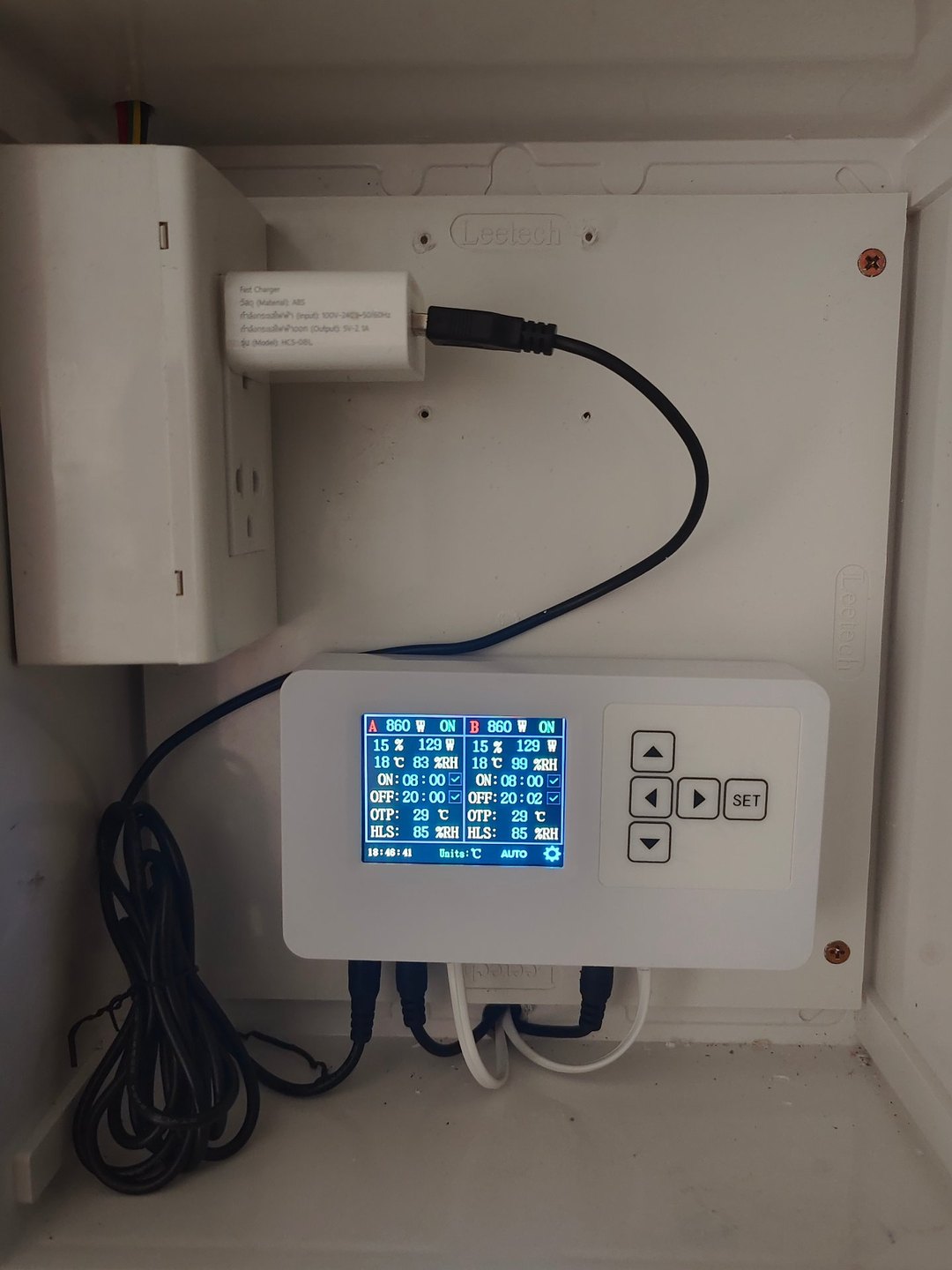
| Room swings more than 0.4 kPa between day and night | Set independent day and night targets on the controller and ramp between them rather than switching | Check for a cooling system that is oversized relative to the lights-off load, which is a common cause of a nightly crash |
Two principles sit underneath the whole table. Change one variable at a time, because temperature and humidity both move the number and a simultaneous adjustment leaves you unable to tell which one worked. And make changes gradually, because a canopy acclimated to one deficit does not respond to a sudden change in it as though nothing had happened; a step change reads to the plant as a stress event whatever the average works out to.
For sizing the equipment that holds a target rather than reaching one, the working figures are the crop's transpiration rate in litres per day, the connected electrical load, and the sensible-versus-latent split of the cooling load. Our glossary of grow room terms sets those out with the conversion factors, and they belong in the same purchase conversation as the fixtures, because a room specified on watts alone will be dry on paper and wet at peak flower.
FAQ
What is a good VPD for cannabis?
Commercial practice runs cuttings and seedlings at 0.4–0.8 kPa, vegetative rooms at 0.8–1.2, and flowering at 1.0–1.5, with late flower allowed toward 1.6 to finish dense canopies. A band is only meaningful when a temperature and a humidity are named together, so state all three, and state them at leaf temperature. At 26 °C and 65% relative humidity a flowering room sits at 1.18 kPa, which is inside the band; the same room at 30 °C and 65% would sit at 1.49 kPa, at the top edge of it.
How do I calculate VPD without a calculator?
Saturation vapour pressure is 0.61078 × e^(17.27 × T / (T + 237.3)) with T in Celsius, and air VPD is that value multiplied by 1 minus RH/100. Short of running it by hand, two useful anchors are that saturation vapour pressure is close to 1.0 kPa at 7 °C, 2.34 kPa at 20 °C, 3.17 kPa at 25 °C and 4.24 kPa at 30 °C. From the 20 °C figure, air at 20 °C and 60% humidity gives 2.34 × 0.4, or about 0.94 kPa. The chart tables in this guide exist so that the exponential does not have to be repeated in a grow room.
Is air VPD or leaf VPD the right number to use?
Leaf VPD is the one that drives transpiration, because transpiration happens at the leaf surface rather than in the room. The gap between the two is exactly the difference between the saturation vapour pressure at leaf temperature and at air temperature, and it does not depend on humidity. At 26 °C air, a canopy running two degrees cooler sits 0.38 kPa below the air reading, which is enough to move a room from the middle of the flowering band into the vegetative band. Read the chart at your measured canopy temperature.
Do LED leaves really run cooler than HPS leaves?
They run somewhat cooler, but by less than the usual rule of thumb claims, and the lamp is not the largest term. An energy balance study across clear sky sunlight, greenhouse sunlight, HPS and LED found that when plants had adequate water, leaves under all four sources sat within about 2 °C of air temperature. Water status and the evaporative cooling that follows from it dominated. Under water stress with low wind the same model put leaves 8 °C above air under LED and 12 °C under HPS. Watch the gap, but suspect the irrigation before the fixtures.
Why does my room read correct VPD and still get mould?
Because a sensor reports bulk air and mould grows in the boundary layer against the flower. Still, near-saturated air collects between dense calyxes even when the room average is on target. The two fixes are air movement through the canopy rather than across the room, and removing the lowest growth that never receives useful light and never dries out. Measuring humidity at the flower rather than at the sensor is the check that confirms it.
Should I fix VPD by changing temperature or humidity?
Both levers work, and the choice depends on what the room has left to give. Raising temperature raises the saturation term and the deficit together, which is the cheaper move in a high-light room because cannabis photosynthesis peaks near 30 °C. Removing moisture with a dehumidifier lowers the actual vapour pressure, which is the standard move in flower where a temperature rise would push the crop toward the end of its cycle early. Where dehumidification is already at capacity, temperature is usually the lever with headroom left.
What VPD should I run at night?
Keep the lights-off deficit within about 0.4 kPa of the daytime figure, which usually means holding the night temperature closer to the day and keeping dehumidification running through the dark period. A room at 26 °C and 60% humidity reads 1.35 kPa with the lights on and 0.70 kPa if it falls to 20 °C at 70% humidity overnight, a swing of 0.64 kPa in the wrong direction. Large nightly oscillation stresses plants more than a steady value that is slightly off target.
Does VPD change when I add CO₂?
Enrichment raises the carbon available to the leaf, which lets stomata partly close while photosynthesis continues. Transpiration falls as a result, so an enriched room tolerates a higher deficit and industry practice runs enriched rooms modestly drier than ambient ones, commonly on the order of 0.2 to 0.4 kPa. Treat it as a separate specification and write it into the controller rather than adjusting by feel, and remember that the same temperature rise that wastes carbon in an ambient room is productive at elevated CO₂.
Can VPD be too low even in a vegetative room?
Yes, and the recent controlled evidence is severe. A CBD-dominant cannabis chemotype grown at 78–98% relative humidity, which held canopy VPD between 0.25 and 0.62 kPa, produced 75.3% less whole-plant biomass and 71.0% less flower biomass, delayed flowering by three weeks, and reduced CBD-A concentration about 4.9-fold. Reduced transpiration impairs nutrient transport, so a room that is too wet is not simply slower. The first practical sign is a substrate that stops drying down between irrigations.
Why does a high-VPD room show calcium deficiency?
Calcium is immobile in the phloem, so it cannot be moved from old tissue to new. It reaches a leaf or a flower tip only if the transpiration stream carries it there, and the tissues that transpire least are the first to run short when that stream narrows. The result is browning tips and pale new growth in a room where the feed was correct all along. Raising calcium in the tank does not address a delivery failure, so measure canopy VPD and check dryback before amending the nutrient programme.
What happens above 2 kPa?
Stomatal conductance has already fallen steeply, and transpiration has passed its peak near 1.95 kPa, so drier air stops removing more water and simply closes the plant down. Moving from 1.0 to 2.0 kPa reduces stomatal conductance by roughly 42%, and since carbon dioxide uses the same pore, that is roughly 42% less carbon available while the light load is unchanged. Evaporative cooling also falls as the stomata close, so leaf temperature climbs, which narrows the margin still further.
Where should the sensor go?
At canopy height and inside the canopy, shielded from direct light. A probe in the walkway or clipped to a wall reports the air a person walks through rather than the air the plants use, and the two can sit in different bands. Take leaf temperature separately with an infrared thermometer, half a metre or so into the canopy, mid-photoperiod, averaging several readings. Position the probe correctly before worrying about calibration frequency, because a well-calibrated sensor in the wrong place gives a consistent answer about the wrong room.