
This page answers the price question directly, because that is what the search is. Then it does the part the price list cannot: it shows what the gap between a factory price and a retail price is made of, how the number scales from one fixture to a room to a facility, and how to build your own budget before you ask anyone for a quote. Prices here are direct-from-factory, EXW, standard configuration, quoted as of November 2026. They move with diode pricing, driver supply and shipping, so treat them as a band to plan against rather than a published price list.
The Short Answer: What a Commercial Grow Light Costs in 2026
Three product classes cover most of what a commercial cannabis room buys: a top light over the canopy, an under-canopy bar inside it, and a controller that talks to both. The table below puts the factory price and the US shelf price side by side, at the same wattage class, so the gap is visible before any arithmetic.
| Product | Factory direct, EXW | US-brand retail | Retail multiple |
|---|---|---|---|
| 4x4 ft top light, 600W to 1,000W, Samsung LEDs and Sosen driver, 3-year warranty | $168 to $268 | $699 to $1,299 | roughly 4x to 5x |
| 4 ft under-canopy bar, 120W | $35 to $59 | $80 to $249 | roughly 2x to 4x |
| Smart controller | $75 to $100 | quoted separately | n/a |
Two things need saying before those numbers get used in a budget. The first is that the comparison is directional, not a like-for-like brand comparison. A US retail price bundles local stock, same-week replacement, warranty administration onshore, technical support in your time zone, and the marketing that put the brand in front of you. A factory price bundles the fixture and the paperwork. Neither is a trick, and a buyer who expects the second to behave like the first will be disappointed in exactly those areas.
The second is that EXW is a shipping term, not a final number. EXW means the fixture leaves our floor; from that point the crate, the freight, the duty and the broker are yours. The next section is about how much that adds, because the honest answer is that a factory price is not what you pay to have light over plants, and a page that pretends otherwise is selling rather than explaining.
Why the Same Fixture Has Two Prices
A fixture that leaves a factory at $200 can sit on a US shelf at nearly $900, the same multiple the table above shows, without anyone in the chain behaving badly. The retail price has to carry every cost the factory price never touched, and each of those costs has a margin stacked on top of it. Walk the chain once and the multiple stops looking strange.
Freight and duty. A pallet of fixtures crosses an ocean, clears customs, and pays an import duty assessed on the declared value. Both are real costs, both are quoted per shipment, and neither appears on an EXW invoice. This is the line most buyers overestimate as a share of the gap and the line most first-time importers underestimate in absolute terms, because a single pallet carries fewer fixtures than they expect.
Warehousing and local logistics. Somebody has to hold stock in-country so a buyer can have a fixture this week instead of in six. Warehouse rent, inventory carrying cost, pick and pack, and last-mile delivery to a grow site all land in the shelf price. A factory does not hold inventory for you, which is why it can quote what it quotes.
Marketing and the cost of being found. In the US cannabis equipment market this is often the single largest line in the gap, larger than freight and duty together. Trade shows, sponsored placements, affiliate programs, influencer grows, content production, demo units sent to reviewers: a brand pays for attention long before it pays for a container, and every dollar of that lands on the fixture.
Distributor and retail margin. A distributor buys at wholesale and sells to a retailer, and the retailer sells to you. Two margins, each a percentage of a price that already includes the costs above, compound rather than add. This is the mechanical reason a 4x to 5x multiple appears where a 1.5x multiple would feel fair.
Warranty, support and compliance. A three-year warranty is a reserve, not a promise: the brand sets money aside for the failures it expects, staffs a support line, keeps spare parts in-country, and pays for safety and performance testing that lets the product be sold at all. A factory selling EXW carries the manufacturing warranty and not the local administration of it.
None of this means the retail price is inflated. It means the two numbers answer different questions. The factory price answers "what does the hardware cost to make and sell once". The retail price answers "what does it cost to have this hardware available, supported and known in your market". A buyer importing directly is not avoiding the second question, only choosing to answer parts of it themselves.
The Anatomy of the Gap, in One Picture
The diagram below is the same idea without the prose. On the left is what leaves the factory; on the right is what reaches a shelf; between them sit the six layers that turn one into the other. Nothing in the middle band is waste, and nothing in it is free.
The Other Factory Number: DDP to Your Door
EXW is the stripped number and the honest one to publish, but it is not the only way a factory quotes. Under DDP, the factory price covers the freight, the import duty and the customs clearance, and the fixtures arrive at the address you name. That number is higher than EXW, and the point that matters here is that it usually still lands below the local shelf price, for three reasons worth separating.
The factory buys freight better than a single buyer can. A factory that ships containers every week is not buying freight at counter rates. It holds contracted rates with its forwarders, negotiated on annual volume, that a buyer arranging one shipment on their own cannot access. A DDP quote puts that rate inside your invoice, which is why the delivered number often surprises buyers who priced the freight themselves first.
One margin instead of a stack. The retail chain adds distributor margin, retail margin and marketing on top of every cost underneath them, each compounding the last. A factory DDP price contains one margin, ours, over hardware, freight and clearance. That is the structural reason a delivered factory price can sit below a shelf price even though both paid for the same ocean crossing.
DDP is a service as much as a term. Under DDP, our forwarder books the export, files the customs entry and runs the inland leg to your site. For a cultivation team, the hours that does not consume are hours on the build, and any first-time importer who has tried to coordinate a broker, a carrier and a duty classification separately knows exactly what that is worth.
For a large commercial grower, the practical conclusion is stronger than the per-fixture arithmetic. At room and facility scale the price difference is capital, and the purchase is not only a price: it is whether the company that built the fixtures stands behind them where they run. We ship with an overseas after-sales team in place, and on large projects our engineers travel to the site to support installation and commissioning. Ask for both numbers on one document, EXW and DDP to your destination, through our request-a-quote form; the comparison between the two is itself useful, and the comparison against the local shelf is the one that decides the purchase.
What $168 and $268 Actually Buy
Within one wattage class, the spread between the low and high end of our own range is not cosmetic. The 4x4 ft class covers 600W to 1,000W, and the fixture at $168 and the fixture at $268 differ in ways that show up in year three rather than in week one.
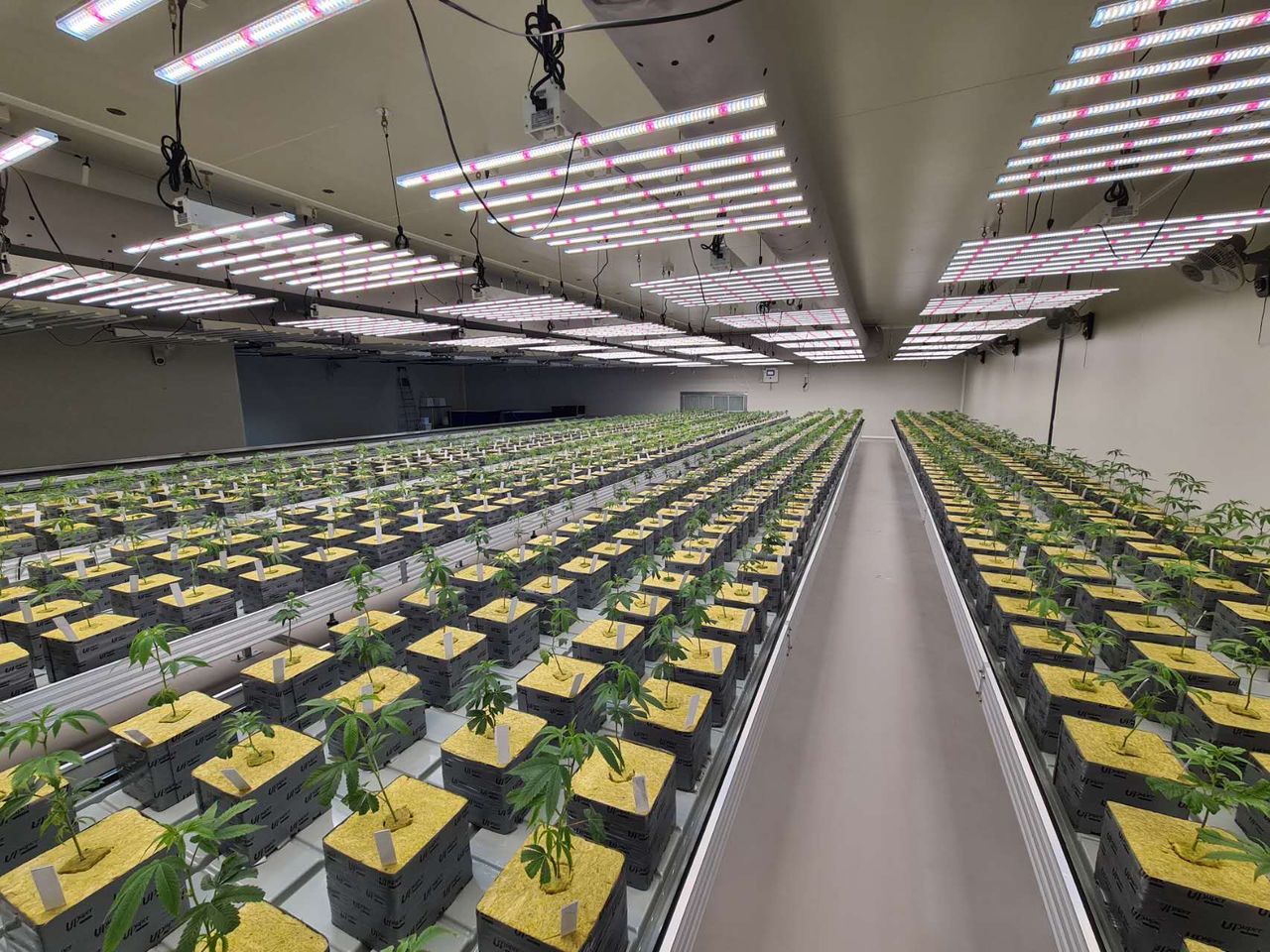
Diodes. Samsung LED packages are binned by output and forward voltage. A tighter bin at the same nominal wattage gives more micromoles per joule and less unit-to-unit variation, which matters when a room is laid out on a calculated PPFD grid and every position has to hit the same target. Cheaper bins exist and are sold as the same wattage; the wattage is the least informative number on the label.
Driver. A Sosen driver is a known quantity with a published dimming curve, a defined minimum output and a warranty that a distributor will honor. An unbranded driver can be identical on a spec sheet and unknown at year four, when a room of fixtures starts dropping out one at a time and the cause is a $30 component inside a $200 housing.
Build and thermal path. Heatsink mass, thermal interface, IP rating, connector quality and the folding structure all scale with price. A fold-out frame costs more to make than a rigid panel of the same coverage, and it pays that difference back in freight volume, which is a cost the buyer sees only when the crate is measured.
Warranty length. Our standard build carries three years. A lower-specification build with a two-year warranty is cheaper, and it is a legitimate product rather than a trap: for a short-cycle room, a backup position, or a grower who replaces fixtures on a technology cadence, two years of coverage on a fixture under $200 can be the better trade. What is not legitimate is a two-year build sold as a three-year one, which is why the warranty wording belongs in the quote and not in a conversation.
Where the 4x6 class lands. A 4x6 ft, 1,000W fixture on the lower-specification two-year build comes in under $200, which surprises buyers who assume more coverage always means more money. It does not, because coverage and build specification are two different axes: the 4x6 frame spreads a similar photon package over more area, and the lower-specification electronics carry a shorter warranty. Above this band sit higher-output and higher-efficacy configurations, including models built around a specific spectrum or a specific controller ecosystem; those are quoted per project because the variables stop being comparable in a table. Both directions, the lower-specification build and the higher configurations, are quoted rather than published: tell us the room and the budget through our request-a-quote form, and the configuration options at both ends come back on one quote.
Why a 1,600W Fixture Does Not Cost Twice a 600W Fixture
Buyers moving from a 4x4 canopy to a 4x8 canopy expect the price to double with the wattage, and it does not, for reasons that are worth understanding before a quote arrives. Price scales with three things that move at different rates: the photon package, the metal, and the paperwork.
The photon package scales roughly with output. More diodes, a larger driver and a bigger heatsink cost more, close to linearly with wattage. This is the part of the price that behaves the way buyers expect.
The frame and the housing do not. A 1,200W to 1,600W fixture uses more aluminium, but it uses one extrusion, one set of end caps and one assembly process, not two. Fixed costs spread over more output, which is why the price per watt falls as the class rises, and why a large fixture can be the better value per micromole even when its invoice is larger.
The paperwork is per model, not per watt. Safety testing, photometric measurement, a DLC listing and the packaging design are costs attached to a model number. A 4x8 class fixture carries roughly the same compliance cost as a 4x4 class fixture, which is a larger share of a cheaper product and a smaller share of an expensive one.
Shipping volume scales worst of all. A 4x8 ft rigid panel occupies volume out of proportion to its photon output, which is why the folding frame exists and why freight on the largest class is the line that most often changes a landed-cost comparison. A 4x6 ft fixture folds the same way a 4x4 does, and folding cuts the crate volume of both, but a folded 4x6 still ships bigger than a folded 4x4. What the folding frame buys is the difference against a rigid panel of the same coverage, not parity with the smaller class.
Our 4x8 class sits in the 1,200W to 1,600W band, and we quote it per project rather than publishing a band, because at that size the spectrum, the driver configuration and the controller ecosystem change the specification more than the wattage does. If a published band is what you need for a first-pass budget, use the 4x6 class as a floor and the 4x4 class price per watt as a ceiling estimate, then replace both with a quote before committing capital.
Per Fixture, Per Room, Per Facility
Single-fixture prices are the least useful number in a budget, because nobody buys one. The same band multiplied by the fixture count of a real room is what a buyer actually signs for, and the multiplication is where the factory-versus-retail gap becomes large enough to change a decision.
| Scale | Fixtures | Factory direct, EXW | US-brand retail |
|---|---|---|---|
| One fixture | 1 | $168 to $268 | $699 to $1,299 |
| 24-light flowering room | 24 | $4,032 to $6,432 | $16,776 to $31,176 |
| 96-light multi-room facility | 96 | $16,128 to $25,728 | $67,104 to $124,704 |
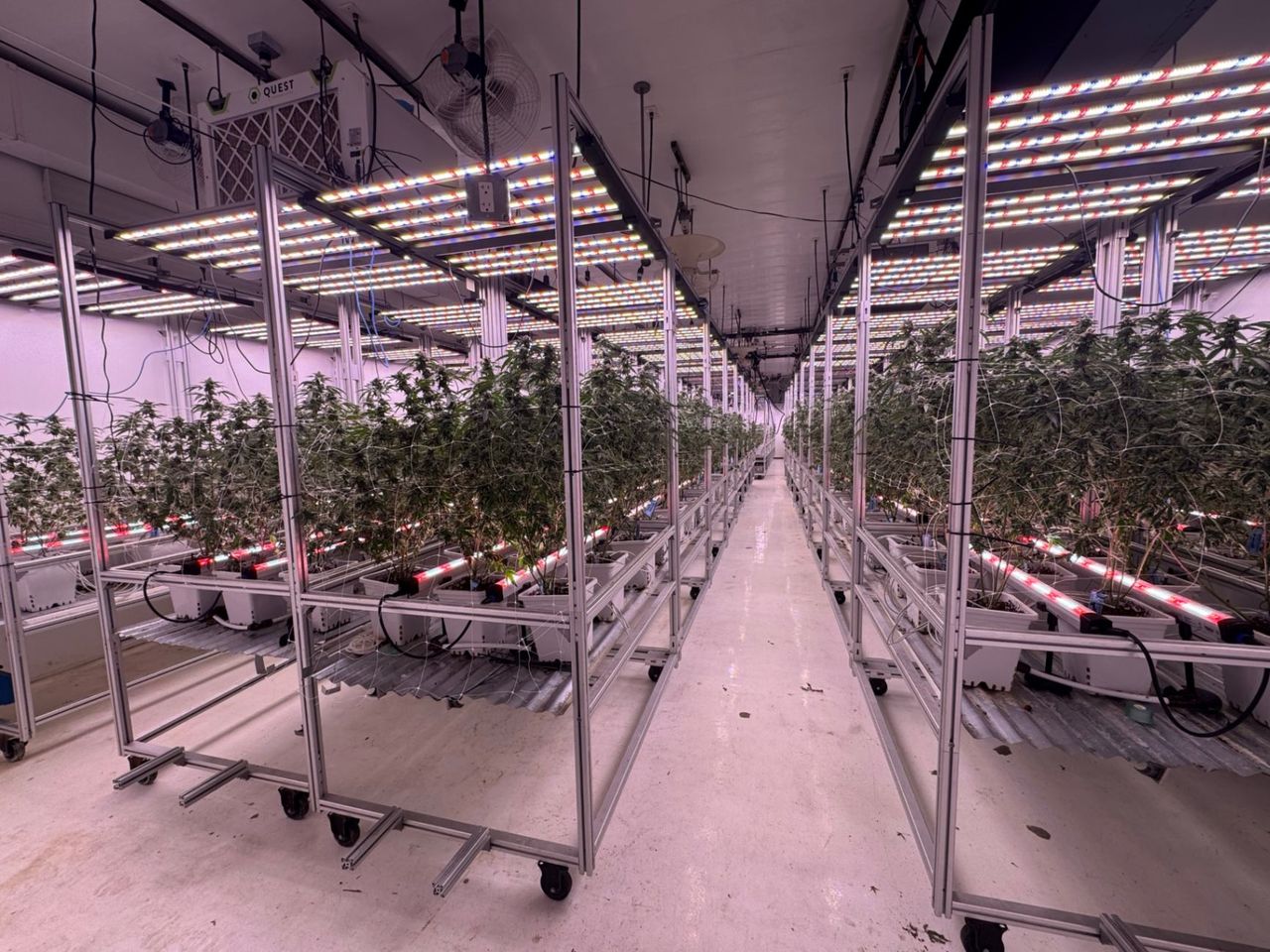
The arithmetic behind that table is plain multiplication, and it is worth doing once by hand so the scale of the gap stops being abstract. Twenty-four fixtures at $168 is $4,032; at $268 it is $6,432. The same twenty-four at retail is $16,776 to $31,176. A 96-light facility multiplies those figures by four again: $16,128 to $25,728 from the factory against $67,104 to $124,704 at retail.
Now the honest correction. The facility that imports does not pocket the difference. It pays freight, duty, brokerage, inland delivery, a panel upgrade if the service cannot carry the new load, controllers, mounting hardware, and its own labor for receiving and installation. Those costs are real, and on a first container they can surprise a buyer who budgeted only the invoice. What remains true is that the gap is wide enough that even after all of it, the imported path usually lands below the shelf price, and the buyer who plans the extra lines in advance is the one who captures that difference instead of discovering it.
The practical instruction is simple: ask for three numbers before you compare anything. The EXW price per fixture, the freight quote for the actual volume and weight, and the duty rate your broker confirms for the classification. A quote that gives you one of the three is not a price, it is an opening.
What the Price Does Not Include
Every commercial lighting budget that goes wrong goes wrong in the same place: the line items nobody quoted. They are predictable, which means they can be planned, which means they stop being surprises.
Electrical capacity. A room that ran high-pressure sodium on a 200-amp service may not carry the same coverage on LED without a panel change, and the panel change is a licensed electrician's invoice, not a lighting invoice. Calculate the new connected load from the fixture wattage and the circuit layout before the lights are ordered, not after they arrive.
Controllers and dimming hardware. A smart controller is $75 to $100 from the factory, which is small against a room of fixtures and large against a budget that did not include it. Add the low-voltage cable, the routing, and the labor to commission the schedule.
Mounting and rigging. Unistrut, aircraft cable, gripples, spreader bars and the labor to hang a grid are a per-fixture cost that scales with ceiling height and with how level the structure is. A folding fixture changes the crate, not the rigging.
Spares and the first failure. A commercial room should hold a small number of spare drivers and one spare fixture, because a single dark position in a flowering canopy is a yield problem in a specific square metre. Budget for it at purchase, when the freight is already moving, rather than at failure, when it is not.
Installation labor and commissioning. Hanging, wiring, addressing controllers, verifying the PPFD grid and documenting the schedule take person-days per room. This is the line most often left out of a lighting budget and most often the reason a project runs over.
The Electricity Line, Which Scales With Hours
Here is the number that reorganizes the whole budget. Take a 700W fixture, a flowering year of 4,380 hours, and a tariff of $0.12 per kWh. The fixture draws 3,066 kWh a year and costs about $368 a year to run. Over five years that is roughly $1,840 in electricity for a fixture that cost $168 to $268 at factory price.
The ratio is the point. The purchase price is a one-time number that a buyer negotiates hard over, and the electricity is a repeating number that most buyers never negotiate at all, because it arrives as a utility bill rather than as a quote. A fixture that costs $100 more but delivers 10 percent more micromoles per joule can be the cheaper fixture within two or three flowering years, and a fixture that costs $100 less can be the expensive one for as long as it runs.
The sensitivity is worth seeing directly, because tariffs vary more than fixtures do. The same efficiency gap priced at $0.10, $0.15 and $0.25 per kWh produces very different annual penalties per fixture, and the difference between the first and the last is larger than the price spread within a wattage class. A room in a high-tariff market should be buying efficacy; a room in a low-tariff market with cheap capital can reasonably buy coverage.
This is also why the useful comparison metric is not dollars per fixture but dollars per micromole per second. Price divided by output puts a $168 fixture and a $268 fixture on the same scale, and it is the only scale on which a cheap fixture and an efficient fixture can be compared without arguing about wattage. The method is worked through in our guide to efficacy in micromoles per joule.
LED Against HPS: Where the Price Difference Pays Back
Most commercial buyers searching this question are not choosing between two LEDs. They are deciding whether to replace high-pressure sodium, and the number they want is the payback period on the difference.
Work it with the assumptions stated openly. A double-ended HPS system and an LED fixture covering the same canopy differ by roughly 409W at the wall for the same photon delivery. Across 4,380 flowering hours that is about 1,790 kWh a year, or roughly $215 a year per fixture at $0.12 per kWh. Against a capital difference of about $600 per fixture, the simple payback is close to 2.8 years, before any HVAC saving that follows the same watt reduction and before any utility rebate.
That arithmetic belongs to a specific tariff and a specific hour count, and it moves when either moves. It also ignores the parts a spreadsheet handles badly: an HPS room needs lamp and reflector replacement on a schedule, its radiant heat is either a load on the cooling system or, in a cold climate, a substitute for heating that an LED room has to buy back. Buyers in genuinely cold spaces should add the supplemental heat to the LED side before comparing, because a heat pump working harder can erase an efficiency advantage that looked unambiguous on paper.
Rebates: The Part of the Price Somebody Else Pays
In several US markets a commercial LED installation can recover part of its fixture cost through a utility incentive, and the qualifying mechanism is usually a listing on the DesignLights Consortium Qualified Products List. The published rebate bands in major cannabis markets run from roughly $50 to $150 per fixture for qualifying commercial LED installations, which on a 96-light room is a five-figure offset.
Two cautions keep that from becoming a bad decision. The first is sequencing: most programs want the application approved before the fixtures are purchased, and a room bought first and submitted later frequently loses the incentive. The second is verification: a listing belongs to a specific model, not to a brand or a wattage class, so the thing to ask for is the QPL listing ID for the exact model on the quote. A fixture that is not listed is not a bad fixture; it is a fixture whose rebate you are choosing to forgo, and that belongs in the comparison as a cost.
We keep our certification files, including the DLC listing documentation for listed models, available on request with a quote. The certifications we hold, and the documentation we can send with a quote, are listed on our certifications page.
Why a Lower Price Can Cost More
The cheapest fixture in a category is rarely the cheapest way to light a room, and the reasons are specific enough to check on a quote rather than argue about in general.
Efficacy sold as wattage. Two fixtures at 720W can differ by 25 percent in photon output. The lower one needs more fixtures to reach the same PPFD, which means more fixtures, more circuits, more rigging and more heat for the same canopy, and the price advantage disappears at the layout stage.
Driver quality. The driver is the component most likely to fail and least likely to be discussed. Ask for the brand and the model, not the wattage. A driver with a defined dimming floor and a published curve can be commissioned and serviced; an anonymous one is replaced as a unit.
Warranty administration. A three-year warranty from a factory means a replacement part ships from a factory. A three-year warranty from a brand with local stock means a fixture is on site this week. Both are three years; they are not the same product, and the difference is priced into the retail figure you were comparing against.
Missing certification and documentation. A fixture without the safety file, the photometric report and the listing ID cannot be permitted, inspected or rebated in many jurisdictions, which converts a cheap fixture into a room that cannot open on schedule.
Freight discovered late. A rigid 4x6 fixture and a folding 4x6 fixture have the same coverage and very different crate volumes. Freight is charged on volume and weight, so the folding frame is not a convenience feature; it is a line in the landed cost that a buyer sees only when the forwarder measures the pallet.
The Twenty-Minute Budget: Sizing Your Own Room
Before asking for a quote, build the number yourself. It takes about twenty minutes, it makes every subsequent conversation shorter, and it produces a budget band rather than a single figure, which is what a plan actually needs.
Step one: map coverage to wattage. Our own sizing follows the canopy, not the room's floor area. A 4x4 ft canopy sits in the 600W to 1,000W class. A 4x6 ft canopy sits in the 1,000W to 1,400W class, with the 1,000W lower-specification build available under $200. A 4x8 ft canopy sits in the 1,200W to 1,600W class. These are starting bands for a flowering canopy at a commercial PPFD target, not a rule that replaces a layout.
Step two: count positions. Divide the canopy into coverage blocks and count them, then add the positions your layout needs for walkways, aisles and uneven structure. A 24-light room is not 24 blocks of perfect geometry; it is 24 positions that fit a real building.
Step three: multiply by the price band. Positions times the factory band gives a hardware budget. Do the same multiplication at the retail band to see what the same room costs bought locally, and put both numbers in front of whoever signs.
Step four: add the lines that are not fixtures. Controllers at $75 to $100 each, cable, rigging, panel work, installation labor, spares. A useful habit is to add these as a percentage of the hardware figure and then replace the percentage with real quotes as they arrive.
Step five: add the first year of electricity. Wattage times hours times tariff, per fixture, then multiplied by the room. This is the number that decides whether the cheaper fixture was cheaper.
What a Quote Should Contain
A quote is a document, not a message. The difference between a supplier who can be compared and one who cannot is whether the document below exists, and asking for it costs nothing.
| # | Ask for this in writing | Why it changes the number |
|---|---|---|
| 1 | Incoterm and, if not EXW, the named port | EXW, FOB and CIF place different costs on different sides |
| 2 | Per-fixture price at your actual quantity | A single-unit price is not a room price |
| 3 | Driver brand and model | The component most likely to fail and least likely to be quoted |
| 4 | Diode bin and efficacy, with the photometric report | Wattage does not tell you photons per joule |
| 5 | QPL listing ID for the exact model | A rebate belongs to a model number, not to a brand |
| 6 | Warranty length and what it covers | Two years and three years are different products |
| 7 | Lead time, packing dimensions and weight | Freight is charged on volume and weight, not on coverage |
| 8 | Certification files for permitting | A missing file can hold a room's opening date |
If a supplier cannot answer these eight in writing, the price is not comparable to anyone else's, and the cheapest-looking number in the inbox is the one with the most unknowns behind it. The same discipline applies when the answer is ours; we would rather send a longer document than a shorter price.
Three Budgets, Three Rooms
The same price band produces three different decisions depending on what the room is for, and it is worth naming them because buyers frequently compare across categories by accident.
A single 4x4 or 4x8 room. Here the fixture count is small, the freight is a crate rather than a container, and the dominant cost is the first year of electricity and the panel work. Buy the highest efficacy the budget allows, buy one spare driver, and do not spend the difference on a controller with more channels than the room will ever use.
A 24-light flowering room. This is where the factory band starts to matter and where the quote discipline starts to pay. At this scale the difference between $168 and $268 per fixture is $2,400 across the room, which is a controller, the rigging and a spare fixture. It is also the scale at which a mixed order, top lights plus under-canopy bars plus one controller, becomes worth negotiating as a single shipment.
A 96-light, multi-room facility. At this scale the purchase is a capital project with a schedule, and the price is only one of four variables that decide it: price, lead time, certification documentation and spare-parts availability. A facility that saves $10,000 on fixtures and loses three weeks of flowering schedule has not saved money, and a facility that cannot produce listing IDs for its rebate application has left a five-figure offset on the table.
Frequently Asked Questions
How much does a commercial grow light cost per fixture?
In the 4x4 ft class, 600W to 1,000W with Samsung LEDs and a Sosen driver, our factory price is $168 to $268 per fixture, EXW, on a standard build with a three-year warranty. Comparable fixtures at US retail run $699 to $1,299. A 4 ft under-canopy bar at 120W is $35 to $59, and a smart controller is $75 to $100.
Why are factory prices so much lower than US retail prices?
Two separate gaps stack here. The EXW factory price leaves out ocean freight and duty, in-country warehousing, distributor and retail margin, warranty administration and local support, and marketing, which in this category is often the largest single line. And the delivered factory price stays below retail as well: a DDP quote from the factory includes freight, duty and customs clearance, and usually still lands under the shelf price, because the factory buys freight on contracted forwarder rates a single buyer cannot access, and because it carries one margin where the retail chain stacks several. Retail runs roughly four to five times EXW in the 4x4 class; against DDP the multiple is smaller, but the direction is the same.
Is the factory price the price I actually pay?
The factory price shown here is EXW: the fixture leaves our floor, and the freight, duty, brokerage and inland delivery are added from there. It does not have to be the number you work with. Ask for DDP and the quote arrives at your door with the freight, the duty and the customs clearance inside it. Request both on one document, EXW and DDP to your actual destination, and compare the DDP figure against your local shelf price, because that is the comparison that decides the purchase.
How much does it cost to light a 24-light flowering room?
At the 4x4 ft factory band that is $4,032 to $6,432 for the fixtures, against $16,776 to $31,176 for the same twenty-four at US retail. Add controllers at $75 to $100 each, cable, rigging, panel work, installation labor and spares, then add the first year of electricity, which is the line that most often exceeds the fixture budget.
Does a longer warranty cost more?
Yes, and the difference is legitimate rather than suspicious. Our standard build is three years. A lower-specification build with a two-year warranty is cheaper: a 4x6 ft, 1,000W fixture on that build comes in under $200. Two years of coverage on a short-cycle room or a backup position can be the better trade; what matters is that the warranty length is written on the quote rather than assumed.
How much does the electricity cost per fixture per year?
At 700W, 4,380 flowering hours and $0.12 per kWh, about $368 per fixture per year, or roughly $1,840 over five years. That is several times the factory price of the fixture, which is why efficacy matters more than the invoice in any room that runs on a normal flowering schedule.
How long does an LED take to pay back against HPS?
At a 409W difference per fixture, 4,380 flowering hours, $0.12 per kWh and a capital difference near $600 per fixture, the simple payback is about 2.8 years, before HVAC savings and before any utility rebate. The number moves with your tariff, your hours, and whether the room needs supplemental heat once the radiant load from HPS is gone.
Can a utility rebate reduce the fixture cost?
In several US markets, yes, typically $50 to $150 per fixture for qualifying commercial LED installations, but only for listed models and usually only when the application is approved before purchase. Ask for the QPL listing ID for the exact model on the quote; a listing belongs to a model, not to a brand or a wattage class.
Is a cheaper fixture with the same wattage a good deal?
Only if it delivers the same photons. Two 720W fixtures can differ by 25 percent in output, which changes how many fixtures a room needs, how many circuits it draws and how much heat the cooling system removes. Compare dollars per micromole per second rather than dollars per watt, and ask for the photometric report that supports the claim.
Do under-canopy lights add much to a lighting budget?
Less than most buyers expect. A 4 ft, 120W bar is $35 to $59 at factory price against $80 to $249 at US retail, and under-canopy lighting typically runs at roughly a quarter of the top-light wattage. On a large room the bars are a small line; the labor to hang and wire them is often the larger one.
Can I get a better price on a larger order?
Usually yes, and for three specific reasons. Materials bought for a batch cost less than materials bought for a few units, because the factory can procure diodes and drivers at volume. A production run of one model does not stop and restart, so line efficiency is higher on a hundred fixtures than on ten. And freight per fixture falls with volume: one fixture ships as part of a pallet, while a full container spreads the same ocean crossing across every fixture inside it. Send the fixture count and the destination, and ask for a quote at that volume rather than asking for a discount on a single unit.
What should I check before paying a deposit?
Eight things in writing: Incoterm and named port, per-fixture price at your quantity, driver brand and model, diode bin and efficacy with a photometric report, QPL listing ID for the exact model, warranty length and what it covers, lead time and packaging dimensions, and the certification files you will need for permitting. A quote that omits any of them is not yet comparable to another quote.