
Why an Uninterrupted Dark Period Decides Flowering
Cannabis is a short-day plant, which is really a misnomer in one direction: what the crop measures is the length of the night, not the day. The receptor doing the measuring is phytochrome, a pigment that flips between two forms under red and far-red light and slowly converts back in darkness. A leaf that spends the daylight hours under a light with a high red fraction carries a large load of the active form, and the night is what drains that load down. When the night is long enough and dark enough, the drain completes, the flowering signal builds, and the crop commits to reproduction. Our grow room terms page carries the pigment definitions; here the point that matters is the drain.
Two properties of that system set up everything else on this page. First, the drain takes hours, so the signal is about duration: breeders and researchers describe a critical night length, and once the night clears it, flowering proceeds. Second, the drain can be reset. Photons absorbed at any point in the night push the pigment back toward the active form, and the drain starts over. That is why a leak is qualitatively different from a shortfall in daylight. Missing daylight costs the crop energy. A leak at midnight costs the crop the night itself.
Phytochrome is not the only receptor involved. Cryptochrome, the blue-light family, feeds the same timekeeping machinery and responds to the kind of cool-white work lighting many rooms run for convenience. The blue pathway matters less to the flowering signal than the red one, but it is one more reason that a dark period is defined by photons rather than by the absence of anything a person would call bright.
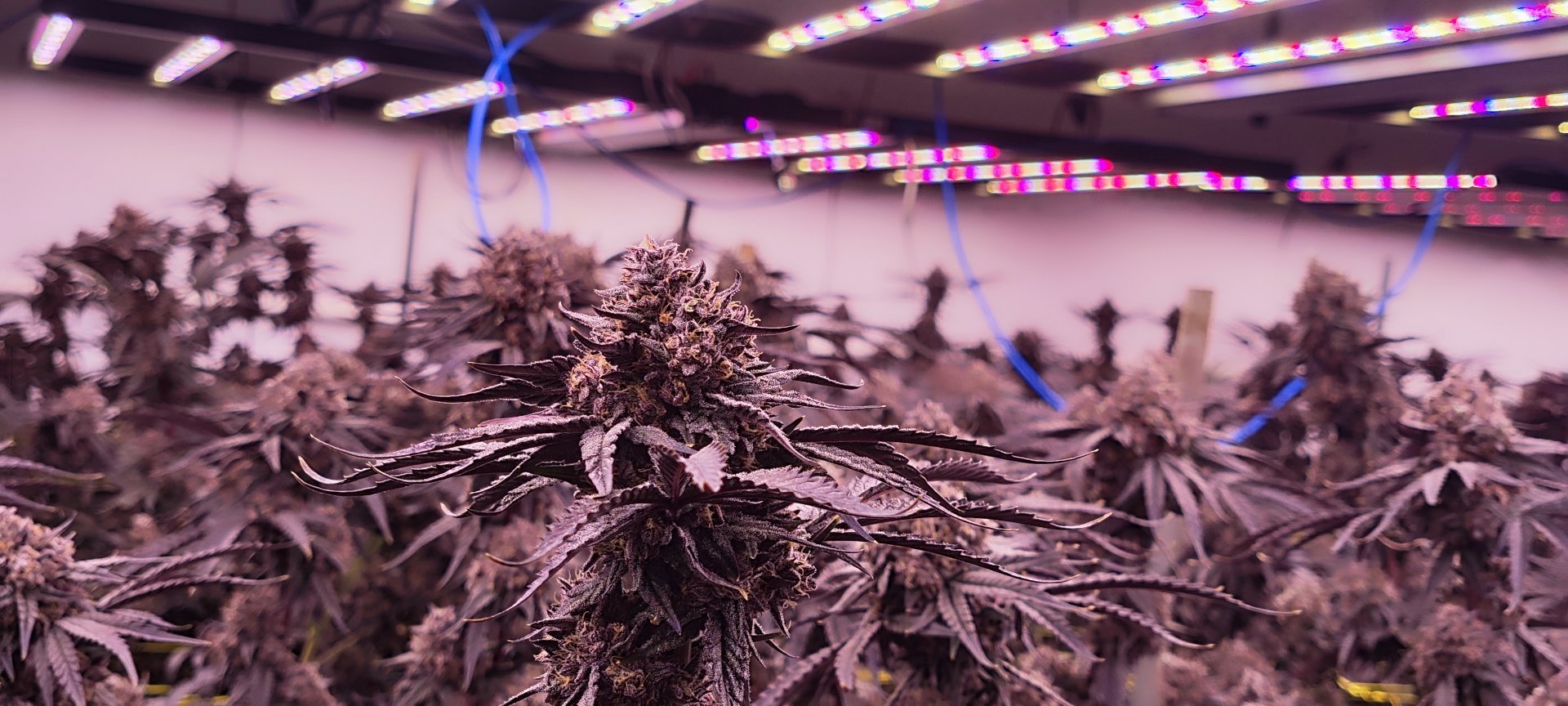
The room this whole page is about looks like this with the lights on: a full flower canopy under LED bars, banking photons by the mole. The night is when the same canopy is supposed to be counting in nanomols, and everything that follows is about keeping that count honest.
The Threshold: Ten Nanomols
The cleanest dose-response work on this question is a 2025 study from Utah State University published in Environmental and Experimental Botany by Eckels and Bugbee. Three soybean and seven cannabis cultivars were grown on a 12/12 schedule and exposed, across the whole dark period, to night lighting from 0 to 150 nmol/m²/s in two colors: red at 658 nm and cool white at 6,500 K. The design was built to test a mechanism, not to rank products: red and white were chosen because they drive the phytochrome system to different operating points, and the plants responded the way that mechanism predicts.
The headline number is small beyond intuition. The most sensitive cultivars of both species responded to a photon flux of 0.01 µmol/m²/s, which is ten nanomols. One cannabis cultivar in the trial delayed flowering by thirteen days under red night light at that level, and the most sensitive soybean lost 7.1 days. Three responses showed up across the trial: flowering arrived late, inflorescence development ran slower, and plants stretched taller. None of those is a visible disaster on the day it starts, which is exactly why the problem goes undiagnosed; a room can run a cycle with a leaking door and read the damage as cultivar behavior or a humidifier tuning issue.
Color mattered in the direction the pigment chemistry predicts. Red night light, which drives the phytochrome photoequilibrium to 0.87, disrupted flowering one and a half to two times more than cool white at 0.57. That is the mechanism confirming itself: the closer the leak mimics what the pigment responds to, the more night it destroys per photon.
Sensitivity varied enormously between cultivars. The tolerant ones kept flowering on schedule under levels that wrecked the schedule of the sensitive ones, and the authors connect that to critical night length: a cultivar that needs a shorter night has more margin before a leak matters. The design consequence is uncomfortable and worth stating plainly. A room is not protected because the cultivar you ran last cycle shrugged. The threshold that matters is the most sensitive genotype you will ever run through the room, and you will usually meet it after the lease is signed and the seeds are bought.
Why the Industry Safety Figure Is 150 Times Too Loose
Ask around, and the number that comes back is one to two µmol/m²/s: forum posts, grow-store counter advice and more than one equipment manual put the safe ceiling somewhere in that band. The figure is not invented, but it is borrowed from the wrong experiment.
Its origin is night-interruption research on long-day plants, where the goal is the opposite of ours: a grower delivers a pulse of light in the middle of the night precisely to prevent flowering, for example in a late-sown bedding crop. A 2014 comparison trial in HortTechnology is typical of that literature: night-interruption treatments averaged 1.5 to 1.8 µmol/m²/s of red plus far-red light, and plants simply placed in positions receiving at least 0.7 µmol/m²/s got the effect. Those numbers are the dose that reliably does something to a plant at night. The industry citation chain flipped the sign: a quantity that was measured as sufficient became a quantity assumed safe.
Against the measured threshold the gap is enormous. Divide the 1.5 µmol/m²/s treatment average by the 0.01 µmol/m²/s sensitivity floor and you get one hundred fifty. A room that passes a checklist built on the borrowed figure can be running a hundred times above the level that delays flowering in the sensitive cultivars on the market today. This single misreading is the most valuable thing on this page, because everything else follows from correcting it: the audit gets harder, the leaks get smaller, and green light stops being an automatic exemption.
The Same Photons Are Nothing as Energy and Everything as Signal
Here is the comparison that makes the threshold believable, because at first sight ten nanomols sounds like a typo. Take the room we use as the worked example across this cluster: 30 by 40 feet, 1,200 square feet of canopy, 900 µmol/m²/s on a 12/12 schedule. That is a flowering DLI of 38.9 mol/m²/day, the number our PPFD and DLI targets recommend for late flower. Now let a leak deliver exactly the threshold flux, ten nanomols, for the entire dark period. Twelve hours of it adds up to 432 µmol/m² of photons, which is 0.0011 percent of the daylight dose, about one part in ninety thousand. One micromol of continuous leak is 0.11 percent of the day's energy. Ten micromols is barely one percent.
| Continuous night light | Share of the flowering DLI | What the published work shows |
|---|---|---|
| 0.01 µmol/m²/s (10 nmol) | 0.0011 percent | Delays flowering in the most sensitive cultivars tested |
| 0.1 µmol/m²/s | 0.011 percent | Between the threshold and the tested band; response expected in sensitive genotypes |
| 1 µmol/m²/s | 0.11 percent | Inside the dose band of the 2025 trial; strong response in sensitive cultivars |
| 10 µmol/m²/s | 1.1 percent | Approaching the top of the tested band; not a defensible night condition for flower |
| 900 µmol/m²/s (the day side) | 100 percent | The photon supply the crop is being paid in |
Percentages are arithmetic on the worked room: 900 µmol/m²/s for 12 hours gives a DLI of 38.9 mol/m²/day, and each night-light row is that flux held for the 12-hour dark period. Dose-response attribution is from Eckels and Bugbee 2025, which tested 0 to 150 nmol/m²/s.
Read the middle of that table again, because it is the whole reason this topic generates arguments. A leak that is energetically invisible, one part in a thousand of the daylight budget, is pharmacologically active as a signal. Energy and information are different currencies, and the night trades in information. Nothing about how small a number feels tells you whether it is biologically active.
Where Leaks Actually Come From
Walking a dark room with an adapted eye and a camera turns up the same short list almost every time. The taxonomy below is ordered by how often each source explains a mystery, and the strength column is deliberately honest about how little is known: only one row in it has a published cannabis-specific measurement, and it is not the one people argue about.
| Source | Where it hides | Strength | What closes it |
|---|---|---|---|
| Status LEDs and displays on drivers, controllers and climate equipment | Behind fixtures, at chest height on electrical walls | Single-digit milliwatt emitters; distance-dependent | Night modes, shrouds, physical masks, relocation |
| Door edges, sweeps and frame gaps | Corridor side, easiest to see after full adaptation | Whatever the corridor is running | Seals, sweeps, light traps, a dark vestibule |
| Penetrations: conduit, pipe, duct, glazing | Sealed once at commissioning and forgotten | Ambient glow, steady | Dedicated light-trapped ports, opaque sealant |
| Near-infrared cameras and IR illuminators | Corners, aimed across the canopy | About 25 µmol/m²/s at one metre, measured | Distance, repositioning, lens shrouds |
| Timers, contactors and manual overrides | The electrical room and the schedule itself | The entire photoperiod, applied at the wrong hour | Interlocked scheduling, logged overrides |
| Adjacent rooms and shared corridors | Glazing, transoms, observation windows | Second-hand light from someone else's schedule | Scheduling agreements, partitions, opaque glazing |
| Moonlight through glazing | Roofs and windows | Roughly 2–6 nmol/m²/s, below the threshold | Not a threat; listed so it stops being blamed |
The camera row is the only one with a cannabis-relevant published measurement: Kusuma and colleagues 2021 put a consumer security floodlight at about 25 µmol/m²/s one metre from the source. The moonlight row is a derived estimate from illuminance conversion, not a measurement. Timer-driven errors are an electrical-integrity topic our lighting load and demand charges guide covers from the billing side.
Two rows in that table deserve a second look because they are invisible to every instrument the room already owns, and they get their own sections below: the infrared row and the indicator-light row.
Whether an Indicator Light Matters Depends on Distance
The smallest leaks are point sources: a power LED on a driver, a display on a dehumidifier, the standby glow on a controller. Whether one of these is a leak or a distraction is pure geometry, and the arithmetic is simple enough to carry in your head. A one-milliwatt red indicator emits about 5.5 nanomols of photons per second at 660 nm. Spread over a sphere, that flux thins with the square of distance, and the threshold line sits where the flux falls to ten nanomols per square metre per second.
The practical reading is not that every LED is a crisis. It is that proximity is the whole game: an indicator across the room is below the line by an order of magnitude or more, and the same indicator zip-tied to a trellis post above a bud site is over it. Inventory the room for emitters within arm's reach of the canopy first, and treat the rest of the LED population as a checklist item rather than an emergency.
Green Light at Night: Why the Practice Works
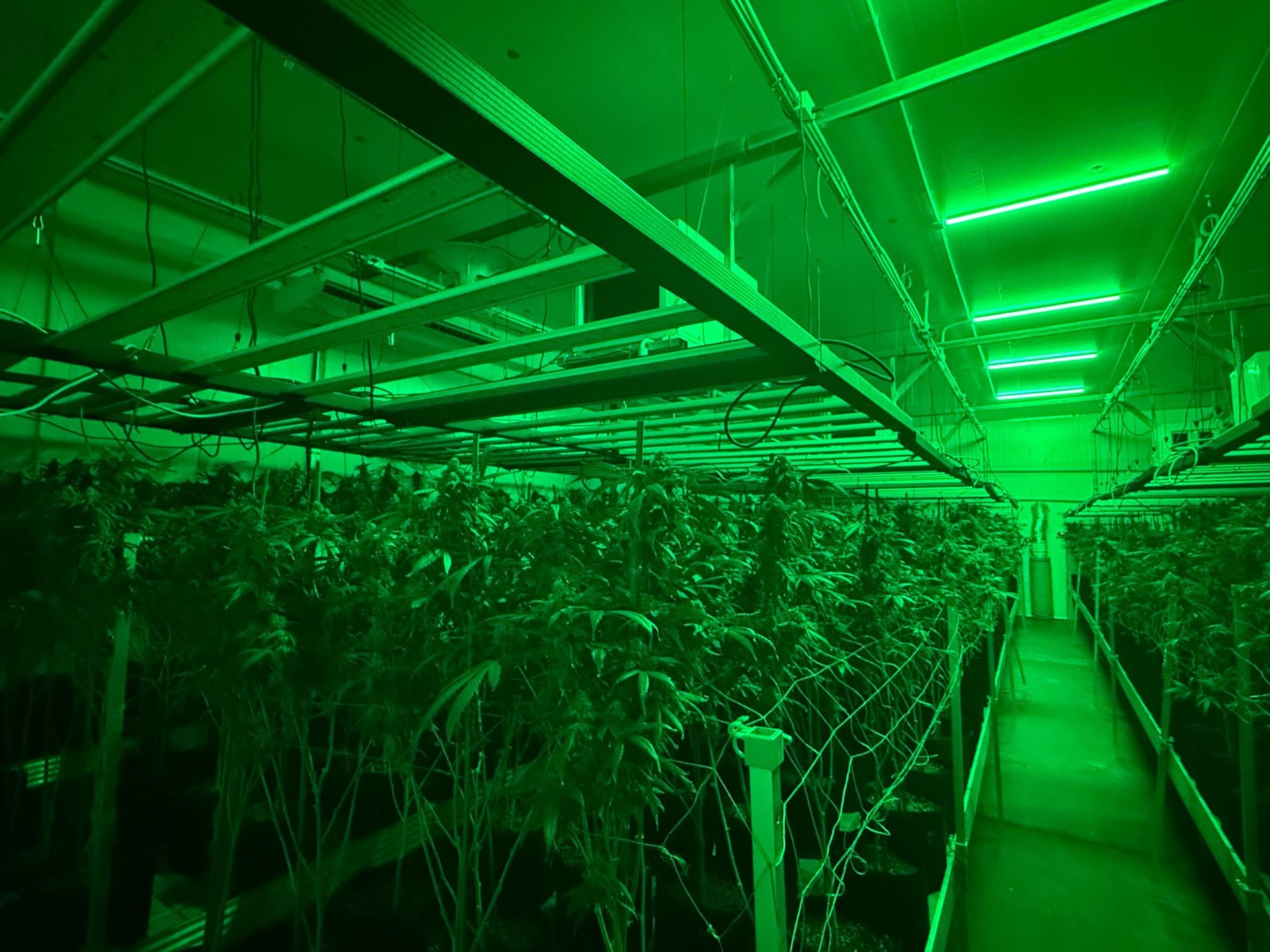
Walk a licensed facility at night and the working light is green: tube fixtures or headlamps that let a crew scout, spray or harvest a room without, in the intended logic of the practice, disturbing the photoperiod. The practice is standard across the industry, it is what we see in customer rooms, and the picture below is what it looks like at ceiling height in a working flower room.
The physics behind the practice stacks two discounts, and both are real measurements. The first is on the human side: the eye is most sensitive near 555 nanometres, in the green, so a green lamp produces a bright working environment while delivering far fewer photons than a red lamp would at the same apparent brightness. The second is on the plant side: the phytochrome system barely absorbs green. In the standard relative-conversion table published by Sager and colleagues in 1988, green at 550 nm converts the pigment at about five percent of the efficiency of red at 650 nm, where the response peaks. Two discounts of roughly twenty times each compound to something on the order of two full orders of magnitude, and that is why green work lighting has a fair claim to being the least-disturbing choice a night crew can make.
Two honesty notes belong right here, because this is where most writing on the topic either oversells or panic-sells. First, no published study has put green work lighting over a flowering cannabis crop and measured the outcome. The practice rests on the pigment arithmetic above and on a large body of grower experience, not on a cannabis-specific trial, and the page says so rather than pretending otherwise. Second, green is not invisible to the plant. Five percent is not a number that rounds to nothing; green photons reach the phytochrome system, and green light in the daylight hours is known to penetrate a canopy deeper than red, which is part of why it earns its place in spectrum discussions on our spectrum guide. A property that carries light deep into a canopy by day does not stop being true at night.
So the working position is neither of the two extremes the internet offers. Green light is not a magic exemption, and it is not a hazard to be banned. It is the best tool for the job, and the job is done well when the crew treats irradiance, distance and duration as the actual criteria. In order of how much they matter: run the lowest output the task allows, keep fixtures mounted high and aimed down the aisles rather than across the canopy, keep visits purposeful rather than lingering, and never assume that a color label does the engineering for you.
The discipline that keeps the practice honest, in the order a crew feels it:
- Lowest output that lets the task happen. Bright enough to work safely is the target; brighter is a guess, and the guess is what shows up in the flowering date.
- High mounting, aisle aim. Fixtures belong at ceiling height over walkways, the configuration in the photo above, not clamped low over the canopy.
- Purposeful visits. A five-minute scouting pass and an hour of lingering pruning are different exposures, and the crop only ever sees the sum.
- Fixed fixtures earn a measurement. A green fixture that burns through every dark period of every cycle is a decision that deserves a verification, not a habit carried over from the last facility.
Near Infrared: The Leak You Cannot See
Everything so far concerns light a person can see. The stranger half of the problem is light nobody in the room can see, and it is not hypothetical. A 2021 study in PLOS ONE by Kusuma, Westmoreland, Zhen and Bugbee ran near-infrared light at 850 nanometres over the entire daily cycle of flowering cannabis and soybean and watched what happened to the schedule. At 121 µmol/m²/s, cannabis flowering delayed by twelve days, a statistically clear result, and the plants were otherwise indistinguishable to a visitor walking the room, because 850 nanometres is invisible to the human eye.
The mechanism is the tail of the pigment itself. Phytochrome absorbance does not drop to nothing beyond 700 nanometres; it declines, and the far-red tail is exactly the region where the standard reference measurements disagree with each other by large factors, which is its own warning about how well-characterized this band is. The practical translation: the near-infrared that cameras, heaters and some LEDs emit is not invisible to the crop just because it is invisible to you.
The same study measured the consumer-grade version of the problem. A security floodlight with night vision delivered about 25 µmol/m²/s at one metre from the unit, which the authors estimated could delay flowering by a couple of days, and about 1 µmol/m²/s at three metres, which they judged likely too low to have noticeable effects. Distance decides, exactly as it does for indicator LEDs. A camera above a doorway across the room is a different exposure from one clamped over the canopy.
There is also an instrumentation twist that makes infrared leaks special: the quantum sensors rooms use to log PPFD are built to the 400–700 nanometre convention and stop precisely where the problem begins. A room can be running a meaningful infrared flux over its canopy at night while the PAR sensor, the lux meter and the eye all report nothing. The one cheap instrument that does see the band is a camera, which is why the audit below leans on long exposures rather than on meters.
Light Leaks and Hermaphroditism: What the Evidence Supports
No claim in this topic travels faster than this one: a light leak will make your crop hermaphroditic. It has an entire folklore built around it, and it deserves careful treatment, because the direct evidence is thinner than the confidence attached to it.
The one study that went looking is an observational analysis of 403 indoor female cannabis plants published by a University of Guelph researcher in 2024. It used distance from the door as a proxy for dark-period light exposure and asked whether plants nearer the leaking door grew more male flowers. They did not: the regression found no predictive relationship, with distance explaining under two percent of the variation in male-flower counts, and the author was explicit that the actual dark-period light levels were probably too low to test the response to very dim light in the first place. Read that carefully: the study is a null result about one leak proxy at one site, not evidence that light cannot induce male flowers, and not evidence that it can.
The historical work that backs the folklore is real but measures something adjacent. In photoperiod experiments from the 1950s, a substantial fraction of genetically female plants produced staminate flowers when the photoperiod itself was shortened to eight or eleven hours, with the share suppressed at fourteen hours, and cool temperatures before induction pushed the rate up by roughly twenty-six percentage points. Those experiments varied the length of the day and the temperature, not the integrity of a dark period, so they demonstrate that sex expression in cannabis is plastic under environmental stress. They do not demonstrate that a dim leak does it.
The current review literature lands where the evidence does. A 2026 review of hermaphroditism in cannabis lays out the hormonal machinery, ethylene pushing female, gibberellin pushing male, and states plainly that for most environmental stressors the field lacks controlled thresholds. The responsible position for a grower is to manage the two risks separately. The photoperiod signal is the one with a published threshold, and it is what the audit on this page protects. Sex expression is real, is measurable, and is managed primarily through genetics and environment, with light integrity as one input among many rather than as the single proven lever.
| Claim in circulation | Direct evidence that exists | Honest status |
|---|---|---|
| A light leak causes hermaphroditism | One observational study with no dose-response; older work varied photoperiod length instead | Unproven in both directions; treat as a risk factor, not a verdict |
| Night light delays and weakens flowering | Dose-response across seven cannabis cultivars with a measured threshold | Established for continuous exposure down to ten nanomols |
| Green work lights are safe | No cannabis-specific trial; pigment physics supports a large discount | Reasonable practice, honestly labeled as unmeasured |
The 13-Hour Day Works Only When the Night Stays Black
One popular practice needs its premise stated correctly, because it is routinely cited as proof that dark periods are negotiable. A 2024 University of Guelph trial compared a standard 12-hour day against a 13-hour day at 540 µmol/m²/s and found inflorescence yield rising by roughly a third to a half across the two cultivars, with cannabinoid concentration holding or rising and one cultivar showing no flowering-initiation delay while the other lost about a day and a half.
That is a real yield lever, and it comes with the premise attached: the day grew by an hour, and the night was still eleven hours long, and whatever yield was gained came from a larger daylight photon budget, not from spending the night. The night that remains has to be genuinely dark, or the experiment stops being an experiment; a crop held at thirteen hours of day with a leaking eleven-hour night has neither a longer day nor a trustworthy night. Growers considering the practice should read it as an intensification of the dark-period requirement, not a relaxation of it, and pair it with the DLI accounting in our DLI guide.
What a Dark-Period Audit Actually Checks
Audit is the right word for this procedure because it is a compliance activity, not a troubleshooting one: it runs on a schedule, it leaves a record, and it is the same every time. The instrument question comes first, because the audit is only as good as what it can see.
| Instrument | Practical floor | Against the 10 nmol threshold | Verdict |
|---|---|---|---|
| PAR quantum sensor | Roughly 0.1–1 µmol/m²/s | Ten to one hundred times too coarse | Blind at the level that matters |
| Phone lux app | Typically 1–10 lux | The threshold is about half a lux in white light | Blind, and confidently so |
| Calibrated low-light lux meter | Down to hundredths of a lux | Can resolve the threshold band | The one meter that works; few rooms own it |
| Camera, long exposure | Sees what the eye cannot | Finds sources, not precise flux | The workhorse for finding emitters |
The half-lux figure is a derived estimate that converts the ten-nanomol threshold through the luminous efficiency of white light, not a measurement, and it inherits the uncertainty of the spectrum the leak happens to have. Camera exposure is qualitative by nature: it answers where the light is coming from, and the calibrated meter then answers how much.
With instruments settled, the audit itself is a short list, and it works best in this order:
- The adapted-eye walk. Twenty minutes of full darkness before entry, then a slow circuit from the darkest corner outward. A human eye after dark adaptation remains a remarkably good leak finder; what it cannot do is quantify, and it should never be the only check.
- The camera sweep. Long exposures from the canopy height outward, plus one exposure aimed at every corner where anything emits. This is also the only step that sees near-infrared, which makes it the step that catches the security-camera row of the leak table.
- The door and envelope inspection from the corridor side. With the room dark and the corridor lit, walk the seal. This is the reverse of how most people check a door and it is much more revealing, because the corridor does the illuminating.
- The schedule log. Pull the controller history and compare commanded photoperiods against actuals: daylight-saving transitions, manual overrides, timer drift and the night-break settings of a controller inherited from another crop. Our load guide covers the same logs from the billing side.
- The indicator inventory. Every emitter within reach of the canopy gets written down with its distance, and the ones that fail the distance arithmetic get a night mode, a shroud or a new address.
One indirect check comes free in sealed rooms that enrich with CO₂: with photosynthesis stopped, a holding room gains carbon dioxide overnight, and a room whose overnight reading barely moves is exchanging air with somewhere else. That reading is a leak test that the room runs on itself every night, and our CO₂ guide explains its mechanics in full.
Photoperiod integrity is, in the end, a property of the building rather than of any single device. Rooms, doors, corridors, cameras and schedules all contribute, which is why the audit walks the whole envelope instead of staring at a gauge.
Closing the Leaks: What Actually Stops Them
Finding is the easy half. Closing is carpentry and discipline, and the kit is short:
- Light-trapped penetrations. Conduit, pipe and duct entries get dedicated ports with internal baffles rather than a bead of sealant, which cracks and glows again within a year.
- Doors that earn their rating. Sweeps, compression seals and, where the corridor cannot be darkened, a small dark vestibule that acts as a light airlock. A door is a device with a maintenance schedule, not a solved problem.
- Night modes and shrouds on emitters. Most modern controllers and climate equipment can blank their displays at night. What cannot be blanked gets a physical mask or a new home.
- Cameras placed like the lights they are. IR units belong far from the canopy or get mechanical shrouds; the distance arithmetic above is the specification.
- Schedules that cannot drift. Photoperiod interlocks, logged overrides and a quarterly check against daylight-saving changes keep the electrical half of integrity as tight as the physical half.
The summary principle is the one this page opened with: the dark period is the one input you cannot verify with the meters you already own, so the strategy is to close first and verify occasionally, with a camera and, if the budget allows, a low-light lux meter. Rooms that run the audit quarterly stop treating flowering variability as a mystery, because the one silent input has been made visible on paper, if not to the eye.
FAQ
How dark does a flowering room need to be?
Darker than ten nanomols per square metre per second, which is the flux at which the most sensitive cannabis cultivars in the published dose-response work delayed flowering. That level is invisible to the PAR meters most rooms own and sits near the floor of a calibrated low-light lux meter, at roughly half a lux in white light. The practical standard is a room that passes an adapted-eye walk and a camera sweep, with the meter used where it can resolve.
Is green light safe for cannabis in the dark period?
It is the best available choice for night work and it is not a free pass. Green photons reach the phytochrome system at about five percent of the efficiency of red ones, and the eye's peak sensitivity near 555 nanometres means a green lamp looks bright while delivering fewer photons, so the two discounts compound to roughly two orders of magnitude. No published trial has measured green work lighting over flowering cannabis, so the practice rests on that physics and on grower experience, and the discipline is irradiance, distance and duration rather than the color label.
Will a light leak cause hermaphrodite plants?
The direct evidence does not support the confident version of that claim. The one observational study of 403 indoor plants found no relationship between distance from a leaking door and male-flower counts, and the older experiments behind the folklore varied photoperiod length and temperature rather than dark-period integrity. Sex expression in cannabis is genuinely plastic, but it is managed through genetics and environment, with light integrity as one input among many rather than the single proven cause.
Can I use a green headlamp to check plants at night?
Yes, and it is the standard tool for the job. Keep it on its lowest useful setting, keep the beam on the aisle rather than held over a bud site, and keep the visit short. Distance and duration do the work the color only helps with: a headlamp at arm's length over a cola is a very different exposure from the same lamp sweeping a walkway.
Do night-vision security cameras disrupt flowering?
They can, and distance decides. Measured work puts a consumer infrared floodlight at about 25 µmol/m²/s one metre from the unit, an exposure the authors estimated could delay flowering by a couple of days, and about 1 µmol/m²/s at three metres, which they judged likely too low to matter. Near-infrared is invisible to people, to PAR meters and to the eye, so a long-exposure photograph is the honest check on any camera mounted near a canopy.
How long does the dark period need to be for flowering?
Cannabis flowers on a critical night length, and the standard 12/12 schedule gives twelve hours of night against a requirement most cultivars clear with margin. Sensitivity varies by genotype: cultivars that flower readily under long days carry more margin, which is also why cultivar changes can change how a room tolerates its own imperfections. The length matters only together with the darkness; an eleven-hour night that is genuinely dark beats a twelve-hour night that is not.
Can I run a 13 hour photoperiod in flower?
It is a documented yield lever with a strict premise. The published trial ran 540 µmol/m²/s and found inflorescence yield rising by roughly a third to a half across two cultivars, with one delayed about a day and a half in initiation and the other not at all, and the extra yield came from the larger daylight budget. The night that remains is eleven hours and has to be genuinely dark, so the practice tightens the dark-period requirement rather than relaxing it.
How do I find a light leak in my grow room?
In order: twenty minutes of full dark adaptation for anyone doing the walk, a slow adapted-eye circuit from the darkest corner, a long-exposure camera sweep from canopy height that also catches near-infrared, an envelope inspection from the lit corridor side, and a schedule-log review for overrides and drift. In sealed enriched rooms the overnight CO₂ rise doubles as a seal test that the room performs on itself every night.
Do autoflowers need a dark period?
Autoflowering genotypes flower on age rather than on photoperiod, so a leak will not delay their initiation the way it does in photoperiod cannabis. They still respond to the light they receive, and the room standard is usually set by the photoperiod cultivars that share the facility. An autoflower-only space inherits the same discipline because the envelope, the doors and the schedules are shared with the rooms that need them.
Does moonlight interrupt flowering?
Almost certainly not. Full moonlight is in the range of 0.1 to 0.3 lux, which converts to roughly two to six nanomols per square metre per second, below the ten-nanomol threshold the sensitive cultivars responded to, and the estimate is flagged as a conversion rather than a measurement. Moonlight is also the exposure the species evolved with, which makes it a poor candidate for the role some growers assign it when a cycle goes sideways.