
The Short Answer, and Why It Is a Range
Ask five growers how long cannabis takes from seed to harvest and you will get five different numbers, and all five can be correct. The full run is a range because it is the sum of six segments, and only some of those segments are fixed. Germination takes days and is largely out of your hands. Flowering length is written into the cultivar's genetics and cannot be compressed. But the vegetative stage has no built-in clock at all: it runs as long as the grower keeps the light schedule vegetative, and that single choice moves the timeline more than any other decision in the plan.
The honest short answer, then, is three numbers rather than one. Photoperiod plants indoors: 12 to 20 weeks from seed to harvest, with 16 to 18 a common commercial planning figure once turnaround is included. Autoflowers: 8 to 12 weeks, fixed by genetics from germination, with no vegetative dial to turn. And after either number: 2 to 6 weeks more for drying and curing before the product is sellable. Every one of the seventeen ways people search this question, from how long does it take to grow weed to how long until bud appears, resolves into the same three numbers and the same six segments underneath them.
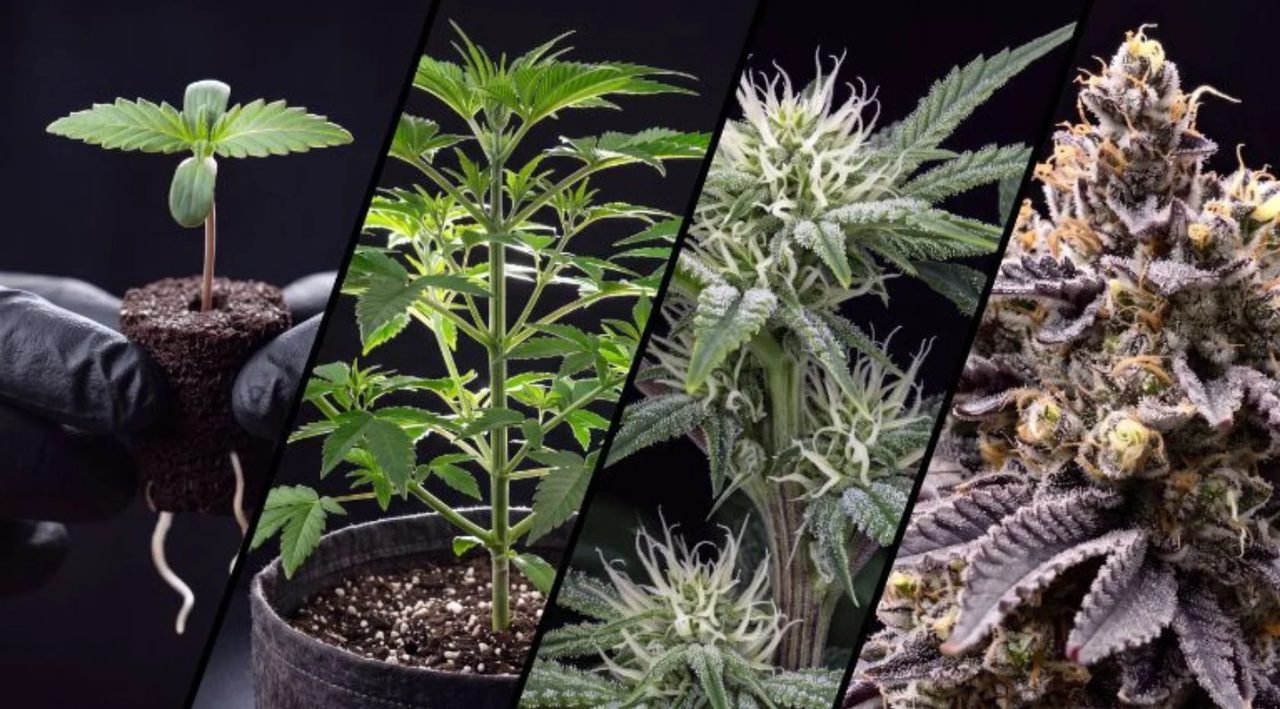
The Stage Clock: Six Segments and Who Owns Each One
The cleanest way to hold the whole timeline is as six segments, each with a typical duration and an owner, meaning whoever or whatever actually decides how long it runs. The durations below are the industry's multi-source consensus band, consistent across the major seed houses and grower references; the owner column is what turns a list of numbers into a planning tool.
| Stage | Typical duration | Who decides the length |
|---|---|---|
| Germination | 1 to 7 days, most seeds 2 to 4 | Seed vitality, moisture and temperature; largely fixed |
| Seedling | 2 to 3 weeks to transplant-ready | Light integral and environment; light is the strongest lever (see below) |
| Vegetative | 2 to 8+ weeks indoors | The grower. Ends when the light schedule flips to 12/12 |
| Flowering | 7 to 14 weeks by cultivar class | Genetics. Indica-dominant roughly 7 to 9, hybrids 8 to 10, sativa-dominant 10 to 14 |
| Drying | 7 to 14 days | Room conditions and load size; process-controlled |
| Curing | 2 to 4+ weeks minimum | Market position and patience; open-ended at the top |
Durations are the consensus band across the major cannabis grower references and seed suppliers, not a single-source figure, and individual cultivars can fall outside it. The owner column is the operationally useful half of the table: two of the six segments are yours, two are the plant's, and two are process control after harvest.
The Only Stage You Own: Vegetative Length
A photoperiod plant flowers when its light schedule gives it longer nights, not when it reaches an age. That makes the flip to 12/12 a decision rather than an event, and it makes the vegetative stage the only segment of the timeline whose length is genuinely chosen. Keep the plant under 18 hours of light and it will keep building structure indefinitely; change the schedule and the countdown to harvest begins on a clock written in the cultivar. Everything else in the plan, the room schedule, the transplant calendar, the harvest date itself, hangs off that one decision.
What the vegetative dial buys is size, and what size buys is yield per plant, at a direct cost in calendar time. Every additional week of vegetation is one more week before the room produces, and one more week of vegetative electricity, in exchange for a larger canopy going into flower. The trade is real in both directions. Facilities that run short vegetation, two to three weeks from transplant, get more crop cycles per year from the same room. Grows that let plants vegetate six or eight weeks get larger individual plants and heavier per-plant harvests, and pay for them in turns per year. Neither is wrong; what matters is that the choice is made against the room calendar rather than inherited by default.
The second thing the vegetative stage decides is stretch. When the schedule flips, most cultivars roughly double in height, sometimes more, during the first weeks of flower, a surge of 50 to 100 percent that is normal biology rather than a problem. The flip decision therefore has to be made against the room's vertical budget: a plant that fills half the headroom at flip ends the cycle pressing into the lights. Experienced growers flip at one third to one half of the target final height, which is one more way the vegetative length choice is really a geometry choice made weeks in advance.
What Flowering Time Is Fixed By
Once the flip happens, the timeline leaves the grower's hands. Flowering duration is a cultivar trait, and the industry's working bands are stable: indica-dominant lines finish around 7 to 9 weeks of flower, hybrids 8 to 10, and sativa-dominant lines 10 to 14. These bands are genetics expressed through the plant's own developmental program, and no lighting strategy compresses them. Light during flower sets how much the plant builds in those weeks, through the daily integral the canopy receives, and our PPFD and DLI target table carries the flowering numbers. It does not set how many weeks the program runs.
This is worth stating plainly because the question "can I speed up flowering with more light" arrives regularly, and the honest answer is no. More light in flower, up to the crop's tolerance and the fixture budget, means denser flowers at the end of the same number of weeks. The ripening sequence itself, the pistil darkening and the trichome maturation the cultivar runs on, is developmental rather than photosynthetic. What lighting can do in flower is protect the clock's accuracy, which is the subject of its own section below, and make sure the weeks the plant does spend flowering are fully productive ones.
The planning consequence is that flowering time behaves like a fixed cost in the production calendar. Cultivar choice, made long before any room is lit, is what sets it, which is why serious facilities keep a cultivar portfolio with staggered flowering times rather than one number: an 8-week room and an 11-week room out of the same vegetative supply pattern can hold the harvest calendar steadier than two rooms of the same cultivar.
Autoflowers: The Clock You Cannot Negotiate
Autoflowering cannabis carries genetics from Cannabis ruderalis, and the trait it inherits is decisive: it flowers by age, not by light schedule. An autoflower switches to flowering roughly 3 to 4 weeks after germination regardless of photoperiod, flowers for about 6 to 8 weeks, and finishes seed to harvest in the 8 to 12 week band. There is no vegetative dial. The plant's entire schedule is written at germination, which makes autoflowers the one class of cannabis where the question "how long from seed to harvest" has a genuinely narrow answer.
| Property | Photoperiod | Autoflower |
|---|---|---|
| Seed to harvest | 12 to 20 weeks, set by the flip decision | 8 to 12 weeks, set by genetics |
| Vegetative length | 2 to 8+ weeks, grower's choice | About 3 to 4 weeks, fixed |
| Flowering trigger | Light schedule (12/12) | Age, independent of light |
| Cloning | Yes; clones inherit the mother's age and stage | Impractical; a clone runs on the original plant's clock |
| Recovery from early mistakes | Weeks of vegetation can buy back a rough start | Almost none; the clock does not wait |
| Commercial fit | Room-based cycles with flexible scheduling | Fixed-duration batches, predictable to the week |
Bands are the multi-source industry consensus. The cloning row matters most at commercial scale: because autoflower clones carry the donor plant's biological age, clonal propagation, the entire front-of-house architecture described in our mother room guide, does not transfer to autoflower production.
At commercial scale the autoflower trade is certainty against flexibility. A facility running autoflowers knows to the week when each batch finishes, which simplifies contracting and sales forecasting, and it can run continuous light schedules through vegetation without managing flip days across rooms. What it gives up is everything the vegetative dial buys: the ability to hold plants to fill a schedule gap, to size a canopy to a room, or to recover from a rough start by extending vegetation. Autoflowers also change the lighting calculus in a specific way, because their compressed life leaves no time for a slow start; the seedling and early vegetative weeks have to deliver from day one, which is where the light evidence in the section after next lands hardest.
Clones vs Seeds: Cutting Weeks Off the Front
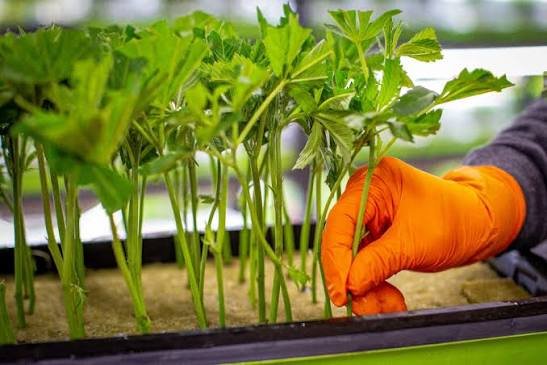
The front of the timeline, germination plus seedling, costs three to four weeks from seed. Starting from clones deletes most of it. A rooted cutting arrives with a root system already built and a known phenotype already expressed, and it goes more or less straight into vegetative growth, which is why our mother room and propagation guide treats propagation as the facility's calendar infrastructure rather than a cost center. The weeks saved at the front are weeks the flower room gets back as turns.
Uniformity is the second half of the argument, and at commercial scale it matters more than the weeks. A tray of seedlings is a population with variance: they germinate over days, grow at different rates, and express the cultivar differently plant by plant. A tray of clones from one mother is one genotype in many copies, so the canopy develops on one schedule, the flip happens to every plant at the same readiness, and the room harvests on one date instead of straggling across three. In a production calendar, a heterogeneous crop does not just vary in quality; it breaks the room's ability to be emptied, cleaned and replanted on schedule, which is the difference between 4 clean turns a year and 4 approximate ones.
The honest counterweight is that seeds have their own advantages: no mother room to run, no clonal pathogen accumulation to manage, and for some markets a seed-grown product story. And autoflower production, as the table above notes, is seed-bound by biology. The timeline point is narrower than the overall debate: when the question is how fast a crop can reach harvest from a standing start, the clone path is three to four weeks shorter before the first lighting decision is even made.
Where Light Actually Buys Back Time
Most of the timeline is fixed, one stage is a dial, and light's role in the dial is the best-evidenced acceleration in the whole plan. The clearest numbers come from greenhouse and seedling research at Michigan State University's floriculture program, where seedlings grown at a daily light integral of 1.3 mol/m²/day were compared against seedlings at 10.8 mol. The high-light seedlings reached transplant-ready size in less than half the time. In the same body of work, plugs raised at 10 to 14 mol were not only higher quality at transplant, quality scores 47 to 68 percent better than low-light controls, they also flowered up to 8 days earlier after transplant, carrying the acceleration through the rest of the schedule.
| Early-stage light change | Measured effect on the timeline | Source |
|---|---|---|
| Seedling DLI raised from 1.3 to 10.8 mol/m²/day | Transplant-ready time cut by more than half | MSU Extension trials (Moccaldi and Lopez) |
| Plug stage DLI raised to 10 to 14 mol | Quality up 47 to 68 percent; flowering up to 8 days earlier after transplant | MSU Extension trials (Runkle and colleagues) |
| Rooting zone held at the 8 to 10 mol optimum | Fastest, most uniform rooting; cuttings ready on one schedule | Propagation DLI consensus, in our propagation guide |
| Flowering PPFD increased within crop tolerance | Heavier flowers at the end of the same number of weeks; the clock itself unchanged | Genetic program; no measured time compression |
The seedling and plug rows are ornamental-species trials rather than cannabis-specific ones, which is the honest caveat, and they are also the reason the industry uses them: early-stage dose-response is among the most replicated results in controlled-environment horticulture. The mechanism, faster canopy development against a fixed developmental program, transfers; the exact week counts should be validated on the cultivar actually being grown.
The pattern in the table is worth internalizing because it inverts the usual intuition. Light does not speed up flowering. What it speeds up is everything before flowering: germination to transplant, plug to usable start, cutting to rooted clone. A facility that wants more turns per year from fixed rooms has exactly two timeline levers, the vegetative dial and the early-stage DLI, and the second one is cheaper than the first because it does not cost canopy size. The numbers that turn intensity into daily integrals, and the stage table with the working bands, are in our PPFD and DLI guide.
Protecting the Flowering Clock
Flowering time cannot be compressed, but it can be corrupted, and the failure mode is light where darkness should be. Cannabis flowering is governed by the length of the uninterrupted dark period, not the light period, a conclusion our light leaks guide works through in detail: the plant measures night length with a sensitivity measured in nanomoles, and light leakage into the dark period, even at levels that look black to the human eye, can delay flowering, stretch it out, or push plants to re-vegetate. A schedule that says 12/12 but leaks is not running 12/12 as far as the plant is concerned.
The timeline consequence is asymmetric, which is what makes leaks expensive rather than merely annoying. A flower room that runs perfectly except for a leaking door seal does not lose a fixed few days; it can lose the whole schedule's coherence, because the delay lands differently plant by plant depending on where each one sits relative to the leak. Rooms become patchworks of plants at different stages, the single-date harvest dissolves, and the room turnaround that the whole commercial calendar in the next section depends on stops being a date and becomes an estimate.
The protection checklist is short and mostly architectural: sealed door seals and light traps on every penetration, fixtures and driver indicators that go fully dark, a dark-period audit with a meter rather than an eyeball, and the discipline of treating any work that must happen in the dark period as a planned event with green-safe lighting, never a convenience. None of it adds a single week of speed. All of it protects the weeks the genetics have already promised.
The Commercial Calendar: Rooms, Staggering and Turns per Year
For a home grower the timeline is a wait. For a facility it is a unit of production, and the arithmetic looks like this: a flower room running three to four weeks of vegetation after transplant, eight to ten weeks of flower for a typical hybrid, and one to two weeks of turnaround for cleanout and replanting completes a cycle in roughly 12 to 14 weeks. That is almost exactly four cycles per room per year, and it is the number facility plans are actually built on, because four turns of a known weight is a revenue model while "how long does it take" is a trivia answer.
| Cycle component | Typical duration | Notes |
|---|---|---|
| Vegetative, transplant to flip | 3 to 4 weeks | From rooted clones; from seed add the 3 to 4 front weeks |
| Flowering | 8 to 10 weeks | Hybrid cultivar band; the cultivar list sets the real number |
| Turnaround | 1 to 2 weeks | Cleanout, sanitization, replant; the most commonly underestimated line |
| Full room cycle | About 12 to 14 weeks | Roughly 4 turns per room per year |
Planning arithmetic at industry working values, not a measured benchmark. A facility running sativa-dominant cultivars at 12 weeks of flower is on a 16 to 18 week cycle and 3 turns; autoflower batches compress the vegetative side to a fixed 3 to 4 weeks by biology instead of by choice.
The staggering insight is where lighting and scheduling meet. Four rooms phased a month apart present the electrical system with a flatter load than four rooms running in lockstep, and the demand charge mechanics in our demand charges guide reward exactly that flattening. The propagation room, sized to a steady weekly clone demand in our mother room guide, only works if the flower rooms actually demand clones weekly, which staggering is what creates. The timeline's segments are fixed or chosen, but the facility-level output, harvests per month, is designed, and it is designed with room count and start offsets rather than with any fixture.
FAQ
How long does it take to grow weed from seed to harvest indoors?
For a photoperiod plant indoors, the working range is 12 to 20 weeks from seed to harvest: roughly one week to germinate, two to three weeks as a seedling, two to eight or more weeks of vegetation depending on the size you choose, and seven to fourteen weeks of flower set by the cultivar. A typical commercial planning figure, with a short vegetation period from clones, is 16 to 18 weeks including room turnaround. Autoflowers complete the same journey in 8 to 12 weeks on a fixed genetic clock.
How long do autoflowers take from seed to harvest?
Eight to twelve weeks, and the range is genetic rather than negotiable. An autoflower begins flowering around three to four weeks after germination regardless of light schedule, flowers for six to eight weeks, and finishes without ever giving the grower a vegetative dial to turn. The compressed schedule is also why early-stage light intensity matters so much for autoflowers: with only about three weeks of vegetation, there is no time to recover from a slow seedling stage.
How long does it take a cannabis plant to bud?
Visible flowering, the pre-flowers and bud formation most growers mean by budding, appears one to two weeks after the flowering trigger. For a photoperiod plant that is one to two weeks after the 12/12 flip, and for an autoflower it is around weeks three to four from germination, triggered by age. The buds then need the cultivar's full flowering run, seven to fourteen weeks depending on lineage, to develop and ripen; the first sight of bud is the start of the clock, not the end of it.
How long does it take to dry and cure cannabis after harvest?
Drying runs seven to fourteen days under controlled temperature and humidity, and curing adds a minimum of two to four weeks, with many operations extending well past that for product quality. For planning purposes, add two to six weeks after the plant comes down before product is sellable. These post-harvest stages run on process control rather than lighting, but they belong on the calendar: they are the difference between the harvest date and the revenue date.
Can you speed up how long cannabis takes to grow?
Three levers genuinely move the calendar and one popular lever does not. Starting from clones instead of seeds saves the three to four front weeks. Running higher daily light integrals in the seedling and plug stages cuts transplant-ready time by more than half in the published trials and can pull flowering earlier by up to eight days after transplant. Choosing faster-finishing genetics, or autoflowers, shortens the flowering segment itself. What does not work is trying to light the flowering stage into finishing faster: more photons there build heavier flowers in the same weeks, because flowering duration is developmental, not photosynthetic.
How long does outdoor cannabis take compared to indoors?
Outdoor photoperiod cannabis runs on the sun's calendar: planted in spring after the last frost, vegetating through the long days of early summer, flowering as nights lengthen in late summer, and harvested in autumn, which totals roughly five to seven months from seed to harvest depending on climate and cultivar. The indoor timeline is shorter not because indoor plants grow faster but because the light schedule lets the grower choose when flowering begins, and the environment holds the same conditions every day of the run.
Does more light make cannabis grow faster?
In the early stages, measurably yes. Seedling trials comparing a daily light integral of 1.3 mol/m²/day against 10.8 mol found the high-light seedlings reached transplant size in less than half the time, and plug-stage integrals of 10 to 14 mol carried quality gains plus up to eight days of earlier flowering downstream. In vegetation, higher integrals build canopy faster toward whatever size the flip targets. In flowering, more light adds weight within the same number of weeks; the developmental clock it cannot move.
How long after switching to 12/12 is harvest?
Count on the cultivar's flowering length plus one to two weeks of ripeness margin, then the post-harvest stages beyond that. A hybrid finishing in nine weeks of flower is harvested around ten to eleven weeks after the flip, allowing for the transition and the tail of ripening. The first two weeks after the flip include the stretch, when plants roughly double in height, so the room's vertical budget should already account for it before the switch is thrown.