
Why the Front of the House Sets the Ceiling for the Whole Facility
A cannabis facility is a chain of rooms, and the chain starts with plants nobody harvests. Mother plants are held in vegetative light to supply cuttings, cuttings are rooted into clones, clones are bulked in a vegetative room, and the flower rooms turn that uniform input into the crop. Every downstream quality question inherits an upstream lighting decision. The uniformity of the mother canopy sets the uniformity of the cuttings taken from it, cutting uniformity sets how evenly clones resume growth after transplant, and the vegetative room passes that uniformity, or fails to, into the flower rooms.
The reason the front of the house deserves its own lighting treatment, rather than a footnote in the flower-room discussion, is that the objective differs in kind. A flower room is managed for yield per square foot. A propagation room is managed for evenness across a tray of plants that cannot yet drink on their own, and the published dose-response work does not climb in that direction: rooting quality rises with daily light up to a band, plateaus, and then falls. The most common lighting mistake in new facilities is importing flower-room intensity logic into rooms whose crop has no roots to water it.
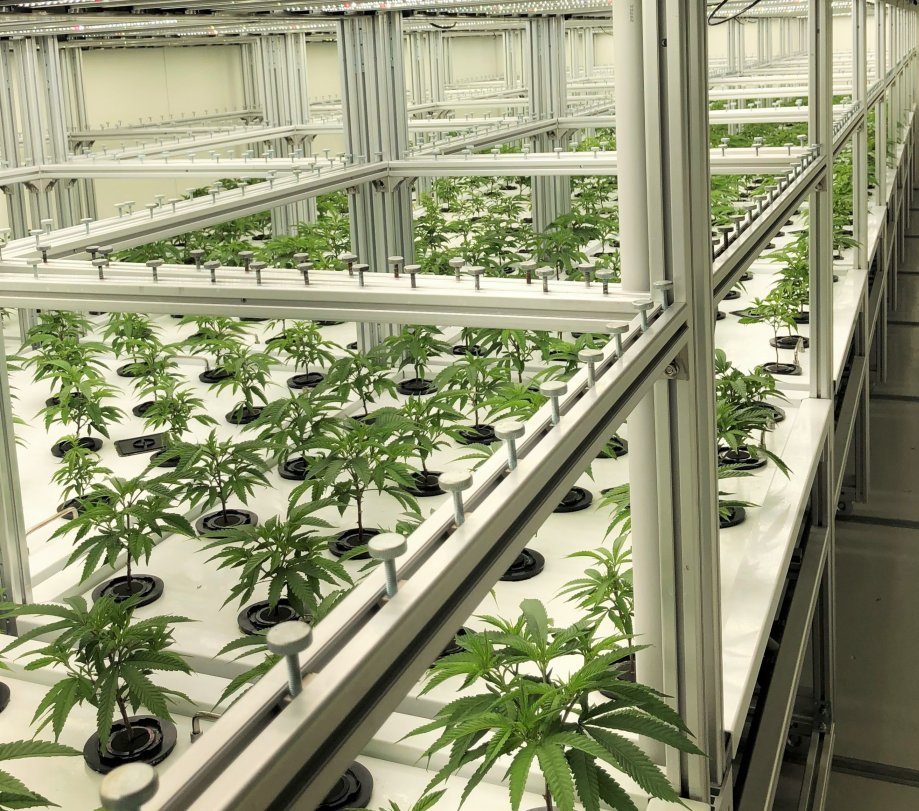
Everything that follows is organized the way the decisions actually cascade: how many plants the flower rooms need, which sizes the rooms; what the mothers and the cuttings should receive, which sizes the light; what spectrum contributes, which is less than the marketing claims; why racks beat benches for this job; and what the hours, the humidity and the electrical load mean for the specification.
How Much Propagation Area a Flower Room Actually Needs
The chain runs backward from the flower rooms, and the first link is arithmetic rather than opinion. A facility that knows how many flowering plants it starts per year knows its weekly cutting demand: divide the annual flower starts by 52, hold a margin for culls, and the result is the number of rooted clones the propagation room has to deliver every week. Everything upstream, the number of mothers, the tray area, the vegetative bench space, exists to hit that weekly number.
| Planning question | Rule of thumb in circulation | Source and status |
|---|---|---|
| Weekly plant demand | Annual flower starts ÷ 52 | Industry practice (CannaCribs) |
| Cuttings per mother | 5–15 every 2–3 weeks, or 20–50 per take; the sources disagree by several fold | GrowerIQ vs CannaCribs (industry, unresolved) |
| Mothers per cultivar | 1–3 | Industry practice (GrowerIQ) |
| Mother redundancy | 10–15 percent, or 20–30 percent, of the mother count as spares | GrowerIQ vs CannaCribs (industry, unresolved) |
| Front-of-house share of floor area | Mother, propagation and vegetative rooms together about one quarter of the facility footprint | Industry practice (complantconsulting) |
Every row is industry planning practice, not peer-reviewed measurement. Where two sources disagree, the table says so, and the honest reading is that the wide bands reflect real variation in cultivar, cycle length and how hard a mother is pushed. Treat the rows as starting bands to plan against, then replace them with the facility's own recorded yields after the first two cycles.
One industry worked example shows the ratios at building scale: a 12,000 sq ft facility carrying 20 mothers and a 1,200-plant propagation room in roughly 400 sq ft, plus a 1,000 sq ft double-tier vegetative room holding 2,000 plants, was sized to feed four flower rooms of 1,000 sq ft each. The example is one case from industry practice, not a law. What transfers is the ratio logic and the proportion of the footprint, roughly a quarter including the vegetative rooms, not the specific numbers, which depend on the cultivar list and the cycle calendar.
The number to defend hardest in that chain is redundancy. A mother lost mid-cycle is not one plant lost; it is every cutting she would have produced for months, and because keeping one to three mothers per cultivar is normal practice, a single lost mother can be the entire cultivar. The 10 to 30 percent spare-capacity band across the industry sources is inexpensive in floor area and expensive to skip, and it is the reason the mother room is planned as a population rather than as a set of individual plants.
The Mother Room Is a High-Consequence Room
Mothers are perennials living inside a facility built around an annual crop. Industry practice turns them over every 6 to 12 months, faster where plant health allows, and manages them under a tension the flower rooms never see: cutting too hard ages the root system and slows growth, while cutting too rarely lets the canopy stretch out of the shape the cutting schedule depends on. The room's job is to keep a small population of plants in steady, managed production for the better part of a year, which is closer to orchard management than to the batch logic of the flower rooms.
The lighting specification follows that job. Industry bands put mothers at 400 to 600 µmol/m²/s on an 18/6 schedule at 73–77 °F and 60–70 percent relative humidity, with a full-room air exchange in five minutes or less. Our PPFD and DLI target table puts mother plants at 550 to 700 µmol/m²/s, a daily integral of 36 to 45 mol. That is flower-room-grade intensity applied to vegetative hours, and it is why the mother room, watt for watt, behaves more like the flower room than like the propagation racks beside it.
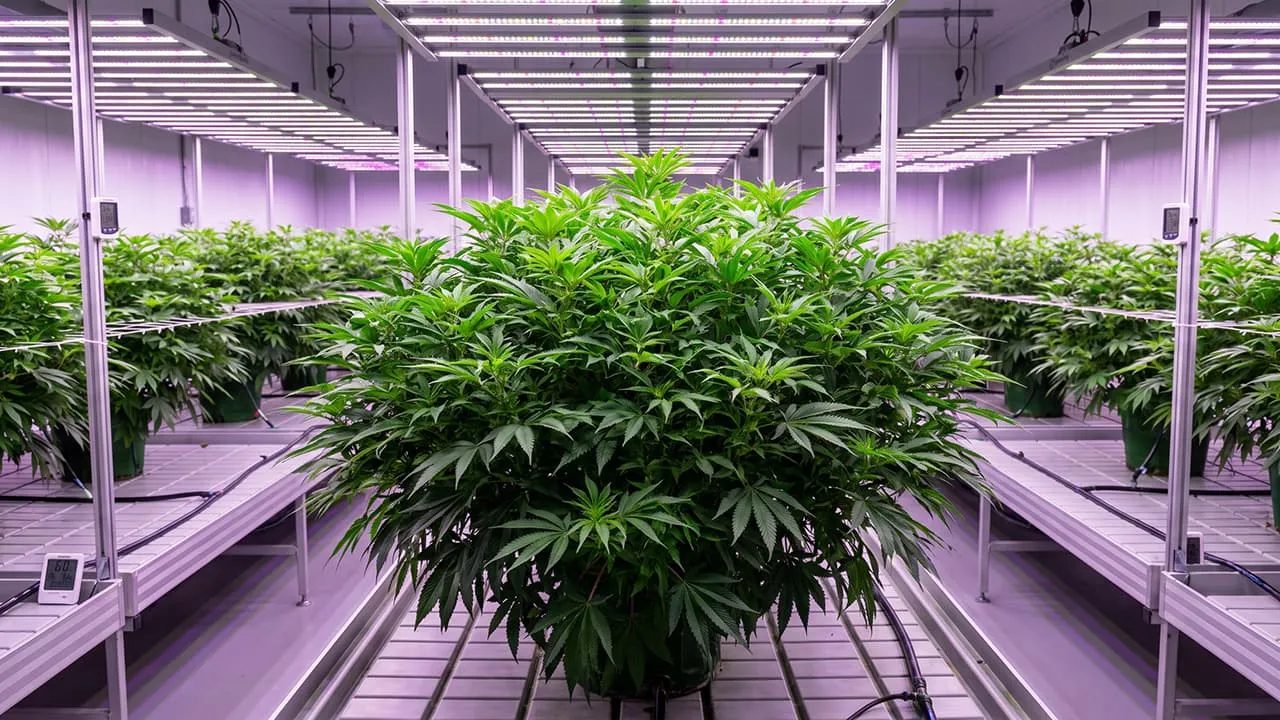
What makes the room high-consequence is not the intensity but the stakes per plant. Every cultivar the facility sells lives, at any moment, in one to three ageing specimens plus whatever redundancy is provisioned, and pathogens that move clonally, of which the hop latent viroid is the industry's standing example, travel in cuttings rather than in room air. That is a biosecurity argument for planned turnover and spare capacity rather than a pathology lesson, and it is the reason the room earns its own monitoring and its own maintenance attention instead of inheriting the flower rooms' habits.
Rooting Has a Light Optimum, Not a Light Maximum
A cutting is a plant with shoots and no roots. Until new roots form, every watt of light on the leaf drives photosynthesis that builds new cells, but it also drives transpiration that the cutting cannot replace, which is why the rooting zone is lit gently, humidified deliberately and watched closely. The research literature on daily light integral in propagation is unusually consistent for horticulture, and its consensus band for rooting is 8 to 10 mol/m²/day. Below roughly 3.5 mol, cuttings root slowly and unevenly; in trials above the band, at around 16 mol, root density came back lower than at the optimum.
What dose buys inside the band is real. In Lopez and Runkle's trials, raising the propagation daily integral from 1.2 to 7.5 mol took petunia root counts from 17 to 40, raised root dry weight by 737 percent and shortened the time to flower from 50 days to 29. Currey's work across nine species found root and shoot growth climbing linearly from 1.2 up to about 12 mol, with several species plateauing near 8. These are ornamental species rather than cannabis, and that matters: the cannabis-specific dose data are thinner, which is exactly why the industry specification leans on the multi-species consensus band instead of a single-crop trial.
| Rooting-zone daily light | What the evidence shows |
|---|---|
| Under 3.5 mol/m²/day | Rooting is slow and uneven (Enfield and colleagues) |
| 3.5 to 8 mol | Rooting proceeds; quality still climbing with dose |
| 8 to 10 mol | The consensus optimum: fastest, most uniform rooting; the specification band |
| 10 to 16 mol | Diminishing, species-dependent returns |
| About 16 mol | Lower root density than at the optimum (Owen and Lopez) |
| Mother plants, for reference | 36 to 45 mol on our stage table: a different plant, already rooted, managed for canopy |
Band values are from the daily light integral research review in HortScience 53(9):1250 and the trials it summarizes; the mother-plant row is facility practice from our stage table, labeled as such. On an 18-hour day, the 8 to 10 mol band corresponds to roughly 125 to 155 µmol/m²/s; our stage table carries the 100 to 200 µmol/m²/s working band for cuttings and clones, and the two descriptions agree where they overlap.
The translation for fixture selection is direct: propagation light is the gentlest light in the building, and paying flower-fixture premiums for it is the category error our efficacy guide addresses. What the zone needs is even coverage at low intensity, control that holds from tray to tray, and sensors that actually read the tier.
What Spectrum Actually Does During Rooting
No stage attracts spectrum marketing like propagation, because the cutting looks fragile and the buyer feels that any edge must be chemical. The most useful recent evidence is a 2024 cannabis trial from Wageningen (Sae-Tang and colleagues, in Scientia Horticulturae) that varied the presence of blue light and the timing of far-red over the rooting period and measured the hormonal and carbohydrate correlates alongside the roots. Its two headline results run against the marketing. The presence or absence of blue light had no significant effect on rooting. Far-red, supplied only during the first seven days, improved rooting and did not cause the elongation that continuous far-red is known for.
The same study tested the mechanism story that circulates on supplement labels: auxin concentrations and carbohydrate levels in the cutting did not correlate with rooting success. A hormone narrative without a measured chain is a story, and the trial is valuable precisely for checking it.
| Claim in circulation | What the controlled work shows | Honest status |
|---|---|---|
| Blue light helps cuttings root | No significant rooting effect of blue presence in the cannabis trial; the most consistent blue gains appear in multi-species ornamental work | Species-dependent at best; choose blue for plant shape, not for rooting |
| Far-red helps rooting | First-seven-days far-red improved rooting without excessive elongation | Supported, with the timing caveat that matters |
| Spectrum matters more than dose | Dose bands predict rooting outcomes across trials; HPS versus LED comparisons found no rooting differences | Dose first; spectrum second |
| Hormone and carbohydrate formulas explain rooting | IAA and carbohydrate concentrations did not correlate with rooting in the cannabis trial | Unproven as stated |
Cannabis rows: Sae-Tang, Heuvelink, Kohlen, Argyri, Nicole and Marcelis 2024, Scientia Horticulturae 325:112614. Multi-species row: Lim and Gómez 2026, HortScience 61(8):1857–1867. The HPS-versus-LED row is from Currey's Purdue work. None of these rows is a product claim, and none of the trials was run on a fixture the authors were selling.
The blue conclusion deserves one careful sentence, because blue still belongs in the room. Its legitimate role in propagation and early veg is morphological: compact internodes, sturdy plugs, cuttings that ship and transplant well. The multi-species vertical-farm work of Lim and Gómez found blue treatments among the most stable for rooting quality and the least prone to stretch, which keeps blue in the conversation as a shape tool. What it is not, on present evidence, is a rooting switch. Our spectrum guide makes the parallel point for flower: spectra shape the plant, while dose builds it.
Why Indoor Multi-Tier Propagation Beats a Bench
The rooting literature contains a direct comparison of production systems, and the rack wins. Lim and Gómez propagated the same cuttings at the same 100 µmol/m²/s in an indoor vertical system and in a greenhouse bench system, and the indoor cuttings produced longer roots, higher root dry weight and lower losses. The indoor daily integrals, roughly 6 to 9 mol on continuous photoperiods, sat at or below the consensus rooting band, so the advantage did not come from extra light. It came from the environment the tiers hold.
The mechanism is control. A rooting zone wants vapor pressure deficit in the 0.4 to 0.8 kPa band our VPD guide details, stable tray temperature and still air with exchange, and a sealed indoor tier delivers all three on command while a greenhouse bench borrows them from the weather. Where the greenhouse loses, it loses on exactly the variables a cutting cannot regulate for itself, because it has no roots to buffer the swings.
The planning consequence is that propagation is the most rack-native task in the facility. Benches spend the building's height on air, and a rooting tray uses a fraction of it; tiers put the same floor area to work several times over, and they hold the humidity and temperature bands that make rooting predictable. Racks are also where the electrical load concentrates, which is the subject two sections ahead.
Lighting a Rack: Short Throws and Low Ceilings
Rack lighting is a different geometry problem from the flower room. Ceiling height is irrelevant inside a rack; tier spacing is everything. The distance from fixture to canopy in a propagation tier is set by the tier's height budget, and it is commonly well under half a metre, at which range the fixture's coverage is a rectangle the size of the tray rather than a wide cone. Fixtures that spread evenly at short throw, whether through wide-angle optics or through closely spaced bars, are the right tool; a bar built to cover a 4 by 4 canopy from three metres is covering a tray edge-to-edge from forty centimetres, and its center-to-edge falloff lands differently than its datasheet suggests.
Uniformity therefore gets measured per tier, with the quantum sensor at tray height, not at room height, and not once but tier by tier, because tiers in the same rack routinely differ from each other more than rooms in the same building do. The cell arithmetic in our fixture-count guide applies directly, with one modification: run it per tier, at the tier's target intensity, over the tray's footprint, instead of over the floor.
Three habits keep a rack honest. Mount within the tier's height budget, remembering the fixture adds height. Orient bars along the tray's long axis so edge falloff falls on the aisle rather than on the tray ends. And put the drivers where their heat leaves the tray microclimate, because driver warmth inside an enclosed tier works against the humidity band the cuttings are sitting in, which is the next section's topic from the wet side.
The Longest Lighting Hours in the Building
The flower room's lights run twelve hours, and then the room goes dark. The front of the house runs eighteen-hour vegetative days, every day of the year, and that difference compounds quietly into the largest annual lighting energy per square metre of floor in the building. The arithmetic, at the 2.8 µmol/J system efficacy our fixture guides use as the working figure, is short enough to check by hand.
| Zone | Intensity | Power draw | Hours per day | Energy per m² of floor per year |
|---|---|---|---|---|
| Flower room, single tier | 900 µmol/m²/s | About 321 W/m² of floor, near 30 W/sq ft | 12 | About 1,410 kWh |
| Vegetative racks, two tiers | 600 µmol/m²/s per tier | About 429 W/m² of floor, near 40 W/sq ft | 18 | About 2,810 kWh, twice the flower room |
| Rooting tiers, four high | 150 µmol/m²/s per tier | About 214 W/m² of floor across the stack | 18 | Lower per tier, but the load never leaves the building |
Arithmetic, not measurement: power is intensity divided by 2.8 µmol/J, stacked tiers multiply the floor load, and the yearly figures multiply by 365. The flower row reproduces the 38.9 mol worked example from our PPFD and DLI guide. Vegetative tier intensity follows the mother-plant band; rooting tiers sit in the rooting band. Where a facility runs different intensities or photoperiods, the rows rescale linearly.
The second half of the hours story is the demand charge, and it is the part facilities meet on the bill rather than in the plan. A flower room's twelve dark hours give its demand profile a daily break; the propagation racks' load never leaves the building, so the front of the house sets the floor under the facility's peak, whatever the flower rooms are doing. Our demand charges guide covers the billing mechanism; the front-of-house consequence is that staggered photoperiods across racks and rooms are worth engineering deliberately rather than inheriting by accident.
The Wet Room: Humidity, IP and Where the Driver Goes
Rooting zones are the wettest rooms in the facility by design: domes, misting lines and fog hold the relative humidity near the bands cuttings need, and every surface that crosses the dew point, fixtures included, cycles through condensation daily. That environment asks more of the fixtures than the flower room does, in a different direction. The industry norm in propagation is humidity-sealed construction, fixtures in the IP65 class or better with sealed connectors, and the sealing has a price our efficacy guide quantifies: a sealed fixture runs a little below the bare efficacy of its diodes, and in a rooting tier that trade is worth making.
Drivers belong outside the tray microclimate: external-mounted, or on the dry side of the rack, where their heat leaves the dome's humidity band instead of fighting it. Service access is part of the same decision. A driver buried behind domes is a driver nobody inspects, and moisture plus electricity is a combination that earns scheduled inspection of glands, connectors and cord drops as a standing part of the room's maintenance calendar rather than an afterthought.
Air exchange closes the specification. Industry practice for the front-of-house rooms is a full-room exchange in five minutes or less, delivered without blowing across open trays, because moving air over an unrooted cutting is the fastest way to undo the humidity the misting system just built. The room is a balance between wet and moving, and every element in it, the fans, the fixtures, the drivers and the sensor placement, is chosen to hold that balance.
A Specification Checklist for Mother and Propagation Rooms
The checklist below compresses the page into the decisions a plan actually needs, in the order they bite:
- Targets by zone, not by building. Rooting at 8 to 10 mol/m²/day, roughly 125 to 155 µmol/m²/s on an 18-hour day; mothers at 550 to 700 µmol/m²/s, 36 to 45 mol; vegetative tiers per cultivar and validated.
- 18/6 as the default photoperiod. Longer vegetative days are cultivar-dependent and are validated, not assumed; the front of the house follows the cultivar, not the reverse.
- Uniformity per tier. One quantum sensor per tier minimum, read at tray height; even tray coverage is the product, headline intensity is not.
- Redundancy in mothers. Ten to thirty percent spare mother capacity, reviewed per cultivar against the facility's own recorded cutting yields.
- Fixture ratings for a wet room. Humidity-sealed fixtures with sealed connectors in dome and mist zones; drivers on the dry side; connectors on the inspection calendar.
- Hours on the meter. Stagger rack and room photoperiods where the tariff rewards it; the load profile is a design input, and the front of the house sets the facility's demand floor.
- Capital where it pays. Low-intensity zones do not need flower-fixture premiums; spend the budget on evenness, sealing and control instead.
A facility's ceiling is set at its front. The flower rooms can only be as even as the trays that feed them, and the trays are only as even as the light that raised them: gentle, level, held inside a band, and running more hours than anything else in the building. None of that is difficult, and all of it is cheaper to design in than to retrofit, which is the argument for treating the mother room and the propagation racks as engineered spaces in the plan rather than as leftover floor.
FAQ
How much light do clones need to root?
Enough to hold 8 to 10 mol/m²/day, the consensus rooting band in the propagation research. On an 18-hour photoperiod that is roughly 125 to 155 µmol/m²/s, and the working band most facilities run, 100 to 200 µmol/m²/s, covers it with margin. Below about 3.5 mol rooting is slow and uneven; in trials near 16 mol, root density came back lower than at the optimum. Most healthy cuttings root in 7 to 14 days under the band, and the evenness of the coverage matters more than the number on the meter.
Do cuttings need light while they are rooting?
Yes. An unrooted cutting has no water-uptake system, but it still needs carbohydrate, and the only source is photosynthesis. Darkness stops that supply, and the cutting lives on stored reserves alone. The reason the zone is lit gently rather than brightly is water balance: every photon drives transpiration the cutting cannot replace until roots form, which is why the light optimum sits in a band instead of climbing the way the flower room's does.
What PPFD should mother plants get?
Our stage table puts mother plants at 550 to 700 µmol/m²/s on an 18/6 schedule, a daily integral of 36 to 45 mol, and industry bands run from 400 to 600 µmol/m²/s at 73 to 77 °F and 60 to 70 percent humidity. That is flower-room-grade intensity on vegetative hours, and it exists to keep the canopy producing cuttings continuously. The canopy management calendar, how hard and how often the plant is cut, shapes the room as much as the fixture schedule does.
Does blue light help clones root faster?
On the present cannabis evidence, no. The controlled Wageningen trial found no significant rooting effect from the presence or absence of blue light, and it also found that auxin and carbohydrate concentrations did not correlate with rooting. What blue demonstrably does is shape the plant: compact internodes and sturdy plugs, with multi-species work finding blue treatments stable for rooting quality and least prone to stretch. Choose blue for plant shape. The one spectrum result that did touch rooting was far-red supplied during the first seven days, which improved rooting without the elongation continuous far-red causes.
How many clones can one mother plant produce?
The industry sources disagree by several fold, which is itself the finding. One practice band puts a mother at 5 to 15 cuttings every 2 to 3 weeks; another describes 20 to 50 cuttings per take. The honest answer is that yield depends on cultivar, plant size, the pressure of the cutting schedule and the health of the root system, so plan from the facility's own recorded yields after the first cycles, and hold redundancy against the uncertainty in the meantime.
How many mother plants does a facility need?
Work backward from the flower rooms. Divide annual flower starts by 52 to get weekly clone demand, add a cull margin, then divide by the per-mother yield band to get the mother count, keeping one to three mothers per cultivar and 10 to 30 percent spare capacity. As a footprint cross-check, mother, propagation and vegetative rooms together run about one quarter of the facility area in industry practice. The weekly demand is fixed by the flower schedule; the mother count exists to serve it.
How often should mother plants be replaced?
Industry practice turns mothers over every 6 to 12 months, and faster, around 3 to 6 months, where plant health allows. The replacement drivers are cutting pressure, which ages the root system, and pathogen status, because viruses and viroids that move in cuttings accumulate across a mother's life. Planned turnover plus spare capacity costs floor area; an unplanned turnover costs a cultivar, and the first is the cheaper of the two.
What size should the propagation room and mother room be?
Size them backward from weekly clone demand, not forward from the floor that is left. One industry example at building scale: a 12,000 sq ft facility fitted 20 mothers and a 1,200-plant propagation room into roughly 400 sq ft, with a 1,000 sq ft double-tier vegetative room, feeding four 1,000 sq ft flower rooms. The transferable figure is the proportion, about a quarter of the footprint for the whole front of house, and the per-mother yield bands above are where the plan's uncertainty concentrates.