Ask whether hydroponics is better than soil and the honest answer depends on what you are measuring, because the two systems do not fail in the same way. Under a modern LED grow light the cannabis plant wants the same things in both: photons at the canopy, water at the roots, oxygen in the root zone and a steady temperature. What changes is how fast a mistake reaches the plant, what it costs to correct, and what the system asks from your light plan. This guide compares hydroponics vs soil cannabis on the variables a commercial room actually manages, then hands you a decision path instead of a verdict.
Neither system is better in the abstract. Soil is a buffer: it stores water, exchanges and holds nutrients, hosts a microbial community, and gives a plant days to recover from a bad decision. Hydroponics is a channel: it delivers exactly what you mix, when you mix it, and reports back within hours. That single difference sets everything else in this comparison.
So the useful question is not "which grows better weed" but "which failure mode can my operation afford". If your constraint is capital and the time your crew can spend watching the crop, soil forgives. If your constraint is consistency between batches and turnaround between cycles, hydroponics measures what soil only suggests. A room selling flower by the gram should pick the failure mode first, then design the irrigation and the light map around it. The rest of this guide walks the dimensions behind that pick.
The table below condenses the comparison into the eight dimensions that decide a commercial purchase. Read the last column first: it translates each line into what it means inside a lit room, where the light plan and the root system share the same physics.
| Dimension | Hydroponics | Soil | What It Means in a Lit Room |
|---|---|---|---|
| Turnaround between cycles | Faster vegetative growth, more turns per year | Slower start, same flowering clock | More cycles means more lighting hours per year |
| Buffer against error | Thin: mistakes reach the roots in hours | Thick: media holds water, pH and EC spikes | High light loads shrink the buffer in both |
| Water and nutrient efficiency | High in recirculating systems, runoff stays in the loop | Lower, drain-to-waste spends solution | Efficiency shows up in the consumables line |
| Root-zone oxygen | Dissolved oxygen in the tank, falls as water warms | Air-filled porosity in the medium | Reservoirs held at 18 to 21 °C, media at 20 to 24 °C |
| Batch-to-batch consistency | High: every input is a logged number | Lower: biology mediates the feed | Contracts price consistency before averages |
| Labor and skill | Daily metering and sanitation routines | Fewer instruments, slower feedback | Skill caps what either system returns |
| Capital at the door | Pumps, meters, dosing, redundancy | Pots, media, beds and drainage | CAPEX is the smaller half of the ledger |
| Cost of a failure | Hours to a room-wide event | Days, usually local to one bed | Expected failure cost decides the purchase |
No line in that table is absolute. Well-run soil beds in raised beds with drip irrigation approach hydroponic control; a neglected deep-water culture tank loses to a healthy living-soil bed every time. The table describes tendencies under equal management skill, and management skill is the variable most comparisons quietly assume away.
Commercial growers measure "better" three ways, and the systems rank differently on each. Yield per square metre per cycle: driven mostly by light delivered and canopy architecture, so the substrate matters less than the sales copy suggests. Cost per gram: where capital, energy, labor and failure rates stack up, and where the two systems genuinely diverge. Variance: how much the result moves between batches when everything was run the same way.
Variance is the dimension buyers underrate and contracts punish hardest. A processor buying forward at a fixed price cares that batch eleven resembles batch one, and hydroponics earns its keep there, because every input is a number you logged. Soil earns its keep on the opposite trade: lower variance in cost, higher variance in outcome. Neither is wrong; they are different risk structures, and the rest of this guide is about choosing yours deliberately.
Hydroponic cannabis grows faster through vegetative growth, and the mechanism is not mysterious: oxygenated water plus a mineral feed the roots never have to search for means the plant spends less energy on root architecture and more on shoot mass. Vegetative turns that take weeks in soil compress measurably in hydroponic systems, and that is the strongest honest claim in hydro's favor.
Two caveats keep the claim honest. First, the flowering clock is developmental, as our seed-to-harvest timeline explains, and no substrate advances it: a hydroponic plant flips on the same photoperiod schedule and finishes on the same genotype schedule. Second, speed is paid for in lighting hours. Faster turns mean more cycles per year, and more cycles mean more hours per year with the fixtures on, which shows up in the energy line of the ledger below. Speed converts a time advantage into an operating cost, and the ledger is where you check whether the trade pays.
This is where the two systems genuinely disagree, and where most growers' regret lives. A soil bed with real volume holds water against a missed irrigation, holds pH against a misbatched feed, and dilutes an EC spike across its exchange capacity. The plant feels a bad day in soil as a slow week, which is forgiving. The same error in a rockwool slab or a deep-water tank reaches the roots in hours: a pump that quits at lights-on in a dense, well-lit canopy becomes midday wilt the same afternoon, and a heater failure in the reservoir becomes root stress overnight.
The buffer question scales with plant density and light intensity, not just with system type. The more photons you deliver, the faster the canopy transpires, and the smaller the reserve that covers an irrigation failure. That is why hydroponic rooms invest in redundancy: duplicate pumps, alarm-equipped reservoirs, auto-dosing with failover, and generators. The equipment list is not paranoia; it is the price of running a system with a thin buffer under a high light load. Soil rooms spend that money on media and space instead. Both budgets are legitimate; only one of them fits your crew.
Recirculating hydroponics uses water with high efficiency, because what the plant does not drink comes back to the tank, and runoff stays in the loop. Soil and coco in pots drain to waste, which spends more water and more nutrient solution per gram but needs no plumbing to speak of. On nutrient control the rankings reverse: hydroponics lets you set EC and pH to a decimal, while soil chemistry is mediated by microbes and exchange sites, slower to move and slower to correct.
Root-zone oxygen is the quiet decider. In soil, air-filled porosity does the work, which is why overwatered pots suffocate roots long before they drown them. In water culture, the dissolved oxygen in the reservoir does it, and warm water holds less of it: that is why hydroponic reservoirs are typically held a little cooler, around 18 to 21 °C, while the media root-zone target sits at 20 to 24 °C, the range detailed in our temperature guide's root-zone section. A healthy hydro root mass, like the one below, is the visible receipt: white, fibrous and smelling of nothing.
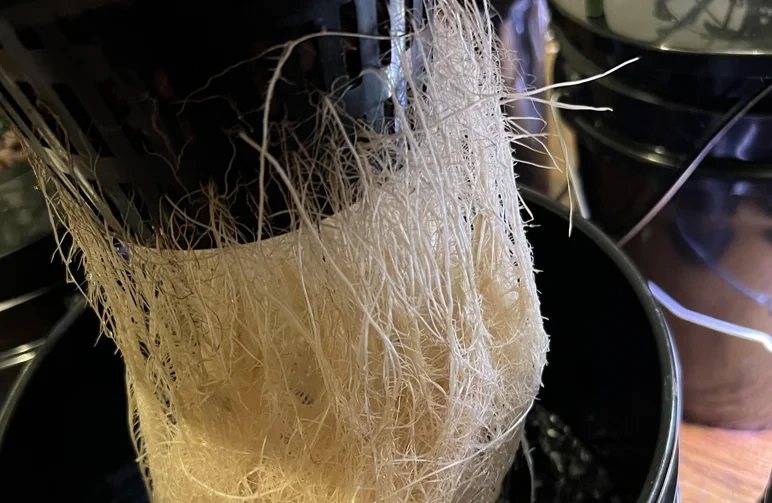
Run the two checks every reservoir change: dissolved oxygen proxy as temperature, and root color as history. Brown, slimy roots in a warm tank are a pythium warning, and pythium in a shared reservoir is the pathogen story the next section covers.
The targets do not change: a cannabis canopy wants the same PPFD and the same DLI in either system, which is the arithmetic in our PPFD and DLI guide. What changes is the tolerance around the target, and the reason is the buffer again. Soil masks a thin light map: a dim corner grows a little slower, the medium keeps feeding it, and the deficit surfaces over weeks as a soft gradient you might never notice. Hydroponics has no such disguise. Every input is metered, so growth tracks delivery closely, and a 15 percent dim cell shows up in stretch and in bud distribution within the same cycle.
Hydroponic rooms also tend to run denser canopies and faster turns, which raises two practical lighting demands. Uniformity has to hold across a fuller canopy at final height: adjacent fixtures overlapping 10 to 20 percent into each other's footprints, a minimum-to-average ratio near 0.85, comfortably above the 0.75 redesign floor in the ASABE S640 standard, the same numbers used in the fixture count guide. And the lower third, where a dense canopy starves bud sites, earns its own layer, sized at roughly a quarter of top-light power as set out in the under-canopy guide. A soil bed can coast on its buffer; a hydroponic room collects on every promise the light map makes.
One more coupling deserves its own sentence: transpiration. Hydroponic roots sit in water that warms with the room, so fixture heat, root-zone temperature and dissolved oxygen form one loop. A lighting plan that dumps heat into a shallow reservoir is a root-health problem wearing a light-cost disguise.
The internet holds strong opinions on whether hydroponic or soil-grown cannabis tastes better, and the controlled evidence holds far fewer. The confounding is brutal: soil and hydroponic comparisons usually differ in cultivar, maturity at harvest, feed program, dry and cure, sometimes all at once, so attributing the sensory difference to the substrate is rarely justified. What plant science supports is narrower: the plant takes up mineral ions regardless of their origin, and aroma lives mostly in genetics, harvest maturity and the post-harvest chain.
The defensible position for a commercial grower: choose the system on the measurable dimensions above, and treat flavor as a maturity and curing project. If a living-soil program fits your brand story, run it for the story and for the customers who pay for it, not because the substrate itself prints terpenes. And if a buyer asks for a flavor guarantee, the honest answer is that the largest levers sit after harvest, which is not where either system's sales team points.
For a first grow, soil is the cheaper teacher. The kit is a pot, a medium and a light, the failure modes are slow, and a beginner's inevitable mistakes cost days instead of crops. Hydroponics front-loads instruments: pH and EC meters, pumps, timers, air stones and a chiller in warm climates, plus the attention to read them daily. None of it is expensive per item; together it is a second hobby attached to the first.
Cost-effective, though, means cost per successful harvest, not cost per purchase. Counted that way, the beginner question becomes: which system lets you finish a crop while you are still learning? For most first-timers that is soil or coco in pots with a hand-watering schedule, upgrading to hydroponics once the fundamentals, lighting included, are routine. The light fixture you buy first serves both systems unchanged, which is worth knowing before anyone talks you into buying twice.
The two systems grow different problems. Soil rooms fight fungus gnats, root aphids and the slow-building soil-borne troubles, most of them local: one bed declines while its neighbor thrives, which makes early detection possible and spreads slower. Hydroponic rooms fight waterborne pathogens, pythium above all, and the arithmetic is crueler: a shared reservoir connects every root system in the room to every other, so an infection that would sulk in one soil pot becomes a room-wide event in hours. Biofilm in irrigation lines is the second hydroponic specialty, and sanitation schedules exist because of it.
Lighting sits inside this section more than it first appears. Dense canopies in either system create humid pockets between the plants, and the VPD targets in our VPD guide are as much a disease-management tool as a growth tool. Whatever the substrate, the rooms that avoid outbreaks are the ones that move air under the canopy and log root-zone temperature next to humidity.
Average yield claims decide arguments on forums; ledgers decide purchases. The structure below is the one we walk buyers through. Fill the middle columns with your own quotes and wage rates, because every published number you copy belongs to someone else's building.
| Ledger Line | Hydroponics | Soil | How to Fill It with Your Numbers |
|---|---|---|---|
| Capital per m² | Tanks, pumps, dosing, meters, redundancy | Beds, media, drainage, soil handling | Quote per m² from your supplier list |
| Energy per gram | Same fixture watts, more hours from faster turns | Same fixture watts, fewer cycles | Fixture watts × hours ÷ grams under them |
| Consumables | Nutrient salts, media slabs, line sanitation | Media, amendments, more water per gram | Track per cycle, not per bag |
| Labor | Daily metering, reservoir work, sanitation | Irrigation, bed work, slower scouting | Crew hours per cycle × wage rate |
| Failure cost | A pump or pathogen event can touch the room | Usually local, slower to spread | Lost-cycle value × expected frequency |
| Learning curve | Steeper, paid in instruments and attention | Gentler, paid in slower cycles | First three cycles, honestly priced |
Two lines deserve emphasis. Energy per gram is fixture watts multiplied by hours, divided by grams harvested under them, and it is the line the lighting plan controls: efficacy, dimming schedule and uniformity decide it long before substrate choice does. And the failure line is the one spreadsheets forget: an expected cost of a lost cycle, priced honestly, moves more purchasing decisions than any per-bag comparison of media. Hydroponics spends to shrink that line; soil spends less but carries a fatter one. The system that looks cheaper on invoice day is often just the one that has not failed yet.
The search engines also surface a variant worth defining: sun hydroponics, meaning water culture or inert substrate grown on sunlight rather than on lamps, in greenhouses or open structures. Compared with traditional soil farming in the field, it inherits hydroponic input control and adds the sun's free photons, but it gives up the two things an indoor room buys: photoperiod control and weather immunity. A greenhouse can run hydroponic cannabis under the same reservoir discipline as an indoor room, while field soil remains the lowest capital per gram at scale, paid for in variance that no pump can schedule away.
Where sunlight is the main source, the lighting question becomes seasonal: the monthly DLI deficit decides how much supplemental light the greenhouse needs, the calculation in our greenhouse lighting guide, and the retrofit path from HPS or bare sun to LED is walked through in the greenhouse retrofit case. Sun-grown and lamp-grown are not rivals so much as two ends of one dial, and most real greenhouses live between them.
Strip the comparison down and the lighting deltas are short. The fixture count comes from the bed layout either way, as the layout arithmetic shows, but hydroponic rooms usually pack beds tighter and turn them faster, so mounting height and overlap get checked more often. Uniformity tolerance tightens, because hydroponics refuses to hide a dim cell the way soil does. Root-zone management moves closer to the fixtures: reservoir temperature, insulation and the heat the lamps add to a shallow tank become part of the same design conversation. And the annual lighting hours rise with cycle count, which changes the demand-charge math, the topic of our lighting load guide.
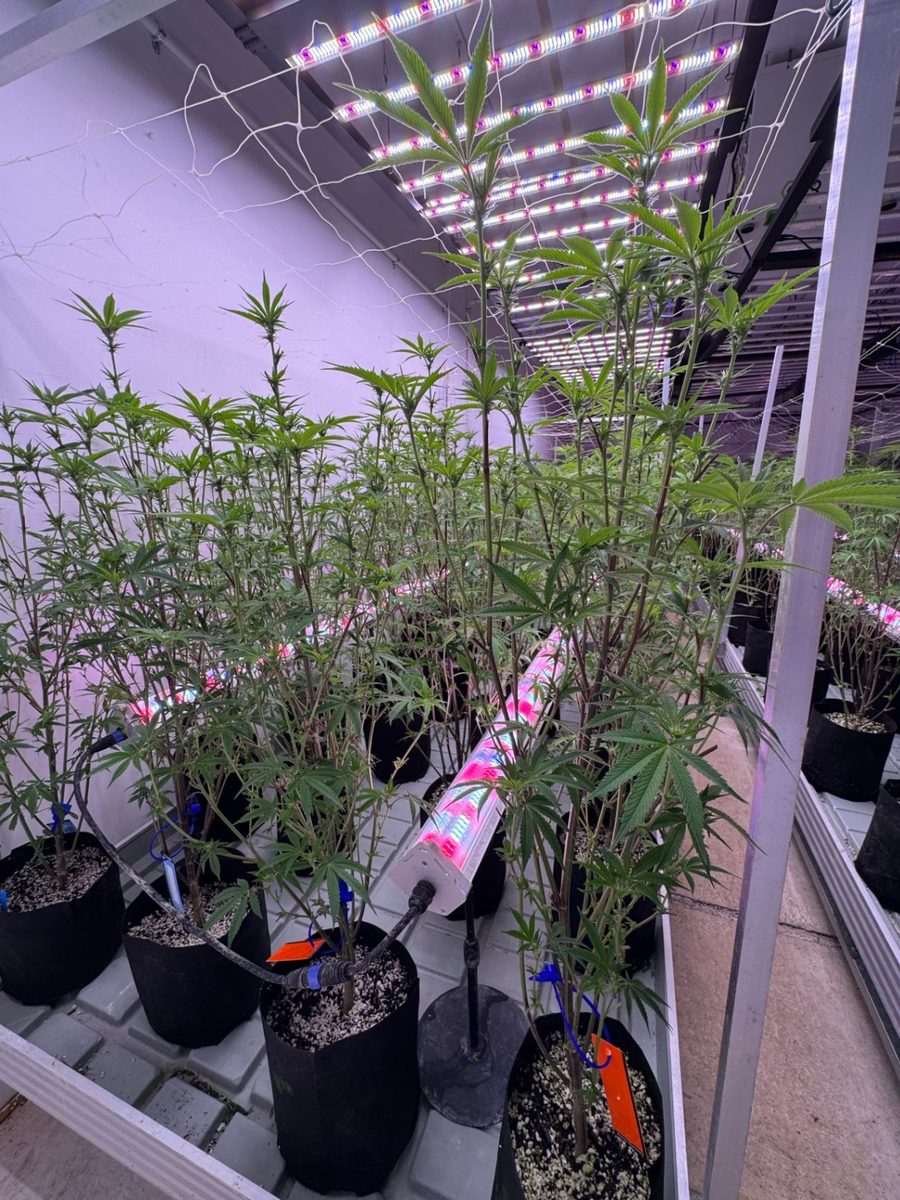
The room in the photo runs soil in fabric pots under a bar layout, and nothing about that light plan is wrong for hydroponics: the same grid, the same overlap, the same dimming schedule would serve a rockwool slab room. That is the practical summary. Substrate choice changes what the room must notice; it does not change what the room must deliver. If you want the two checked against each other for a specific floor plan, send the dimensions and the media you plan to run, and we will return the layout with the uniformity numbers attached.
Answer five questions in order and the decision makes itself. How thin is your capital, really, not on invoice day but across three cycles? How many hours of trained attention can your crew give the crop daily? How reliable are your power and water, counting the grid as it is, not as advertised? How hard does your buyer weigh batch-to-batch consistency? And how expensive is a lost cycle for you, priced at contract value rather than at input cost? Heavy capital but light attention pushes toward soil; the reverse pushes toward hydroponics; a buyer paying for consistency pushes toward whatever your crew can run without missing a morning.
The decision tree below compresses the same logic, and the branch most rooms forget is the last one: a mediocre system run attentively beats an excellent system run occasionally, in either substrate.
Grown to the same maturity under the same light, the visible differences are modest: hydroponic flower often runs denser and more uniform because every input was metered, while soil-grown flower varies more from plant to plant with the medium. Aroma and potency are dominated by genetics, harvest maturity and the dry-and-cure chain rather than by the substrate, so treat flavor claims attached to either system with caution.
Three, in practice. Delivery: hydroponics feeds a mineral solution directly to the roots, while soil nutrients arrive through microbial exchange, slower but buffered. Feedback: hydroponic systems report a mistake in hours, soil in days or weeks. Infrastructure: hydroponics buys pumps, meters and redundancy, soil buys media, space and drainage. The plant's light and photoperiod requirements are the same in both.
Soil, counted as cost per successful harvest rather than cost per purchase. A pot, a medium and a light finish a first crop while the fundamentals are being learned, and mistakes cost days. Hydroponics adds meters, pumps and daily attention before the grower has the habits that make those instruments useful. Upgrade once the basics are routine; the lighting carries over unchanged.
Faster through vegetative growth, yes, because oxygenated water and directly available minerals let the plant spend less on root foraging. The flowering phase runs on the genotype's own schedule in either system, and no substrate advances it. The speed converts into more cycles per year, which is a real gain paid for in more lighting hours and more labor turns.
The PPFD and DLI targets are identical. What tightens is the tolerance: soil masks a weak light map behind its buffer, while hydroponic growth tracks delivery closely, so dim cells surface within the cycle. Hydroponic rooms plan for the same targets with tighter uniformity, 10 to 20 percent fixture overlap and, in dense canopies, an under-canopy layer for the lower third.
No reliable evidence says so. Potency is set primarily by genetics, then by light delivered across the cycle, maturity at harvest and the post-harvest chain. Controlled substrate comparisons are scarce and usually confounded, because the two systems differ in several variables at once. Both systems reach the cultivar's ceiling; the light plan matters more than the substrate in getting there.
Different, and less forgiving of inattention. Soil teaches slowly, because its buffer converts mistakes into slow declines you can study. Hydroponics compresses the feedback, so the same mistake reaches the roots in hours, which is an efficient teacher with a harsh grading curve. A grower who has learned to read plants in soil usually transitions to hydroponics in a cycle or two.
Water culture or inert-substrate growing powered by sunlight instead of lamps, typically in greenhouses. It combines hydroponic input control with free photons, giving up photoperiod control and weather immunity in exchange. The lighting design question becomes the seasonal DLI deficit and how much supplemental light covers it, which is the greenhouse lighting calculation, not the indoor room's.
Yes, with a cost. Washing the soil from the roots, bare-rooting, shocks the plant and loses the fine root hairs that do most of the uptake, so expect days of slowdown and some leaf drop while the root system rebuilds for water culture. Commercial rooms rarely convert mid-cycle; they start clones directly in the medium the system runs, which is cheaper than any rescue.
Pumps stop, aeration stops, and a dense canopy under full light keeps transpiring, so the margin is hours, not days, in most designs before roots suffer. This is why hydroponic rooms buy redundancy: duplicate pumps, battery or generator backup for aeration, alarms on the reservoir, and staff trained to respond before the canopy wilts. Soil rides the same outage comfortably, which is the buffer argument in its purest form.
For learning plant science, yes; for saving money, rarely. A single-tent hydroponic setup spends most of its budget on instruments and redundancy for a few plants, while hand-watered pots in the same tent under the same light reach the same ceiling with a fraction of the hardware. The tent is where hydroponic skills are cheap to practice and expensive to justify.
It hides one, for a while. A soil bed keeps feeding and watering a plant sitting in a dim cell, so the deficit surfaces slowly as a soft gradient rather than as visible stress. Hydroponics reports the same cell within the cycle through stretch and bud distribution. Neither changes the physics: the dim cell still produces less, whichever system was polite about it.
Send the room dimensions, the media you plan to run and the fixtures you have today. We answer with the layout that holds uniformity at your target PPFD in either system, the root-zone temperature checks that pair with it, and a fixture quote to match.
