
Search "when should you replace LED grow lights" and most of what comes back is written for a tent: swap the bulb when it flickers, upgrade every five to seven years, watch for dimming. Some of that transfers, and the parts that do are the boring ones. What almost never gets written is the version that matters to a facility running hundreds of fixtures over multiple flower rooms, where the question is not whether one fixture still glows but whether a lighting fleet still delivers the light levels the cultivation plan was built on.
The stakes are different at facility scale for a simple reason: the lighting plan and the rest of the building were designed together. The fixture count, the wall wattage, the electrical service, the cooling load and the target PPFD at the canopy were all sized against each other during the original build. When fixtures age and drift below that target, the room does not announce it. Plants stretch a little, cycle times creep, and nobody points at a fixture, because every fixture still turns on. This page is about finding the drift early and acting on it deliberately, written from the equipment side of the table.
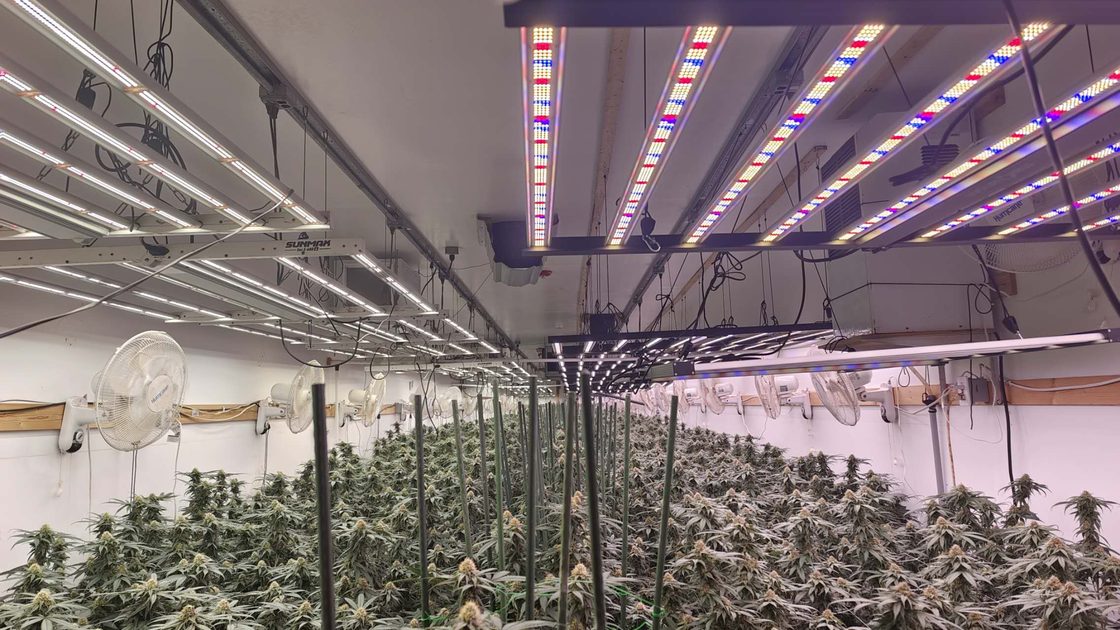
The Short Answer: Four Triggers, Not a Calendar
An LED fixture has no consumable that a technician swaps on a schedule. That is the core difference from the HPS era, where lamp replacement was calendar work: lamps lost spectrum and output fast enough that facilities replaced them on fixed intervals whether they needed to or not. LED fixtures degrade slowly, unevenly and mostly invisibly, which is why a calendar is the wrong instrument. The right instrument is a set of triggers, each with its own signal and its own data.
Four triggers cover nearly every replacement decision a facility faces. They are listed in the order they usually arrive: light output drift is the slow one that starts on day one, driver failures are the random ones that start appearing after the warranty period, the efficacy gap between generations grows every year as new fixtures improve, and the business events arrive on their own schedule regardless of the hardware. A facility that tracks all four will replace some fixtures earlier than its neighbors and others much later, and that unevenness is the point: the decision follows the data, not the calendar.
| Trigger | The signal | The data that decides | The typical first move |
|---|---|---|---|
| 1. Canopy drift | plants respond before people do: stretch, slower finish, a room that seems dimmed | the measured grid against the commissioning baseline and the datasheet maintenance factor | deep clean and inspection, then a driver check, then a replacement plan for what remains |
| 2. Driver failures | flicker on strike, dead channels, units that will not turn on | part availability, swap labor, and the failure pattern tracked by batch and install date | repair young fixtures with catalog drivers; forecast batch aging before it forces the issue |
| 3. Efficacy gap | the market moves while the fleet stands still | the ratings delta between generations, your rates and hours, and the net cost of the swap | compute the payback for the oldest room first, with numbers from real bills |
| 4. Business events | warranty expiry, depreciation close, rebate window, room rebuild | the calendar of clocks that runs alongside the hardware | inspect and measure before each clock closes, then decide on schedule rather than in an emergency |
The rest of this page works through each trigger in turn, then covers what does not justify a replacement, how to measure the drift without a laboratory budget, the money arithmetic of running, repairing or replacing, and what to demand from the supplier who wins the replacement order. One boundary applies throughout: nothing here promises a specific lifespan for any fixture, because lifespans are stated in datasheets, not in articles. The numbers that matter for your facility are the ones printed on your fixtures' own datasheets, and the measurement method below tells you how to check reality against them.
What Actually Wears Out in an LED Fixture
An LED grow light is three systems in one box, and they age at different rates. Understanding which part is aging tells you which trigger is approaching and what the replacement actually looks like when it comes.
The diodes age the slowest and the most predictably. Photon output declines gradually with operating hours and junction temperature, a process called lumen depreciation, and quality diodes in a well-cooled fixture lose only a few percent of their output over many thousands of hours. The failure mode is drift, not death: the fixture still turns on, the spectrum barely moves, and the room is simply a little dimmer than it was. Because the decline is slow, no single measurement detects it. Only a comparison against a baseline does.
The driver is the first component to fail in most fleets, and it fails the old-fashioned way: electrolytic capacitors dry out, solder joints fatigue under thermal cycling, and one day a fixture will not strike or begins flickering. Drivers are also the part most exposed to the room environment, because heat and humidity attack them from both sides of the board. The good news is that drivers are replaceable components, which is why a driver failure starts a repair-versus-replace calculation rather than ending in a verdict. The bad news is that driver models get discontinued, and a fixture whose driver is no longer manufactured is a different decision than one whose driver is a catalog part.
Everything in between ages by environment: connectors corrode in humid rooms, cables get damaged by scraping and trolley strikes, lens covers collect dust and mineral film that steal output long before the diodes do, and gaskets that once sealed the enclosure harden and crack. This middle layer is the reason a cleaning and inspection pass belongs in the maintenance calendar even though the fixtures themselves are not consumables. A fixture that measures well below its baseline is sometimes not degraded at all, just dirty, and the measurement method in a later section is designed to catch exactly that before anyone spends money.
Start From the Datasheet, Not From a Forum
Every commercial fixture datasheet states lifetime figures, and reading them correctly is the foundation of the whole replacement decision. The two terms that matter are L90 and L70. L90 is the number of operating hours at which the fixture is specified to still emit at least 90 percent of its initial output; L70 is the same statement at 70 percent. A datasheet that says L90 at 60,000 hours is making a specific, testable claim: run the fixture 60,000 hours and it should still be within ten percent of new. These figures are typically extrapolated from accelerated aging tests under industry standards, so treat them as the manufacturer's commitment rather than a guarantee for your room's exact conditions.
Two adjustments turn the datasheet number into a planning figure. First, the rating assumes a junction temperature the fixture only enjoys when cooling works: a fixture run hot, in a stuffy room or caked in dust, depreciates faster than its rating, which is one more reason the room environment belongs in the maintenance conversation. Second, the rating assumes the fixture runs its rated current; a fixture dimmed to half output for a young-plant room accumulates hours more slowly in wear terms than the same fixture at full power in a flower room. Neither adjustment changes the order of magnitude, and both are reasons to measure rather than to distrust the datasheet.
The datasheet also supplies the number most facilities skip: the maintenance factor, sometimes called the light loss factor. Lighting designers apply it when sizing a room, precisely because fixtures drift. A room designed for a target PPFD at end of life was sold more light on day one so that it still meets the target after years of depreciation. That has a practical consequence for replacement timing: a room meeting its target today may be doing so because it is still riding that day-one surplus, and the honest way to know how much margin remains is to measure, which is the next trigger.
Trigger 1: Canopy PPFD Has Drifted Below the Design Target
The first trigger is the one that matters to the plants and therefore to the business: the canopy no longer receives the light level the cultivation plan assumes. Every room was built around a target, whether it was written as a PPFD figure at a defined height, a daily light integral, or a fixture count from a layout drawing. Fixtures drift, diffusers foul, reflective surfaces dull, and over the years the room slides away from the number it was commissioned at. The plants respond before anyone does: elongated internodes in flower, slower finish, and a crop that behaves as if it were running a dimmer nobody touched.
The diagnosis is a comparison, and it needs three inputs. The first is the baseline: the PPFD grid measured when the room was commissioned or at some documented point when the fleet was known good. The second is a remeasure of the same grid points under the same conditions, ideally annually and always before a major decision. The third is the datasheet maintenance factor, which says how much drift the design already anticipated. A room that has lost three percent against baseline is aging normally. A room that has lost twelve percent is either aging fast, badly fouled, or was never quite what the paperwork said, and each of those has a different remedy: deep clean, driver check, or replacement plan.
One caution keeps this trigger honest: compare measurements taken the same way. PPFD readings shift with fixture dimming state, meter positioning, ambient daylight in greenhouse-adjacent rooms and meter calibration drift. A two-point drop measured with an uncalibrated meter in a differently dimmed room is not a trigger, it is noise. The measurement section below describes a grid and logbook method that survives comparison across years. And note what this trigger does not do: it does not tell you whether to replace the whole fleet, because the drift is rarely uniform. Per-fixture measurement, fixture by fixture and row by row, usually reveals a small number of underperformers dragging a fleet average, and replacing the underperformers first is the cheapest possible version of this decision. The fixture-count arithmetic behind partial replacement is the same one described in our guide to how many fixtures a room needs.
Trigger 2: The Driver Fails, and the Repair Quote Decides
The second trigger arrives as an event rather than a trend: fixtures start failing, one at a time, in ways that have nothing to do with gradual drift. Flicker on strike, dead channels, units that hum and stay dark. In most fleets the driver is the component that fails, and the first few failures during the warranty period cost nothing but a service ticket. The decision begins when failures outpace the warranty, because from that point every failed driver starts a small calculation: repair or replace.
The calculation has four inputs, and it is worth writing them down the first time so the second failure takes minutes instead of a week. The driver part cost and availability, which depend on whether the driver is a current catalog part or a discontinued model. The labor to swap it, which ranges from ten minutes on a fixture with a serviceable driver tray to a full fixture drop-and-return on sealed designs. The shipping and handling reality of a heavy fixture coming down from a room that is mid-cycle. And the age of the fixture itself, because a repair on a fixture that is also sixty percent through its rated life buys less runway than the same repair on a young one.
| The situation | What it usually means | The repair case | The replace case |
|---|---|---|---|
| Single failure, young fixture, catalog driver | an isolated component event | strong: a swap restores the fixture fully at modest cost | rarely justified by one unit |
| Repeated failures, one batch, aging fixtures | a batch pattern approaching the end of its practical life | bridging only, while the replacement plan runs | the fleet data supports a phased replacement project |
| Driver model discontinued | the repair option is on a countdown | worthwhile only while spares last | plan the replacement before the last spares are gone |
| Fixture near rated life and off its datasheet curve | ordinary aging, accelerated by environment | buys little runway at a worse price each year | the replacement trigger speaking plainly |
Two fleet-level observations sharpen the trigger. First, driver failures cluster: a batch of fixtures that shares a driver model and a production period tends to fail on a similar clock, so the third failure in six months is a signal about the batch, not just the unit. Tracking failures by room, batch and install date turns scattered annoyances into a forecast, and a forecast of repeated driver failures on aging fixtures is the strongest repair-versus-replace evidence there is. Second, availability is the quiet deadline: when the manufacturer announces the driver model is end-of-life, the repair option is on a countdown, and facilities that plan the replacement before the last spares are gone schedule the work on their own terms instead of during an emergency. The thermal and electrical side of keeping drivers alive in the first place is covered in our grow room safety and energy guide.
Trigger 3: The Efficacy Gap Between Generations Pays for Itself
The third trigger is the one nobody schedules and everybody eventually meets: the market moves. Fixture efficacy, measured in micromoles per joule, has improved steadily across the industry's LED generations, and a fleet that was competitive at purchase becomes a fleet that pays last decade's electricity rate for this decade's light. The trigger fires when the arithmetic of swapping an older fleet for a current one closes inside a payback window the business accepts, and the arithmetic is public, testable, and mostly about your own utility rate and operating hours.
Worked honestly, the arithmetic has three terms. The first is the efficacy delta: a fixture generation rated at 2.0 micromoles per joule and a current generation at 3.0 do not merely differ on a spec sheet, they differ in wall wattage required to deliver the same photosynthetic output, and the ratio between the two ratings is the fraction of lighting energy the newer fleet no longer draws. The second term is your exposure: kilowatts of lighting load times operating hours times your delivered rate, which for a facility already tracking demand charges is a number the bills already contain. The third term is the net cost of the swap: the new fixtures minus whatever the old fleet returns as scrap, resale or trade-in, plus electrical and disposal labor. When the annual energy difference divided into the net cost yields a payback the business finds acceptable, the trigger has fired, regardless of whether the old fixtures still work.
Two honesty checks keep this trigger from justifying premature projects. First, the delta must be real, measured in datasheet figures at the same driving conditions, not marketing comparisons between a premium new fixture and a bargain-bin ancestor. Second, the swap must genuinely be driven by energy: a facility whose rooms run few hours, or whose rates are low, may find the same swap takes a decade to close, which changes the answer entirely. The full method, including how efficacy figures are defined and how to compare them between datasheets, is in our guide to fixture efficacy, and the demand-charge arithmetic that determines what a saved kilowatt is actually worth is in our guide to demand charges and lighting load.
Trigger 4: The Business Event, Not the Fixture
The fourth trigger has nothing to do with hardware condition, and facilities that ignore it end up making the same replacement decision at the worst possible moment, mid-emergency. Several business clocks run alongside the fixtures, and when one closes, the replacement question is already on the table whether the fixtures are aging or not.
Warranty expiry is the simplest. A commercial fixture warranty is a cost-sharing agreement that ends on a date, and a fleet approaching that date should get its inspection and measurement pass before the date, not after, because defects discovered inside the window are the manufacturer's problem and the same defects discovered a month later are yours. The depreciation schedule is the accountant's version: when the lighting fleet reaches the end of its booked life, the capital conversation about the next fleet is open whether or not anyone planned it, and a replacement project that lands in the same fiscal year as the schedule closure competes for budget on far better terms than one that arrives as a surprise. Utility rebate windows belong to the same family: programs that pay per watt saved open and close on the utility's calendar, and a replacement project that qualifies for a current program differs from the identical project a quarter later by the size of the incentive. Room events are the last and often the largest: a room rebuild, a change of cultivation method, a bench reconfiguration or an expansion phase already scheduled will touch every fixture in the room anyway, and a lighting fleet assessment belongs in that project's scope by default rather than as an afterthought.
The discipline that ties the family together is a calendar of its own: keep the warranty end dates, the depreciation close dates and the facility's project roadmap in one list alongside the measurement logbook, and review the list annually. Most facilities that feel ambushed by lighting replacements were not ambushed by hardware. They simply never put the business clocks and the hardware data on the same page.
What Does Not Justify a Replacement
Just as important as the four triggers is the list of reasons that should not open a capital project, because the replacement market sells against them constantly.
A newer spectrum on the datasheet. Spectrum evolution is real and some of it matters, which is why our guides to wavelengths and to ultraviolet and far-red additions exist. But a spectrum claim is a reason to evaluate a fixture, not a reason to scrap a fleet that measures well and meets its targets. If the agronomic case for a spectral feature is strong, it will survive a pilot: buy a small number, run them against the incumbent fleet in the same room, and let the plants vote before the fleet decision. Fixture age alone. A fixture that is old but holds its baseline and passes inspection is not a liability, it is a paid-off asset, and replacing it early to feel current is a subscription to other people's marketing. The calendar is exactly what this page argues against. One or two bad units. Failures happen in every fleet; what justifies a project is a pattern, tracked by batch and room, not the first dead unit. Competitor floor plans. Facilities modernize at different paces for different reasons, and the only fleet comparison that matters is against your own baseline and your own numbers.
The pattern behind the whole list: a replacement decision is justified by data about your fleet and money about your building, and everything else is a hypothesis that should be bought in small quantities and tested before it is bought by the room.
How to Measure the Drift Yourself
Every trigger above runs on measurements, and the measurements do not require a laboratory: they require a meter, a grid, a logbook and the discipline to repeat the same procedure. Facilities that build this habit catch fouling, batch defects and genuine drift years before the plants make the case for them.
Establish the baseline when the room is young. After commissioning, or after any full replacement, measure PPFD at a fixed set of canopy points: a grid that covers the benches, the edges and the known weak zones, with fixture dimming state and time of day recorded. Photograph or save the controller settings. Log everything in a document that lives with the room, not in someone's inbox. A quiet carbon dioxide enriched or high-DLI room can be measured with the same method; the grid is what matters, not the target. Remeasure on an annual rhythm and after any event. Once a year, and after any electrical event, cleaning campaign or controller change, run the identical grid. The comparison only works if the conditions match, so the logbook entries matter as much as the numbers. Interpret against both baselines at once. Compare the new grid to the room's own history and to the datasheet maintenance factor. A room tracking its datasheet curve is healthy; a room falling off the curve early is telling you something the datasheet cannot, and the something is usually fouling, cooling or a batch issue rather than ordinary diode aging.
Keep a per-fixture fleet sheet. Alongside the room grid, the fleet sheet records install date, batch, driver model, warranty end, failure history and any single-fixture measurements. It is a boring spreadsheet that does two outsized jobs: it converts scattered failures into batch patterns for the driver trigger, and it turns the eventual replacement project from a scramble into an ordered list of what goes first. The cleaning pass belongs here too, because a fixture that recovers after cleaning was never a replacement candidate, and the only way to know is to measure before and after the wash.
The Money Table: Run, Repair, or Replace
The three triggers and the fleet data compress into one decision framework, and it fits in a table. For any fixture or fleet under question, the realistic options are to run it as is, to repair it, or to replace it, and each option has a cost, a benefit and a condition under which it wins. The version below is the one facilities actually fill in, with their own numbers, and the exercise of filling it in once is usually worth more than any article on the subject.
| Option | What you spend | What you get | It wins when |
|---|---|---|---|
| Run as is | a cleaning pass, an annual measurement and the meter's calibration | a paid-off asset keeps working, and the fleet sheet keeps score | the room tracks its datasheet curve and still meets its targets |
| Repair | the driver part, the swap labor and the freight a fixture rides down and back up | full output restored on a fixture the fleet already owns | fixtures are young and drivers are current catalog parts |
| Replace | the new fleet net of scrap, resale or trade-in, plus electrical and disposal labor | current-generation efficacy, a fresh warranty clock and a new commissioning baseline | the efficacy payback closes inside the accepted window, or the business clocks align |
Reading the table honestly requires the numbers to be real: the delivered electricity rate from an actual bill rather than an average, the labor quote from whoever will actually do the work, and the residual value of the old fleet estimated pessimistically rather than optimistically. One more measurement note belongs here, because it prevents a common and expensive mistake: PPFD meters drift too, and a five-year-old meter that has never been recalibrated is not a reliable witness. Note the meter model and calibration date in the same logbook, and have the meter checked on the manufacturer's interval. An entire replacement project can be miscast by a meter that reads low, so the cheapest line item in the whole decision is the meter's own service record.
Why HPS Replacement Habits Do Not Transfer
Facilities converting from high-pressure sodium carry habits that actively distort the replacement decision, and naming them is faster than unlearning them slowly. HPS lamps were consumables: they lost output and spectrum stability quickly, were cheap relative to the fixture, and were swapped on a schedule as a matter of course. LED fixtures broke that model, and the habits built around it need retiring one by one.
Three stand out. The lamp-swap reflex: there is no lamp to swap, and a fleet that waits for visible failure is waiting for the driver trigger while ignoring the drift trigger, which arrives years earlier and without an event. The fixture-equals-lamp accounting: HPS budgeting treated lighting as an operating expense with a small annual consumables line, while LED fleets are capital assets with a datasheet, a warranty and a depreciation schedule, and they reward the asset-management habits described above. The five-to-seven-year folklore: the honest version of that interval is "the point at which a typical fleet's efficacy gap and business clocks align", which is a calculation, not a number, and it moves with rates, hours and rebates. Facilities still running sodium today face a different and simpler version of this page: for them, the conversion decision, its pitfalls and its first-month checkpoints are covered in our LED retrofit guide, and the technology comparison itself in our LED versus HPS guide.

Buying the Replacements: What to Ask Before You Sign
When the triggers converge and the project becomes real, the replacement order deserves the same procurement discipline the original build had, with two additions the second time around makes possible: your own fleet data, and a market that has moved.
Buy against your measured grid, not against a catalog coverage claim. The replacement project is the one moment when a facility knows its canopy better than any salesperson: send the supplier the room dimensions, the ceiling height, the target PPFD and the measured weak zones, and ask for a fixture count, a layout and the wall wattage behind it, exactly as a first purchase deserves. A supplier who quotes from the drawing rather than the catalog is demonstrating how the next five years of service will go, and the questions that separate suppliers are the same ones in our guide to choosing a grow light supplier. Buy the serviceability, not only the fixture. Ask which driver models the design uses and whether they are catalog parts with stated availability, ask how the driver is accessed in the field, and ask what the warranty covers and for how long, in writing, including who pays freight on a warranty claim. Fleets live or die on the driver trigger, and the answers to these questions are the difference between a repair and a replacement the next time a batch ages out. Buy the phasing with the rooms. Replacement projects run alongside crops, and the supplier who can phase deliveries room by room, hold fixture counts against your installation calendar and support commissioning measurements at each phase is worth more than a margin difference on the quote.
A closing note on the moment of commissioning: the day the last new fixture is hung and energized is the day the new baseline grid gets measured. The fleet that replaces this one, years from now, will make its decision against the numbers captured that week, which is the quiet argument for treating measurement not as a project activity but as a standing habit of the facility.
A Replacement Walkthrough You Can Run This Quarter
The argument of this page compresses into a short sequence any facility can run without stopping production, and running it once converts the replacement question from an anxiety into a standing agenda item.
One. Assemble the fleet sheet: install dates, batches, driver models, warranty end dates, failure history to date. Two. Run the PPFD grid on one representative room and compare against commissioning numbers or, missing those, against the datasheet maintenance factor as a stand-in. Three. Add the business clocks: warranty expiries, depreciation closes, known rebate windows and any scheduled room projects for the next two years. Four. Compute one efficacy-gap scenario for the oldest room in the fleet, using current datasheet figures and your delivered rate and hours, and see whether the payback lands inside a window your business would accept. Five. Write the result down as a one-page standing plan: which trigger is closest, what the next measurement date is, and what event would promote the replacement from plan to project. Facilities that do this once rarely need to be persuaded again, because the page they end up with is the answer to "when should we replace" in their own building, in their own numbers, on their own clock.
Frequently Asked Questions
How long do LED grow lights actually last?
The honest answer lives on the fixture's datasheet, stated as an L figure: the hours at which the fixture is specified to still emit a given share of its initial output, commonly quoted with figures such as L90 at tens of thousands of hours for commercial-grade products. The rating assumes the fixture runs cool, clean and at rated current, so a real facility's result tracks the datasheet only as well as its cooling, cleaning and electrical hygiene allow. Treat the datasheet as the manufacturer's commitment, measure your own fleet against it annually, and let the four triggers in this guide, not a calendar, decide the replacement.
Can I replace just the driver instead of the whole fixture?
Often yes, and it is frequently the right call for a young fleet: a driver is a replaceable component, and a catalog part swapped by a technician restores the fixture fully. The decision changes when the driver model is discontinued, when the fixture design makes the swap a full drop-and-return, or when the fixture is already well into its rated life, because a repair buys less runway each year. Track failures by batch: repeated driver failures across one batch of aging fixtures usually means the fleet is approaching the replacement trigger, while a single failure on a young fixture is a repair ticket.
How often should I measure PPFD in a flower room?
Annually at minimum, on a fixed grid with the dimming state and conditions recorded, plus a remeasure after any electrical event, cleaning campaign, controller change or room modification. The value is not in any single measurement but in the comparison across years, which is what catches drift while it is still cheap to act on. Keep the logbook with the room, note the meter model and calibration date alongside, and treat an unexplained drop as a cleaning and inspection prompt before assuming the diodes have aged.
Is it worth replacing fixtures that still work?
Sometimes, and the case is arithmetic rather than sentiment. Working fixtures can still be the wrong fixtures when the efficacy gap between their generation and the current market translates, at your rates and hours, into energy savings that close the net cost of the swap inside a payback window your business accepts. The same arithmetic often fails at low rates or short operating hours, which is why it must be computed, not assumed. The other working-fixture replacements are triggered by business clocks: a warranty ending, a depreciation schedule closing, or a room rebuild that touches every fixture anyway.
Do LED grow lights dim over time?
Yes, gradually, through lumen depreciation of the diodes, and the decline is slow enough that no single visit to the room detects it. Optical fouling adds a second, faster layer of dimming that cleaning reverses, and driver problems add a third layer that announces itself as flicker or dead channels rather than smooth decline. Because the plant response to slow dimming is subtle, the reliable detector is a repeated measurement grid compared against a baseline, not the eye and not the plants.
What PPFD drop should trigger a replacement?
There is no universal number, because every room was sized with its own margin. The comparison that matters is against two references at once: the room's own commissioning baseline and the datasheet maintenance factor the design already anticipated. A room tracking its datasheet curve is aging normally, while a room falling off the curve early deserves a cleaning and inspection pass first, a driver check second, and a replacement plan only when the measured drift persists after both. Watch for unevenness too: a fleet average can hide a handful of underperformers that are cheaper to replace individually.
Should I replace all fixtures at once or room by room?
Room by room, in almost every operating facility. Phasing keeps flower rooms in production, spreads capital across fiscal periods, lets each room's commissioning measurements become the next room's reference, and gives the electrical and disposal work a schedule instead of a crunch. Whole-fleet swaps make sense mainly when a rebuild or an expansion phase already has the rooms empty, or when a batch defect forces a recall-style response. Whatever the phasing, measure each room's baseline the week its new fixtures are commissioned.
Does replacing HPS with LED change my HVAC?
Yes, and in both directions, which is why the conversion deserves an engineering pass rather than a watt-for-watt swap. LED fixtures send less radiant heat toward the canopy at the same light level, so rooms often run cooler at the canopy while the air-side balance shifts, and dehumidification behavior changes with it. The wall wattage drawn by lighting also changes the electrical load picture, including demand charges. Treat the conversion as a lighting-plus-climate project: the retrofit checkpoints are in our LED retrofit guide and the load arithmetic in our demand charges guide.
What warranty should I expect on commercial LED grow lights?
Commercial-tier fixtures commonly carry multi-year warranties, with five years a frequent figure in the current market, but the length matters less than the terms. Read what is covered, component by component, with drivers the item to check first; who pays freight on a claim; whether replacements ship first or after return; and how the manufacturer handles a discontinued driver near the end of the term. Align the fleet sheet with the warranty calendar, and get the inspection and measurement pass done before the warranty ends rather than after.
Can I mix old and new fixtures in the same room?
You can, and many facilities do while phasing a replacement, but mix deliberately rather than accidentally. Check that both fleets respond to the same controller and dimming protocol so the room behaves as one system, compare the light distribution of the two generations so the canopy does not develop a patchwork, and measure the mixed room rather than assuming the averaged output. A mixed room is also a natural pilot bed: the newer fixtures running alongside the incumbents produce exactly the comparison data the next replacement decision will need.
Do utility rebates pay for replacing fixtures that still work?
Some programs do, and some restrict payments to cases where the replaced equipment meets specific age or efficiency criteria, so the honest answer is that eligibility rules vary by program and change over time. What a facility can control is the timing: keep the replacement plan current, check the utility's active programs before committing the project, and let a live incentive window influence the calendar among otherwise acceptable dates. A rebate improves the arithmetic of a project the triggers already justify; it should not be the trigger by itself.
When is repair the better answer than replacement?
Repair wins when the fixture is young, the driver is a current catalog part, the access is serviceable and the failures are isolated. It loses ground as the fixture ages, as failures cluster into batches, and as parts availability narrows, at which point each repair buys less runway at a worse price. The practical test is the fleet sheet: a single failure among young fixtures is a ticket, a third failure in six months on one batch is a forecast, and a forecast of repeated failures on fixtures near the end of their rated life is the replacement trigger speaking in its most concrete voice.