
The Clock You Are Working Against
Autoflowering cannabis begins to flower by age rather than by night length. The trait comes from Cannabis ruderalis and behaves as a recessive allele at a single locus, autoflower1, which was mapped in 2022. The practical consequence is simple: roughly three to four weeks after germination the plant starts reproductive growth whether the lamp runs 18 hours or 24. Nothing in the light schedule starts it, and nothing in the light schedule stops it.
That removes the one dial a photoperiod grower relies on. In a photoperiod room, a slow week can be answered with another week of vegetation, and a plant that outgrows its neighbours can be held back until the canopy levels. In an autoflower run there is no such correction. The plant keeps moving through its program on the same schedule whether the room is ready or not, which is why the timing decisions in this guide are mostly about reading the plant correctly rather than about following a calendar.
The working life of a modern autoflower is 70 to 90 days from germination to harvest. A 2026 controlled trial discussed below ran a fast F1 line to harvest in 75 days, which is a useful anchor for what a well-managed room looks like. Short-cycle lines finish in 65 to 75 days, balanced hybrids in 75 to 85, and sativa-leaning or XXL lines in 85 to 100. The number is a property of the cultivar, not a result of how cleverly the room is run, and the difference between a 70-day line and a 95-day line is a scheduling decision made at seed purchase.
This is also why two plants sown on the same day can be two nodes apart by week three. Temperature, root-zone health and the daily light integral all move how fast the plant builds structure before the clock turns, and none of them move the clock itself. Node count and the first pistils are therefore better triggers than a date on the wall. The calendar tells you what to expect; the plant tells you what to do.
When to Top Autoflowers: The Window in Practice
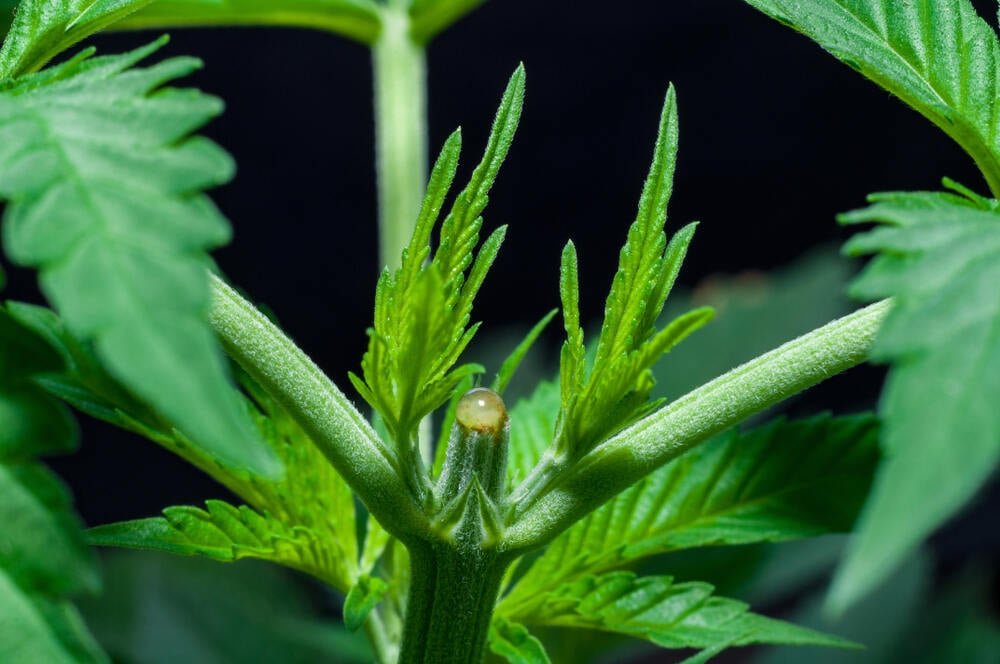
A node is the point on the stem where a pair of leaves meets it. The two cotyledons at the base do not count, and neither does the first pair of single-blade leaves on a young seedling. Start counting at the first pair of fully serrated true leaves and work upward. On a vigorous plant in a warm room at a proper daily light integral, the fourth and fifth nodes are usually visible between day 18 and day 21. On a slower plant the same stage may not arrive until day 25 or later, which is exactly why the calendar is a poor trigger.
The cut itself is simple. Once the plant carries four or five true nodes and none of them shows a pistil, remove the growing tip just above the fourth node. The two shoots sitting at that node take over as leaders, and the plant's growth is redistributed across a wider top instead of a single dominant stem. Some growers cut one node lower, above the third; that is slightly earlier, slightly less mass removed, and slightly faster to recover. Either position works. What matters is that the plant had enough nodes below the cut to keep growing, and that the cut happened before the plant committed to flower.
The window closes on a visual signal, not a date. The first white pistils emerging at the nodes mark the start of pre-flower, and from that point the plant is spending its resources on flower formation. A cut made after that does not buy more branches; it takes leaf area and recovery time away from a plant that has already started its reproductive program. On a fast autoflower the first pistils can appear on day 21, so a plant that looked ready on day 18 may be closed by day 22. Check the nodes every couple of days once the fourth node is visible.
Do not stack stresses. Topping in the same week as a transplant, a defoliation pass or a nutrient change gives the plant three problems to solve with one recovery budget. The plant should be actively growing, with healthy new leaves and no sign of pests, before any cut is made. A sterile blade matters more than it does on a photoperiod plant, because there is no extra month of vegetation to outgrow an infection at the wound.
After the cut, hold the environment steady for a week and watch for new growth from the two shoots. Five to seven days is the normal response in a healthy room. If the plant has not moved by day seven, the cut was probably too early or the plant was already stressed; leave it alone and let the clock run. The alternative to topping is low-stress training, started around day 10 to 14 by bending the main stem and tying it down. LST costs no recovery time and is the better choice for a weak plant, a first autoflower run, or a room where height is not the constraint.
| What you see | What it means | What to do |
|---|---|---|
| Fewer than four true nodes | Root system and reserves are not ready | Wait, recount in three or four days |
| Four to five nodes, no pistils, active growth | Window is open | Cut just above the fourth node |
| First white pistils at the nodes | Pre-flower has begun | Do not cut; switch to LST |
| Visible flower clusters | Flowering is under way | No topping at this stage |
| Droop, burn, pests or stalled growth | Recovery budget already spent | Fix the cause before any cut |
| Transplant week | Two stresses stacked | Postpone one of them by a week |
What the Evidence Says About Topping and Yield
The most direct evidence on autoflowers comes from a 2026 controlled trial run by Grodan with CRIC Labs and Royal Queen Seeds. Forty-eight Medusa F1 autoflowers were split into two groups of 24. One group was topped during early vegetation and the other was left intact. Everything else was held constant: 5.4 plants per square metre, rockwool blocks, 1,000 µmol/m²/s at 18/6, an EC of 2.4 to 2.7, and 75 days from germination to harvest. This is a tightly controlled commercial-style run, not a tent comparison.
| Measured | Topped | Untopped | Result |
|---|---|---|---|
| Yield per plant | 255 g | 270 g | 15 g lower, not statistically significant |
| Final height | 74 cm | 84 cm | 10 cm shorter |
| Main cola length | 19 cm | 21 cm | 2 cm shorter, growth moved to side shoots |
| Cannabinoid concentration | Modest increase | Baseline | Direction positive, size not specified |
| Sugar leaf share | About 2 points higher | Baseline | More trim labour per kilo |
| Cycle length | Up to one week longer | 75 days | A planning cost, not a plant failure |
Source: Grodan, CRIC Labs and Royal Queen Seeds, controlled trial on Medusa F1 autoflower, published January 2026. One cultivar, one environment, optimal conditions. The authors state that the results should not be generalised to every autoflower line without further study.
Read the table as a description of where the mass went, not as a verdict on whether the cut was worth it. The topped plants gave up 15 g per plant and 10 cm of height, kept the same harvest window to within a week, and spread their flower over more terminal sites. The authors' own conclusion is that topping is agronomically viable when applied early, that it does not increase yield, and that its value is canopy management: height control, light distribution and a more uniform top. In a room with a hard height limit, that trade can be worth making. In an open room with good light penetration, it is labour spent for a shape you may not need.
Why Topping Makes a Bushier Plant Without Making More Flower
The shoot tip produces auxin, which travels down the stem and keeps the buds at each node dormant. Cut the tip off and that supply stops, while cytokinins moving up from the roots take over and release those buds. The plant does not create new growth; it redistributes the growth it was already going to make. A single dominant cola becomes several smaller ones, and the stem, petiole and sugar-leaf fraction rises. In the 2026 trial the sugar-leaf share was about two points higher and the main cola was 2 cm shorter. Bushier is a shape, not a yield.
Two other studies fill in the mechanism, with caveats that matter. A 2026 study in the Journal of Cannabis Research topped two industrial hemp cultivars above the fourth, fifth and sixth node in a greenhouse. Topping reduced height by 17 to 25 percent, increased lateral shoot length, and produced the highest fresh and dry biomass at the fourth and fifth nodes. The plants also showed higher photosynthetic rates and higher CBD and CBG content at the fourth-node cut. That is a clean demonstration that node position matters and that the fourth and fifth nodes are a sensible target, but the crop was industrial hemp, grown in pots and in a greenhouse, and it was photoperiod-sensitive. A 2022 medicinal cannabis study found that an apical cut raised inflorescence dry mass from 16.3 to 18.5 g per plant, while the effect on CBD yield across the experiment did not clear conventional significance, with a p-value of 0.0923.
The pattern across all three is consistent. Removing the apical meristem releases lateral buds and changes architecture; that part is reliable plant physiology. Whether the change shows up as more usable flower depends on genotype, plant density, light distribution and how much productive tissue was removed, and in the one trial that used an autoflower, it did not. Treat topping as canopy engineering. It is a legitimate tool for a height-limited room, a strain that stretches into the fixture, or a canopy that needs to be flattened before flower. It is not a yield button, and the honest expectation is a similar harvest in a shorter, wider plant.
How Long Do Autoflowers Flower?
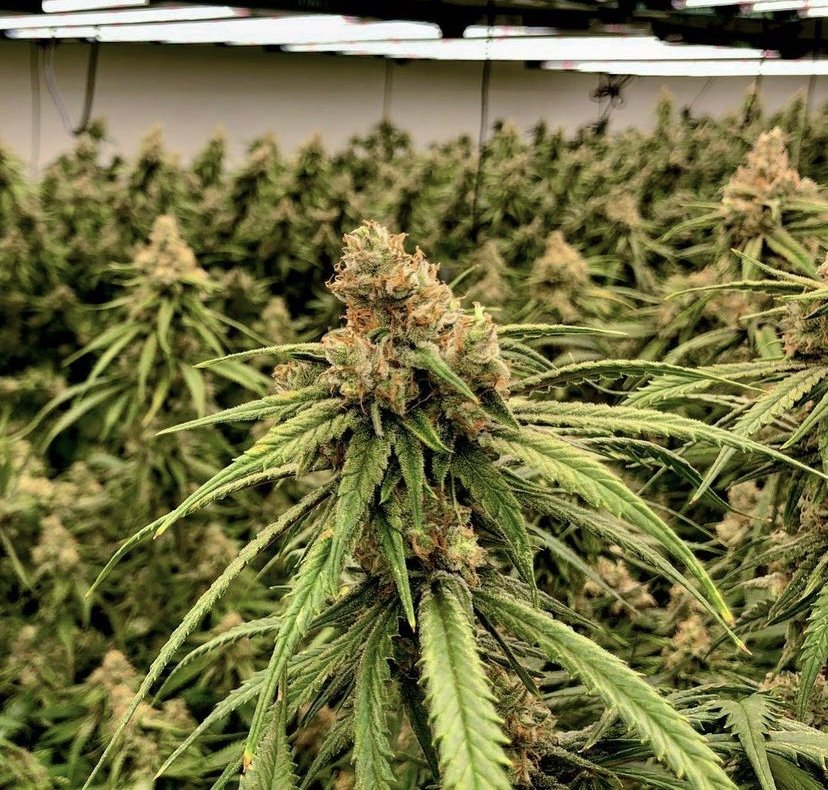
Most autoflowers begin flowering three to four weeks after germination, when the first pistils appear at the nodes. Visible flower clusters follow one to two weeks later. From that trigger, the flowering period runs about six to eight weeks for a balanced modern line, five to six for a fast indica-leaning auto, and eight to ten for a sativa-leaning or XXL line. Add the front of the cycle and the working seed-to-harvest range is 70 to 90 days, with fast lines at 65 to 75 and long lines at 85 to 100.
| Line type | First pistils | Flowering | Seed to harvest |
|---|---|---|---|
| Fast indica-leaning | Day 18 to 24 | 5 to 6 weeks | 65 to 75 days |
| Balanced hybrid | Day 21 to 28 | 6 to 8 weeks | 75 to 85 days |
| Sativa-leaning or XXL | Day 25 to 35 | 8 to 10 weeks | 85 to 100 days |
Bands are the working range across breeder catalogues and controlled trials, including the 75-day Medusa F1 run cited above. Individual phenotypes can finish a week either side of the band, and cooler root zones slow the whole program.
Breeder numbers tend to read short for three reasons. The advertised figure is often the flowering period alone rather than the full cycle, it is measured under near-optimal conditions, and it describes the fastest phenotype in the line rather than the average. A catalogue that says eight weeks may mean eight weeks of flower on a 70-day plant, not eight weeks from seed. When the number is used for room planning, take the upper end of the band and add a week of margin. A room booked on the catalogue's best case is a room that runs late every cycle.
What does not change the flowering length is worth listing, because each one is a common piece of advice. Switching an autoflower to 12/12 does not speed it up; it only removes light from the day and lowers the daily integral. Flushing does not shorten the finish. More light does not compress the weeks, it adds weight within them. Topping can add up to a week by forcing the plant to rebuild its top. The flowering clock is developmental, and the only real lever on the harvest date is cultivar choice made before planting.
Harvest timing is a separate judgement from the calendar. The reliable signals are trichomes that have gone from clear to cloudy with a small share of amber, and pistils that have darkened and curled across most of the canopy. Breeder dates are forecasts. The plant at week nine with clear trichomes is not ready, and the plant at week eight with cloudy trichomes and amber starting is. For a commercial room, book the harvest window by the cultivar's upper band and sample the canopy before committing the trim crew.
When to Flush Autoflowers
Flushing means stopping nutrient solution and irrigating with plain water, sometimes with enough volume to leach the substrate, in the last one to two weeks before harvest. The practice rests on two assumptions: that it removes residual nutrients from the flower and improves the smoke, and that the resulting stress raises cannabinoids or terpenes. Both assumptions have been tested, and neither holds up as a general rule across the trials published so far.
| Study | Design | What it found |
|---|---|---|
| Saloner, Sade and Bernstein, 2024, Industrial Crops and Products | Five medical cultivars, flush versus feed to harvest | Cannabinoids changed in 30 percent of samples and terpenes in 3 percent, in both directions; no consistent quality gain and no yield penalty |
| RX Green Technologies, 2019, industry trial | One cultivar in coco, flush for 0, 7, 10 or 14 days | No significant difference in yield, THC, terpenes, blind taste or ash colour; extraction yield about 2 points higher at 10 and 14 days |
| Alden and Faust, 2025, HortScience | Two high-CBD cultivars, flush for 0 to 4 weeks | Dry flower mass fell as the flush lengthened; Southern OG lost 8, 12 and 29 percent at two, three and four weeks; THC unchanged |
The RX Green trial is an industry study rather than a peer-reviewed one, and it used a single cultivar and the company's own nutrient line. The Saloner and Faust studies are peer-reviewed. Their designs differ, which is why the results sit side by side rather than in a single rank order.
The only consistent effect across the trials is a reduction in tissue nitrogen, phosphorus and potassium, and in the longer flushes a reduction in dry mass. That is what stopping fertilizer does: it accelerates leaf senescence and lowers yield. The yellow fan leaves that growers read as evidence of cleansing are the plant moving mobile nutrients out of old leaves and into the flower, which is the opposite of removing nutrients from the flower. Ash colour is not a reliable test of nutrient status, and no controlled trial has shown that a two-week flush improves smoothness or flavour.
The practice still has a legitimate use, just not the one it is usually sold on. In inert media such as rockwool or coco, salts accumulate in the root zone over a long cycle, and high substrate EC can restrict water uptake and distort the finish. Leaching the substrate back to a low EC before harvest is a real horticultural operation. The Clemson protocol behind the 2025 study leached to below 0.2 mS/cm, which took roughly 15 to 25 litres of water through a 1-gallon container, then irrigated with water only until harvest. The target is a measured substrate EC, not a number of days on the calendar.
That gives a decision rule that works on any autoflower run. Measure runoff EC first. If it is in the range your feed program targets, there is nothing to flush; keep feeding and spend the last two weeks on environment and harvest timing. If it has climbed well above target, leach the substrate and then water only. If the room is in living organic soil, there is no salt build-up to leach in the first place, and a flush mostly disturbs the biology; taper the feed instead.
| Medium | Does EC control matter? | Working approach | Check |
|---|---|---|---|
| Rockwool or coco | Yes, salt accumulation is real | Leach, then water only for 3 to 7 days if EC was high | Runoff EC, PourThru method |
| Peat or soil with synthetic feed | Yes, when EC has climbed | 7 to 10 days only if runoff EC is above target | Runoff EC, not the calendar |
| Living organic soil | No salt build-up to leach | No flush; taper feed and keep the biology intact | Soil test and plant colour |
| Deep water or recirculating hydro | Reservoir management, not leaching | Fresh solution for 3 to 5 days if EC is high | Reservoir EC and pH |
What to do with the last two weeks instead is unglamorous and effective. Hold VPD and canopy temperature steady, keep the daily light integral at the flowering target, avoid overwatering as the root system slows, and sample trichomes across the canopy rather than at the top cola alone. The finish is decided by the plant's developmental program and the stability of the room, not by the last reservoir change.
The Only Speed Lever: Light in the First Four Weeks
Because an autoflower's vegetative window is only three to four weeks, the light delivered in that window is the one variable that changes the size of the plant that enters flower. There is no later week of vegetation to make up a slow start. The site's PPFD and DLI target table puts seedlings at 13 to 26 mol/m²/day and vegetation at 26 to 39, and those are the bands to hit from the first true leaves rather than after the first set-back.
Autoflowers also let a room run a long photoperiod through flower, which changes the arithmetic but not the target. A daily light integral of 40 to 45 mol/m²/day is the working ceiling for a well-managed flowering room at ambient CO₂, and the same dose can be delivered on different clocks. More hours do not create more photons; they let you reach the same dose at lower intensity.
| Schedule | Hours | PPFD for 40 to 45 mol | What changes |
|---|---|---|---|
| 18/6 | 18 | 617 to 694 | The default; a dark window to shed heat |
| 20/4 | 20 | 556 to 625 | Lower intensity for the same dose; less cool-down time |
| 24/0 | 24 | 463 to 521 | No dark period; continuous heat load |
| 12/12 | 12 | 926 to 1,042 | What a photoperiod flower room runs; no speed benefit for autos |
Calculated from DLI = PPFD × hours × 0.0036. Values are canopy averages, not fixture ratings. The 12/12 row is included to show why flipping an autoflower is a losing trade: the plant flowers on age regardless, and the shorter day removes a third of the daily dose.
That table explains a decision that otherwise looks like a matter of taste. Running 18/6 at 650 µmol/m²/s and running 24/0 at 490 µmol/m²/s deliver the same daily dose, but the first gives the room six hours to shed heat and the second runs the HVAC flat out around the clock. The 24/0 schedule is not wrong in a cold room or a small tent where heat is welcome, and it is a poor choice in a sealed room in summer. What matters is that the dose lands in the band, not which clock was chosen to deliver it.
The trial cited earlier ran 1,000 µmol/m²/s at 18/6, which is 64.8 mol/m²/day. That is far above the 40 to 45 working ceiling, and it was possible because the plants were in rockwool with a high-input fertigation program in a research facility. It is not a number to copy into a soil room. Its relevance here is narrower: it shows what a well-resourced autoflower can tolerate, and it means the topping result was measured in a room with no light limitation. In a room running at 35 mol, a topped plant has less margin to rebuild its canopy, and the case for cutting is weaker, not stronger.
Fixture sizing for an autoflower room follows the same geometry-first rule as any other room: choose the fixture length that matches the bed width, lay rows to cover the bed without overhanging the aisle, then pick the power tier that reaches the target PPFD at the mounting height. The fixture count guide works through that arithmetic, and the short version is that an autoflower room needs the same photons as any other flowering room. The difference is that it never has a 12/12 week to make up for a weak fixture.
The Autoflower Calendar, Week by Week
The calendar below is a planning frame, not a promise. It assumes a balanced hybrid in a warm room at a proper daily light integral, and it shifts by a week or more with a fast or slow line. Use it to order the decisions, and use the plant to time them.
| Week | What you see | Decision | Light |
|---|---|---|---|
| 1 to 2 | Cotyledons, first true leaves, roots establishing | No training; keep the environment stable | 13 to 26 mol |
| 3 | Four to five true nodes, vigorous growth | Topping window opens; cut above node four | 26 to 39 mol |
| 4 | Pistils at the nodes, stretch begins | Window closes; LST only from here | 35 to 45 mol |
| 5 to 6 | Flower clusters set, stretch ends | Stop high-stress training; hold the canopy | 40 to 45 mol |
| 7 to 8 | Calyx swelling, resin building | Watch runoff EC; hold VPD and temperature | 40 to 45 mol |
| 8 to 9 | Pistils darkening, trichomes turning cloudy | Flush decision by EC, not by calendar | 40 to 45 mol |
| 10 and later | Cloudy trichomes with some amber | Harvest, dry and cure | 35 to 45 mol |
Two rows carry most of the risk. The week-3 row is the only chance to top, and it is easy to miss because a fast plant can show pistils on day 21. The week-8 row is where growers tend to substitute a ritual for a measurement, either flushing on a fixed date or skipping the runoff check because the plant looks fine. Both rows are decided by a signal from the plant or the substrate, which is the theme of the whole schedule.
The post-harvest side belongs on the same calendar even though the lamp no longer matters. Drying runs one to two weeks and curing adds at least two to four, so the date the room is empty is not the date the product is sellable. The seed to harvest timeline lays out the full six-segment clock for both photoperiod and autoflower runs, and it is the right page for the commercial arithmetic of turns per year.
What This Means in a Commercial Room
At commercial scale, the autoflower trade is certainty against flexibility. A facility running autoflowers knows to within a week when each batch finishes, which simplifies contracting, labour planning and sales forecasting. It does not need a mother room, a clone pipeline or a flip day, and it can run the same long photoperiod in every room from seed to harvest. Those are real operational savings, and they are the reason autoflowers have a place in a production portfolio even where per-plant yield is lower.
The cost is everything the vegetative dial buys. A room cannot be held for a schedule gap, a canopy cannot be sized to fill a space, and a rough start cannot be answered with another week of vegetation. Per-plant yield is generally lower than a photoperiod line, and older comparisons put flower yield per unit area at roughly half, although modern F1 autoflowers have narrowed that gap considerably. Higher planting density recovers part of it; the 2026 trial ran 5.4 plants per square metre, and seed suppliers routinely recommend tighter spacing than a photoperiod room would use.
The cycle arithmetic is the honest part of the case. A 75-day autoflower crop plus one to two weeks of turnaround gives roughly four and a half to five turns per room per year, against about four for a 12 to 14 week photoperiod cycle. That is a 15 to 25 percent scheduling advantage, not a doubling, and it does not fully close the per-area yield gap. The facilities that do well with autoflowers are usually chasing predictability and a simpler front of house, not the highest grams per square metre.
Two details from the trial belong in the operating budget. Topping raised the sugar-leaf share by about 2 points, which is more trimming labour per kilo of finished flower, and it may add up to a week to the cycle. A room that tops every plant to solve a height problem in one corner has bought that labour and that week across the whole crop. The cheaper answer is often to top only the plants that need it, or to solve the height problem with fixture mounting height and a stretching cultivar instead.
On the lighting side, the autoflower room is simpler than a photoperiod room and less forgiving at the same time. Simpler because there is no flip, no 12/12 transition and no need for two lighting schedules. Less forgiving because the whole vegetative build happens in three weeks, and a fixture that is undersized or badly distributed has no later stage in which to compensate. Size the room on geometry, verify the canopy with a PPFD map, and run the daily integral rather than the hours.
FAQ
When is the ideal time to top autoflowers for maximum yield?
Four to five true nodes, with no pistils at the nodes, which usually lands between day 18 and day 21 on a vigorous plant. That is the ideal time for the cut itself. Maximum yield is a different question: the 2026 controlled trial on Medusa F1 found topped plants at 255 g per plant against 270 g for untouched controls, a difference that was not statistically significant. Topping is a canopy tool, not a yield tool. Yield in an autoflower run comes from hitting the daily light integral in the first three weeks, keeping the root zone healthy, and harvesting at ripeness.
How many nodes should an autoflower have before topping?
Four to five true nodes, counting from the first pair of serrated leaves and ignoring the cotyledons. At that stage the root system and leaf area can pay for the recovery. Cut just above the fourth node and leave the two shoots at that node to take over. A plant with three nodes is still too young, and a plant at six nodes is usually close to pre-flower, which closes the window.
Can you top autoflowers after they start flowering?
No. Once white pistils appear at the nodes, the plant has begun pre-flower and the recovery budget is being spent on flower formation. A cut at that point removes leaf area and can delay maturity without adding useful branches. Low-stress training is still safe: bend the main stem or tie side branches outward to spread the canopy without wounding the plant.
How long do autoflowers flower?
Most lines flower for six to eight weeks, starting three to four weeks after germination. Fast indica-leaning autos can finish in five to six weeks of flower, and sativa-leaning or XXL lines can run eight to ten. The full seed-to-harvest cycle is 70 to 90 days for most modern autoflowers, with fast lines at 65 to 75 days and long lines at 85 to 100.
How long do autoflowers take from seed to harvest?
Seventy to ninety days is the working range. A modern F1 in a well-run room can finish in 75 days, which is what the 2026 controlled trial recorded. Short-cycle lines finish in 65 to 75 days, balanced hybrids in 75 to 85, and sativa-leaning lines in 85 to 100. The number is set by genetics, and light, temperature and root-zone health move the plant through the program faster or slower but do not rewrite it.
When should you flush autoflowers?
When runoff EC is above the range your feed program targets, not on a fixed date. Measure the runoff first. If EC is in range, there is nothing to flush and the plant should keep feeding through the last two weeks. If EC has climbed, leach the substrate, which in a 1-gallon container can take 15 to 25 litres of water to bring EC below 0.2 mS/cm, then irrigate with water only for three to seven days in inert media or seven to ten in soil.
Do you have to flush autoflowers?
No. A 2024 peer-reviewed study across five medical cultivars found that flushing changed cannabinoids in 30 percent of samples and terpenes in 3 percent, with no consistent quality gain, and a 2025 study found that longer flushes reduced dry flower mass. The visible yellowing is accelerated leaf senescence, not impurities leaving the flower. Flushing is useful for correcting high substrate EC in inert media, and it is not a quality ritual.
Do autoflowers need 12/12 to flower?
No. Autoflowers flower by age, so they will flower under 18/6, 20/4 or 24/0. Switching to 12/12 does not speed them up; it removes six hours of light from the day and lowers the daily light integral, which usually costs yield. The one reason to shorten the photoperiod is heat management in a room that cannot shed the load, and even then the better answer is usually to dim the fixture and keep the longer day.
If topping does not increase yield, why do growers top autoflowers?
For shape, not for mass. A topped plant is shorter, its canopy is flatter and more even, and air moves through it more easily, which matters under a low ceiling or in a humid room. What topping cannot do is add light to the room. Once the canopy has closed, extra branches split the same nutrient budget into smaller colas and more sugar leaf. Where the canopy does not fill the bed, bending branches without cutting them produces a similar shape without the recovery pause, so the cut is best saved for rooms where height, not bud sites, is the limiting factor.