
Search for what far-red or blue light does to flowering and you get two kinds of answers. The first kind is a marketing page that assigns every wavelength a superpower. The second kind is a plant-science paper written about arabidopsis or ornamental bedding plants, with conclusions that do not transfer to a photoperiod-sensitive cannabis room without translation. Both fail the same way: they skip the receptor layer, the layer that decides what a wavelength actually means to the plant.
This page works at that layer. Each band gets the same treatment: the receptors that read it, the developmental response those receptors drive, what that response is worth in a commercial room, and what it costs when the share drifts too far. The page also settles a question the industry has been quietly reversing for the past two years: whether green light is wasted. It is not, and the reversal is not marketing. It started with a measurement error, and the fix has real consequences for how a grow light should be built.
One boundary up front. Photoperiod cannabis flowers because of night length, not because of a spectrum. A wavelength change will not bring a room into flower earlier or hold it back later; the 12-hour clock does that, and our page on light leaks in the dark period covers the one spectrum-adjacent thing that can. What wavelengths change is the plant that flowers: its architecture, its stretch, its leaf, and how readable all of it is from the aisle.
How Different Wavelengths Affect Flowering and Development: The Short Answer
Five bands do five different jobs. Red, 600 to 700 nm, is the engine: the most photosynthetically productive band per joule, and the band that loads the phytochrome switch that reads day and night. Far-red, 700 to 750 nm, is two things at once: a photosynthetic enhancement when delivered alongside red, and a shade-avoidance signal that stretches stems when it dominates. Blue, 400 to 500 nm, builds a shorter, denser, darker-green plant and helps run the circadian clock. Green, 500 to 600 nm, penetrates the canopy deeper than any other band and keeps the crop readable to human eyes. UV, 280 to 400 nm, is a dosed signal with a safety and equipment cost, not a growth input.
None of these bands flips flowering on its own. The switch that starts flowering in photoperiod cannabis is a long, uninterrupted night, which the phytochrome system measures, and which the room either protects or sabotages. The spectrum decides what the plant looks like when the flip arrives and how the first weeks of flower proceed: internode length, bud-site spacing, leaf thickness, canopy density. That is what "affecting flowering and development" means in a commercial room, and it is the standard every claim below is held to.
The practical summary, before the mechanisms: red and white carry the photons; far-red and blue are the two dials with the strongest developmental leverage; green is the band that makes the first four useful in a real room; and UV is optional, dosed, and never the first thing to fix.
Five Receptors Decide What a Wavelength Means
Plants read light through five receptor families, and the mapping between band and response runs through them. The phytochromes, PHYA through PHYE, absorb red and far-red and exist in two interconvertible forms: Pr, which absorbs red around 660 nm, and Pfr, which absorbs far-red around 730 nm. The cryptochromes, CRY1 and CRY2, absorb blue and near-UV and drive de-etiolation, the circadian clock and flowering-time pathways. The phototropins, PHOT1 and PHOT2, absorb blue and run phototropism and stomatal opening. A third blue-sensing family, ZTL, FKF1 and LKP2, times clock-gated processes including photoperiodic flowering. And UVR8 absorbs UV-B directly, running protective gene expression when the dose arrives.
Two consequences follow, and both matter for buying decisions. First, one wavelength rarely maps to one response: blue is read by at least three receptor families, so a blue change moves architecture, stomata and clock timing together, not separately. Second, receptor families overlap in absorption, so "adding far-red" does not only add a far-red response; it also shifts the phytochrome balance that red was holding. The plant reads the new spectrum as a whole, which is why single-wavelength claims from a brochure rarely reproduce in a room.
This is also why the receptor layer is where wavelength conversations with suppliers should start. A fixture spec that lists the bands without the ratios behind them is describing ingredients, not a recipe. The questions that separate a real spectrum recipe from a marketing one are covered in our guide to choosing a spectrum for cannabis flower.
Phytochrome Is a Switch, and the Night Resets It
The phytochrome system is the one that decides flowering, so it comes first. In daylight, red photons convert Pr to Pfr; far-red photons convert Pfr back to Pr. At lights-off the plant holds whatever balance the day's spectrum left it with, called the photostationary state, and then darkness slowly converts the remaining Pfr back to Pr on its own. In a short-day plant, flowering is triggered when that dark conversion runs long enough uninterrupted: the night has to be long enough for the Pfr level to fall past the threshold the plant uses as its signal.
That single mechanism explains three things growers see in rooms. It explains why the dark period is sacred, and why even a small light leak can hold a flower room in limbo: fresh Pfr formed in the middle of the night restarts the countdown. It explains why the spectrum at lights-off matters: a day that ends with a high far-red share leaves less Pfr at dark, effectively giving the plant a head start on the night. And it explains why "more red" is not automatically a flowering input: red drives the photosynthetic engine, but on the phytochrome side it is the night, not the day, that the plant is measuring.
For a commercial room the operational summary is short. The 12-hour clock decides when flowering starts. The spectrum decides what the plant does with it. And the R:FR ratio, the ratio of red to far-red photons the canopy receives, is the number that connects the two, which is where far-red earns its own section.
Red, 600 to 700 nm: The Engine and the Signal
Red earns its dominance honestly. Chlorophyll absorbs it strongly, red LEDs convert electricity to photons efficiently, and commercial fixtures, whether narrow red-blue panels or white-based bars, all carry red as the largest photosynthetic share. Per joule, red photons do more photosynthesis than any other band, which is why efficacy figures and red share tend to move together across the industry.
The interesting part is what red does beyond photosynthesis. Through phytochrome, the red share of the spectrum sets the plant's read of its own light environment: a canopy bathed in red and starved of far-red reads as open sky, and stays compact; a canopy under a falling R:FR ratio reads as being shaded by neighbours, and starts stretching. Red is therefore not just fuel, it is half of the signal pair that governs plant shape, which is why the far-red section that follows is really about the pair.
What red cannot do, alone, is hold a room together. A spectrum with no blue grows tall, loose plants with thin leaves and poorly functioning stomata. A spectrum that is all red also fails the people in the room: dark-red foliage is nearly impossible to score for colour, pests or deficiencies from the aisle. Those limits are what blue and green are for, and the order they should be fixed in is covered at the end of this page.
Far-Red, 700 to 750 nm: Not Extra PAR, Two Mechanisms
Far-red sits just outside the conventional photosynthetically active band, and that position has produced a decade of confusion about whether it is light at all. It is, and it does two separate jobs that should never be conflated.
Mechanism one is photosynthetic. Photosystem I and photosystem II do not absorb equally across the spectrum: as red-only light drives PSII hard, PSI runs lean. Add far-red alongside the red and PSI picks up photons the red alone cannot give it, and the combined quantum yield rises above what either band delivers alone. This is the Emerson enhancement, measured consistently since the 1950s, and it is the honest photosynthetic case for a far-red channel: it raises the yield of the photons you are already buying. What it is not is a PPFD increase, and it should never be quoted as one, because PAR meters will not see it.
Mechanism two is developmental, and it runs through the same R:FR ratio that governs stretch. Lower the ratio and the plant reads shade: internodes elongate, petioles lift, leaves expand and thin, and branching tightens. In flowering cannabis that stretch has a use and a cost at the same time: early-flower stretch opens spacing for bud sites along the stem, while unchecked stretch outruns the trellis, pushes flower sites into the shade of the upper canopy and eats height budget. The dose and timing question, including end-of-day far-red as a tool, is covered with real numbers in our guide to UV and far-red.
The commercial reading: far-red is worth specifying when it runs as a channel beside a red-dominant base, with the stretch response measured in internode length per week, not assumed from a brochure. A fixture that permanently blends far-red into the base spectrum has made a shape decision for the whole cycle, and the buyer should know whether that decision was made on purpose.
Blue, 400 to 500 nm: Architecture and the Clock
Blue's developmental signature is compression. Through the cryptochromes, blue suppresses the shade-avoidance program that far-red drives: internodes shorten, leaves thicken and darken, and the plant holds a compact, transplanted-looking architecture. Through the phototropins it opens stomata and steers leaf orientation toward the source. Blue costs more per photon than red on the fixture's efficacy figure, which is why the industry argues about the right share, and why a low-blue spectrum always scores a slightly higher number at the wall.
On flowering, the honest answer is directional by species, and this is where ornamental-horticulture conclusions get misapplied. In long-day plants, a stronger blue component has been measured to promote flowering; in short-day plants, blue delivered as a night interruption behaves like the rest of the visible spectrum and holds flowering back. Cannabis, a short-day plant, sits on the second side of that line: blue does not start flowering and will not speed it up. What blue changes is the plant that enters flowering, and the difference shows in the first weeks of the flip: a vegetative room grown with a sensible blue share hands over shorter, denser plants whose stretch in the first fortnight stays inside the trellis plan, while a low-blue vegetative room hands over tall, thin-leafed plants that the flower room then spends weeks correcting.
There is also a clock role worth knowing. Cryptochromes feed the circadian timing that photoperiodic flowering reads, which is one reason spectrum changes made mid-cycle can produce short-term developmental surprises. The operational rule: set the blue share for architecture in the vegetative room, keep it stable through the flip, and treat mid-cycle spectrum experiments as the last tool, not the first. The channel question, one fixed spectrum versus independently switchable channels, is a buying decision covered in our multi-channel versus single-channel guide.
Green, 500 to 600 nm: The Band That Was Written Off
For two decades green was the band the industry agreed to ignore. The reasoning came from a test tube: extracted chlorophyll has a deep absorption dip around 550 nm, so green photons passed through a solution with much of their energy intact, and the conclusion travelled from the cuvette to the brochure: green is reflected, green is wasted, red and blue are all a plant needs. The reasoning was real, the transfer was wrong.
Three things changed. First, leaf-level work, most cited from Terashima and colleagues in 2009, showed that a green photon entering a leaf does not pass through once; it scatters, changes angle, crosses pigment layers repeatedly, and a substantial share of it is absorbed after all. The leaf is not a cuvette. Second, the same physics that makes green scatter inside a leaf makes it travel through a canopy: green reflects and transmits more than red or blue, so it reaches lower leaves that red photons, absorbed in the top third, never touch. In a dense flower canopy that penetration is photons delivered to chloroplasts that would otherwise sit in the dark. Third, green is the band the human eye is built around: peak eye sensitivity sits near 555 nm, so a spectrum carrying green is a crop a grower can actually read, leaf colour, deficiency onset, pest damage and ripeness all score from the aisle instead of under a headlamp.
The signal side is subtler and worth stating carefully. Green photons are read: they partially reverse blue- and red-triggered responses, and in controlled work on ornamental species green has acted as a long-day signal, delaying flowering in some short-day crops under specific doses and timing. That is not an argument against green in a cannabis room; it is an argument for proportions, and for the same discipline every band gets: a stable recipe, changes measured, and the dark period kept dark regardless of what the work light emits.
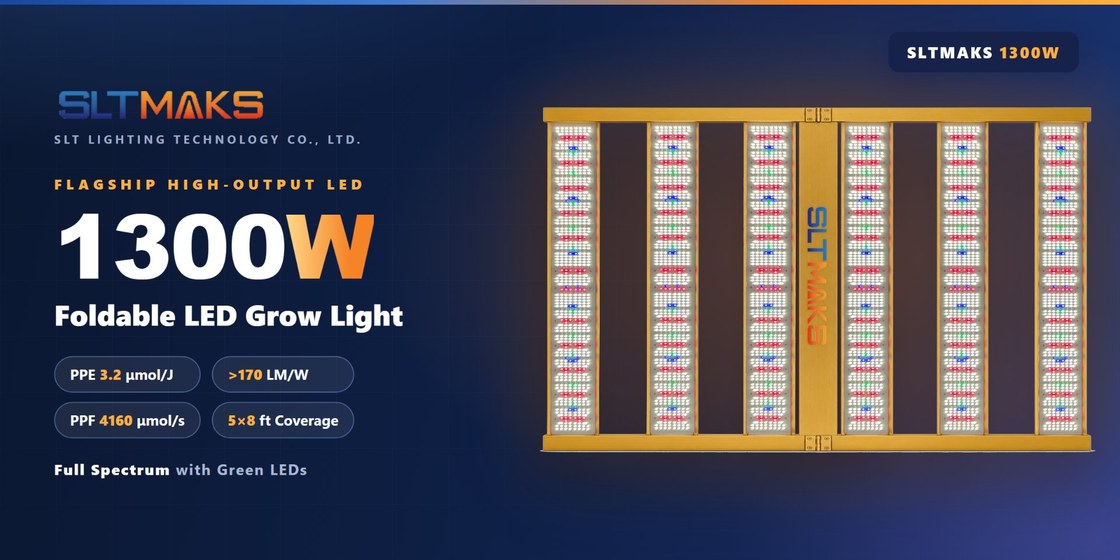
The commercial reversal followed the science. White-based full-spectrum fixtures have always carried green as part of their mix; what changed is that manufacturers stopped treating it as an embarrassment and started naming it. The upgraded SLTMAKS Golden 1300W is an example from our own line: a foldable, white-based full-spectrum fixture now built with green LEDs in the mix, delivering PPF 4,160 µmol/s at 3.2 µmol/J, alongside the series' 660 nm red, 460 nm blue and 730 nm far-red emitters.
The boundary to keep when reading those brochures, including ours: green's return is a story about penetration, canopy use and visible crop, not a promise of higher yield. A fixture that advertises green as its headline feature is selling a recipe decision, and the recipe should be judged on the whole spectrum, the ratios, and the measurements the supplier can produce, in that order.
UV, 280 to 400 nm: A Signal You Dose, Not a Growth Input
UV is the band where the honest position is the boring one. UVA, 315 to 400 nm, arrives in most white-based spectra at low levels and behaves, at room doses, as part of the background rather than a dial. UVB, 280 to 315 nm, is the band the UVR8 receptor reads directly, and the band behind most of the secondary-metabolite research. The research is real and moving; the room-level results are modest, dose-dependent, and inseparable from the costs: UVB hardware, the interlocks and shielding it demands, and a photon band that burns people and plants with equal indifference.
Our position, consistent across the site: UV is a signal you dose deliberately, late in flower or not at all, never a default growth input, and never the first fix for a room underperforming. The full treatment, the three bands' different effects, the dose units, the equipment cost including the chiller, and a stage-by-stage recipe, is in the UV and far-red guide.
The Band Table: What Each Wavelength Changes and What Overshoot Costs
The five bands in one table, with the overshoot cost of each, because every band on this page is beneficial at a share and expensive above one. The shares themselves are recipe decisions that belong on a spec sheet with the ratios stated, not in a generic guide; what a buyer can hold any supplier to is the right-hand column.
| Band | Receptor that reads it | What it drives | What overshoot costs | What to watch |
|---|---|---|---|---|
| Red 600 to 700 nm | phytochrome Pr side, chlorophyll | the photosynthetic engine and the open-sky read that keeps plants compact | a red-heavy room with no blue grows tall, loose plants the flower room must correct | canopy PPFD on a grid, min to average uniformity |
| Far-red 700 to 750 nm | phytochrome Pfr side, PSI beyond PAR | the Emerson enhancement beside red, and stretch through a falling R:FR ratio | stretch that outruns the trellis and pushes sites into shade | R:FR at the canopy, internode length per week |
| Blue 400 to 500 nm | cryptochrome, phototropin, ZTL | architecture: shorter internodes, thicker leaves, stomatal function | a slightly lower efficacy figure, and plants so compact the canopy crowds early | blue share on the spec sheet, leaf thickness |
| Green 500 to 600 nm | weak on phytochrome, partially reverses blue and red signals | canopy penetration to lower leaves, and a crop the crew can read from the aisle | a diluted red and blue share if the green fraction is padded for looks | under-canopy PPFD profile, leaf colour scoring |
| UV 280 to 400 nm | UVR8, chiefly UV-B | a protective signal tied to secondary-metabolite research | burn, interlock and shielding costs, safety exposure | a dose log, and the decision to skip it entirely |
Read the table as a set of steering inputs around a fixed base. The base, red and white carrying the DLI, is set by the room plan and covered in our PPFD and DLI targets guide. The dials, blue, far-red and the green share, are set by the developmental goals of each room, which is the two-room question the next section takes up.
Putting the Wavelengths to Work in a Two-Room Operation
A two-room facility gives each band a natural home. The seedling and vegetative room wants architecture: a sensible blue share for short internodes and thick leaves that transplant cleanly, and enough green in the mix that technicians scanning trays all day can see what they are looking at. It is a low-power room by design, fixtures in the 240 to 320W class running in their comfortable output band, so the spectrum question there is about proportions, not brute force.
The flower room wants photons and shape control. Red and white carry the 12-hour photon load; the far-red channel exists as a deliberate tool, for the Emerson gain beside red and for early-flower stretch when the trellis plan wants it, rather than as a permanent base-spectrum ingredient nobody remembers ordering; and the green share keeps the canopy readable through twelve weeks of flower, which is when early problem detection is worth the most. The full room-by-room logic, including what "best" means for each room's fixture, is covered in our two-room guide to full spectrum fixtures.
| Room | Developmental goal | Band decisions | What to watch |
|---|---|---|---|
| Seedling and vegetative room | compact, transplant-clean architecture | a sensible blue share for internode length, green in the mix so technicians can read trays, low-power fixtures in the 240 to 320W class running in their comfortable band | internode length, leaf thickness, handover plant height |
| Flower room | photon delivery with shape control | red and white carry the 12-hour load, far-red as a timed channel rather than a permanent blend, green share keeps twelve weeks of flower readable | R:FR at the canopy, early-flower stretch, bottom-leaf condition |
| The dark period | an uninterrupted night | no band is safe at the wrong intensity after lights-off; the work light is the dimmest green there is, pointed away from the canopy | a dark-period audit with a meter, not an eyeball |
The table's last column is the one to argue about with a supplier, because a fixture whose green and far-red behaviour cannot be stated in those terms is a fixture whose recipe was assembled from a catalogue rather than from measurements. The upgraded Golden 1300W we ship states its recipe the same way this page does: white base, red, blue and far-red emitters named by wavelength, green in the mix, and the ratios documented rather than implied.
Three Mistakes That Look Like Wavelength Problems
Before changing a spectrum, rule these three out, because each one mimics a wavelength response closely enough to send a buyer shopping for the wrong fixture.
The first is borrowing conclusions across photoperiod classes. Most accessible wavelength research, especially the flowering-time work, is done on long-day ornamentals, where blue and far-red can genuinely promote flowering. Cannabis measures the night. A conclusion of the form "wavelength X accelerated flowering" exported from a long-day species into a short-day room is usually wrong in direction, and it is the single most common imported error in the space.
The second is judging spectra in lumens. Lux and lumens are weighted for human vision, which peaks in green and nearly discounts deep red, so a lux meter systematically over-reads green and under-reads the band doing most of the photosynthesis. A supplier quoting lumens for a grow light is describing how bright the fixture looks to a person, and our guide to efficacy and µmol/J covers the units that actually describe plant light.
The third is attributing to the spectrum everything that changed with it. A new fixture arrives with a different spectrum, and often with different output, different suspension height, different dimming behaviour and a different heat profile at the same time. If the room's DLI, temperature or VPD moved with the fixture, the spectrum is the least of the variables that changed, and the honest way to isolate it is the measurement routine in the next section.
What to Measure Before You Change Spectrum
The routine is short and it is the same whether the change is a new fixture, a new channel or a new recipe. Baseline the room first: two weeks of records under the current spectrum, covering canopy-level PPFD on a grid, an under-canopy reading below the flower sites, internode length on marked plants, and the room's dark-period audit. Then change one thing, run the same records, and compare like against like.
The instrument matters more than most buyers expect. A standard PPFD meter integrates everything from 400 to 700 nm and will not report the band shares at all, which makes it blind to exactly the changes this page describes. A spectroradiometer reports the spectrum band by band and is the tool that answers questions about blue share, R:FR ratio and green penetration. The R:FR reading specifically is what turns the far-red conversation from an opinion into a number: daylight sits near 1.2, dense shade falls below 0.3, and the plant's stretch response tracks where between those the canopy actually sits.
The under-canopy reading is the one that surprises rooms most. Because green penetrates and red does not, the photons reaching the lowest flower sites change profile, not just magnitude, when the spectrum shifts, and that bottom-of-canopy contribution is invisible to a single top-of-canopy PPFD number.
| Tool | What it reports | What it cannot do | Room use |
|---|---|---|---|
| PPFD meter | integrated 400 to 700 nm photon flux at a point | cannot report band shares at all, so it is blind to every change this page describes | the DLI and uniformity baseline, before any spectrum talk |
| Spectroradiometer | the spectrum band by band, including beyond PAR | not a substitute for a grid of PPFD points; spot readings only | blue share, green fraction and the delivery-day fixture check |
| R:FR reading from a spectrum scan | the ratio connecting the spectrum to stretch | a point measurement; canopy gradients need several | far-red decisions, measured in internode response |
| Dark-period audit | light present after lights-off, at canopy height | says nothing about the day spectrum | the check that protects the flowering trigger itself |
One discipline closes the routine: record what the fixture is actually emitting, not what its listing says. Channels drift, batches vary, and the fixture that arrives is occasionally not the fixture that was ordered. A five-minute spectroradiometer pass on delivery, before installation, is the cheapest insurance on this entire page.
Frequently Asked Questions
Do cannabis plants actually use green light?
Yes. Green photons are absorbed less per encounter than red or blue, but inside a leaf they scatter and cross pigment layers repeatedly, so leaf absorption remains substantial, and in a canopy green travels deeper than any other band, reaching lower leaves that red never does. The old "green is wasted" claim came from a chlorophyll solution test that does not describe a leaf, let alone a canopy.
Why did the industry believe green light was useless for so long?
Because the founding measurement was made in a cuvette, not a leaf. Extracted chlorophyll has a deep absorption dip near 550 nm, green photons passed through the solution, and the conclusion jumped from solution to plant. Leaf-level work published from 2009 onward corrected the transfer: green scatters inside the leaf, is substantially absorbed, and penetrates the canopy. The industry took another decade to act on it.
Does green light affect flowering in cannabis?
Green is read as a signal, and in controlled ornamental work it has acted as a long-day signal, delaying flowering in some short-day crops at specific doses and timings. In a cannabis room the flowering decision is governed by the uninterrupted night, and the spectrum's role is to leave that night dark. The green that matters operationally is canopy penetration and human visibility, and the green that matters after lights-off is covered in our guide to dark-period leaks.
What does far-red light actually do during flowering?
Two things. Delivered beside red, it rebalances the two photosystems and raises the photosynthetic yield of the photons already being delivered, the Emerson enhancement. Delivered in a way that lowers the red-to-far-red ratio, it drives stretch: longer internodes and expanded leaves, which early in flower can open bud-site spacing and late in flower can outrun the trellis. Dose and timing decide which one you bought.
Is blue light necessary for flowering?
Not for starting it. Cannabis flowers on night length, and blue does not change that clock. What blue does is build the plant that flowers: shorter internodes, thicker leaves and functional stomata in the vegetative room, which together determine how the first weeks of stretch proceed. The flowering-promotion claims for blue in the literature come mostly from long-day species and do not transfer to a short-day room.
What R:FR ratio should a cannabis canopy have?
The honest framing is directional rather than a target number. Outdoor daylight sits near 1.2 and dense shade falls below 0.3, and the plant's shade-avoidance response scales between them. A room running a low ratio permanently is prescribing stretch for the whole cycle; a room that wants compact growth holds the ratio high through veg and treats any far-red addition as a timed tool with a measured internode response. Measure the canopy with a spectroradiometer rather than accepting a fixture's nominal ratio.
Why are so many new grow lights advertising green LEDs now?
Because the science reversed and the market followed. Leaf-level work established that green penetrates leaves and canopies usefully, canopy research showed it feeds lower foliage, and the human-visibility argument, a crop that growers can actually see and score, carried the commercial case. White-based fixtures always carried some green; the change is that manufacturers now name it instead of hiding it inside "full spectrum".
Can I add green to an existing red-blue room?
Not usefully by bolting green bars onto a narrow red-blue fixture, because the value of green arrives as part of a balanced recipe, not as a standalone band. The practical routes are fixtures with a white base, which carry green naturally, or a fixture whose recipe states the green share explicitly. Swapping a narrow red-blue panel for a white-based fixture delivers the penetration and visibility benefits together with the architecture benefits of blue, which narrow panels also lack.
Does UV light increase potency in cannabis?
The honest answer is that the research is real, the room-level effects are modest, dose-dependent and genetics-dependent, and the equipment and safety costs are not trivial. UVB triggers protective responses through the UVR8 receptor, and secondary-metabolite effects have been measured under controlled doses. What no responsible supplier should do is quote a potency promise. Treat UV as an optional, dosed signal with real hardware and safety requirements, and only after the room's base plan is right.
How do I measure what wavelengths my room actually receives?
With a spectroradiometer, not a standard PPFD meter, which integrates 400 to 700 nm and cannot report band shares. Take canopy-level readings on a grid, an under-canopy reading below the flower sites, and a reading at lights-off to audit the dark period. The R:FR ratio from those scans is the number that connects your spectrum to stretch, and the under-canopy profile is where green's contribution shows.
Will a green work light interrupt the flowering dark period?
Less than any other colour, but not by magic, and not to zero. Controlled work on short-day plants found flowering effects from green light at very low night-time intensities, far below what the eye needs, so the safe practice is the same as for any work light: the dimmest fixture that lets a person walk safely, pointed away from the canopy, inside a full dark-period audit. Our guide to light leaks and green work lights covers the threshold numbers and the audit routine.
What should I change first if my room is underperforming?
Almost never the spectrum. Work in order: the DLI actually delivered at the canopy, the uniformity across it, the integrity of the dark period, then temperature and VPD, and only then the band shares. Spectrum changes are a finishing tool on a room that already measures correctly, and the cheapest fixture change is usually the one that fixes the first three items rather than the one that adds a fashionable wavelength.