
Search for the best full spectrum LED grow light for cannabis and most of what comes back is a ranked list. A ranked list cannot answer the question, because the fixtures on it are being asked to do different jobs in different rooms. Rankings assume one fixture is being compared with another on the same task. Commercial rooms do not work that way. A facility that harvests every two weeks is not choosing one fixture. It is choosing two room configurations and a handover date between them.
The distinction matters because the two rooms are sized from opposite ends of the power range, not from opposite ends of one dimmer. A seedling room is a low-power room: 240 to 320W over a 4x4 block, running at 50 to 90 percent of its own rating between fresh cuttings and the last vegetative week. A flower room is a high-power room: 600 to 1,000W and above, running at 75 to full output. A model that is excellent in one of those conditions is not automatically good in the other, and the datasheet does not tell you which one it was designed for.
This page treats the room, not the fixture, as the unit of decision. It covers what each room is actually asked to deliver, how spectrum behaves inside each one, how to size both without guessing, and which numbers on a spec sheet deserve a second look. The stage-by-stage mechanism that the second half of the usual search query asks about belongs here as well, because a room is only a container for a stage window, and spectrum only earns its cost inside that window.
The Short Answer: Two Rooms, Two Different Definitions of Best
In a two-room facility, plants move from a smaller room at lower intensity to a larger room at higher intensity, and they do not come back. That one-way flow sets the specification for both rooms. The first room has to produce a plant that can survive a step up in light; the second has to carry that plant through the most expensive weeks of its life at the highest photon flux the cultivar will tolerate.
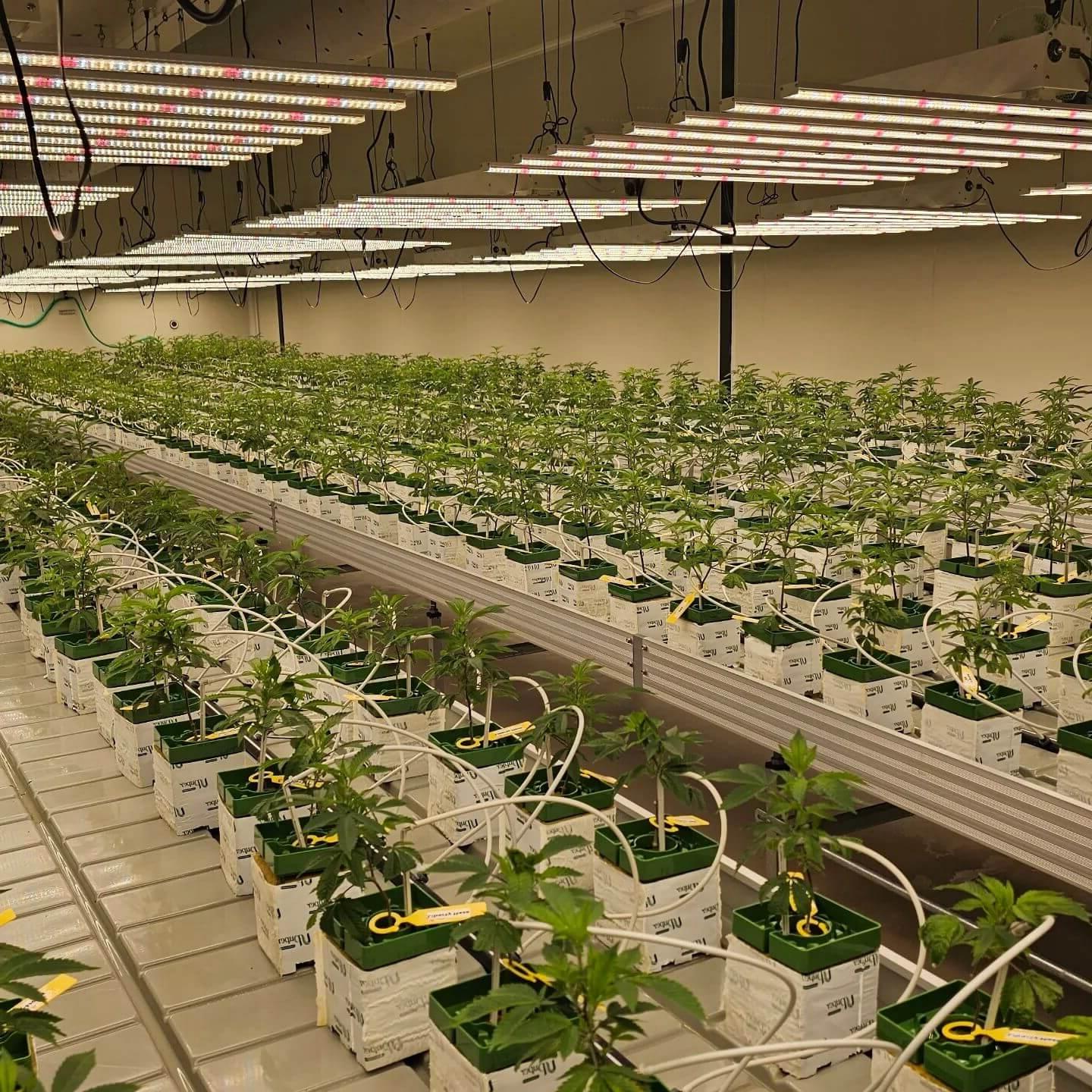
The seedling room is judged at its own working point, not at the bottom of someone else's range. What matters is whether the wattage class matches the bench, so that the room's 200 to 400 µmol/m²/s arrives at 50 to 90 percent of the fixture's rating; how evenly it spreads that light over a tray; how much blue the spectrum carries so leaves stay compact rather than reaching; and how little heat it adds to a small sealed volume. The failure mode here is not a dimmer set low. It is a 600W or 1,000W flower fixture in a room that never needs more than 600 µmol/m²/s, sitting at 15 to 25 percent for the whole cycle and paying for peak output the room cannot use.
The flower room is judged at the top. What matters is wall-plug efficacy at full output, photon flux delivered across the coverage block rather than at the centre, a spectrum that still works during the last week of vegetative growth, and a uniformity ratio that survives being pushed to 1,000 µmol/m²/s or beyond. Efficiency here is not a virtue, it is a recurring cost: at 12 hours a day, every 0.2 µmol/J of efficacy is paid for on the electricity bill for the life of the room.
The table below is the one we use to keep the two conversations separate. Every row is a criterion where the correct answer in one room is the wrong answer in the other.
| Criterion | Seedling room | Flower room | How to verify |
|---|---|---|---|
| Target PPFD | 100 to 300 µmol/m²/s | 700 to 1,200 µmol/m²/s | a PPFD grid at the height you will actually hang the fixture |
| Photoperiod | 18 / 6, or 24 hours for fresh cuttings | 18 / 6 in late vegetative growth, 12 / 12 after the flip | the timer, because no datasheet changes it |
| Fixture class | 240 to 320W over a 4x4 block | 600 to 1,000W over a 4x4 to 5x5 block | photon flux, never the wattage on the badge |
| What decides best | wattage class matched to the bench, spread, blue share | wall-plug efficacy, photons per coverage block, uniformity | a third-party report, then a test in your own room |
| Channels | one, and no reason for more | one, or multi only if the recipe changes mid-cycle | who will actually change the recipe, and how often |
| Typical mistake | buying flower-class wattage for a room that never passes 600 micromol | buying propagation-class wattage and running it at full output | compare cost per micromole delivered, not cost per fixture |
Why Commercial Growers Split the Cycle Into Two Rooms
The two-room layout is not a tradition. It is the cheapest way to resolve four conflicts that appear the moment a single room has to serve both ends of the cycle.
The first is the photoperiod. Vegetative growth wants 18 hours of light and flowering wants 12, and a room can only run one schedule at a time. Running both stages in one room means flipping the whole room at once, which produces a harvest every nine to twelve weeks and an empty room in between. Two rooms let one room stay on 18 hours while the other runs 12, so a harvest leaves every two to four weeks instead of every quarter.
The second is intensity. A fresh cutting is comfortable at 100 to 200 µmol/m²/s and a flowering canopy wants 700 to 1,200, a difference of roughly four to six times. A single room sized for flower has to be dimmed to a small fraction of its output for propagation, and a room sized for propagation cannot reach flowering intensity at all. Splitting the rooms lets each one be specified around the output it actually runs at, instead of asking one fixture set to cover a four- to six-fold intensity difference.
The third is climate, and the fourth is risk. A propagation room runs warmer and more humid than a flower room, with a vapour pressure deficit that would be a mould risk in a dense flowering canopy. And a problem in one room, whether it is powdery mildew, a stuck valve or a failed driver, does not take the whole pipeline down when the plants are already split across two environments with different schedules.
The Room Map: What Moves In, What Moves Out, and When
A two-room facility has a rhythm that can be drawn on one line. Cuttings or seedlings arrive in the first room, spend two to five weeks there, cross into the second room at a defined size, spend one to three weeks in late vegetative growth, flip to 12 hours, and finish eight to ten weeks later. The handover point is the only date that has to be managed precisely, because it is where the plant meets the largest change in its light environment.
In practice the handover happens at four to six nodes, roughly 25 to 35 cm of height, when the plant has enough leaf area to use the higher intensity immediately. Move it earlier and the plant spends a week recovering from a light step it cannot use; move it later and the first room becomes a bottleneck that costs more per week than the second room saves.
The map also explains why the fixture classes differ so much. Room A never needs to deliver more than roughly 600 µmol/m²/s, and for most of its occupancy it delivers 200 to 400. Room B is asked to deliver 700 to 1,200 for the whole 12-hour day, which is a different electrical problem, a different thermal problem and a different capital problem. Treating them as one purchase is how facilities end up with a flower-class fixture idling at 15 percent in a propagation room and a propagation-class fixture being pushed to full output in flower, which is the most expensive way to run both.
What Full Spectrum Means on a 2026 Spec Sheet
The phrase is used in three different ways, and only one of them is a specification. The first is descriptive: a white-phosphor LED board with a correlated colour temperature around 3500K and added deep red, usually 660 nm, and often far red at 730 nm. The second is comparative: full spectrum as the opposite of a narrow blue-red blend, which is a real distinction with real consequences for leaf temperature and for how the canopy looks to the eye. The third is marketing: the words printed on a box with no spectral power distribution behind them.
For a buyer, only the third usage is dangerous. A full spectrum claim without a spectral power distribution file, or at least a plotted curve with wavelengths marked, cannot be checked and should not be paid for. Our guide to what a full spectrum 1000W LED actually changes works through the five mechanisms in detail, including why a wider waveband reaches tissue a narrow blend misses, and it is the technical companion to this page. What matters here is narrower: the same full spectrum label is applied to a propagation spectrum and a flowering spectrum, and those two are not interchangeable even though both are white.
The practical difference is the blue-to-red balance. A spectrum with a higher blue share produces shorter internodes, thicker leaves and a more compact plant, which is what a seedling room is buying. A spectrum weighted further into red produces more flower mass per photon in the weeks that matter, which is what a flower room is buying. Our spectrum guide for cannabis flower covers the flowering end in detail, including where the red share starts to cost you through photobleaching; this page covers how to choose the room that receives it.
The Seedling Room: Four Criteria That Decide Best
The first criterion is the wattage class, because it decides everything that follows. A propagation room is a low-power room: the usual specification is 240 to 320W over a 4x4 block, which puts the room's 200 to 400 µmol/m²/s at 50 to 90 percent of the fixture's rating. Starting from the class rather than from a percentage on a dimmer is what keeps the purchase honest. A fixture is not a seedling light because it can be turned down; it is a seedling light because its ceiling sits near the room's ceiling.
The second criterion is the dimming range, which a low-power room still needs, just not a deep one. Room A walks from roughly 100 µmol/m²/s for fresh cuttings to 500 or 600 in the last week before handover, and the low end is normally reached by hanging the bar higher over the tray rather than by pushing a large fixture to the floor of its dimmer. A range of 100 to about 30 percent covers the room. Whether the fixture dims to off matters more than the exact floor, because a unit that stops at 10 percent still has to be switched at the breaker, which in a room visited twice a day is a real inconvenience rather than a datasheet detail.
The third criterion is spread at the output the room actually uses, measured at 30 to 50 percent and not only at full power. Uniformity is usually quoted at full output, where it is easiest to achieve. At 30 or 40 percent the same optics spread the same pattern, so the ratio should hold, but the measurement is worth asking for, because a fixture with a narrow beam and a high ceiling can produce a bright centre and dim edges that only become visible when the room is turned down. A propagation bench that roots unevenly is usually a light distribution problem before it is a humidity problem.
The fourth criterion is blue share, and heat runs alongside it. A seedling room is small, sealed and often run warmer than the rest of the building, so every watt of waste heat is a watt the HVAC has to remove from a volume with very little air mass. Fixtures in the 240 to 320W class over a 4x4 block are the usual answer, not because they are cheaper per watt, but because they let the room run at 50 to 90 percent of the fixture's rating instead of pushing a flower-class unit to the bottom of its dimmer.
Sizing the Seedling Room: The Arithmetic That Prevents Overbuying
The arithmetic is small enough to do on one line, and doing it prevents the most common overbuy in a facility. A 4 ft by 8 ft propagation bench is 3.0 m². At a seedling target of 250 µmol/m²/s the bench needs about 750 µmol/s of photon flux, which is 23 µmol/s per square foot of bench for anyone working in imperial units. Two 240W bars rated near 650 µmol/s each deliver 1,300 µmol/s, so the room runs at about 58 percent for seedlings and reaches the 400 µmol/m²/s of the last week before handover at roughly 92 percent, with a little headroom left.
Now compare the same bench served by a single 600W 4x4 fixture rated at 1,740 µmol/s. To hit the same 750 µmol/s the dimmer sits at 43 percent, which is workable. To give a fresh cutting its 100 µmol/m²/s, the same fixture sits near 17 percent, which is where driver efficiency typically falls by several points and where a small output error becomes a large percentage error. The fixture costs more, draws more at the wall for the same delivered light, and buys peak output the room will never use.
There is a counter-argument worth stating, because it is the reason some growers still choose the larger fixture: one model across both rooms simplifies spares, and a 600W fixture in the seedling room can be reused in flower later if the room is repurposed. That is a genuine operational benefit, and it is worth paying something for. It is not worth paying for twice, once in capital and again on every electricity bill for the life of the room.
The Flower Room: Four Criteria That Decide Best
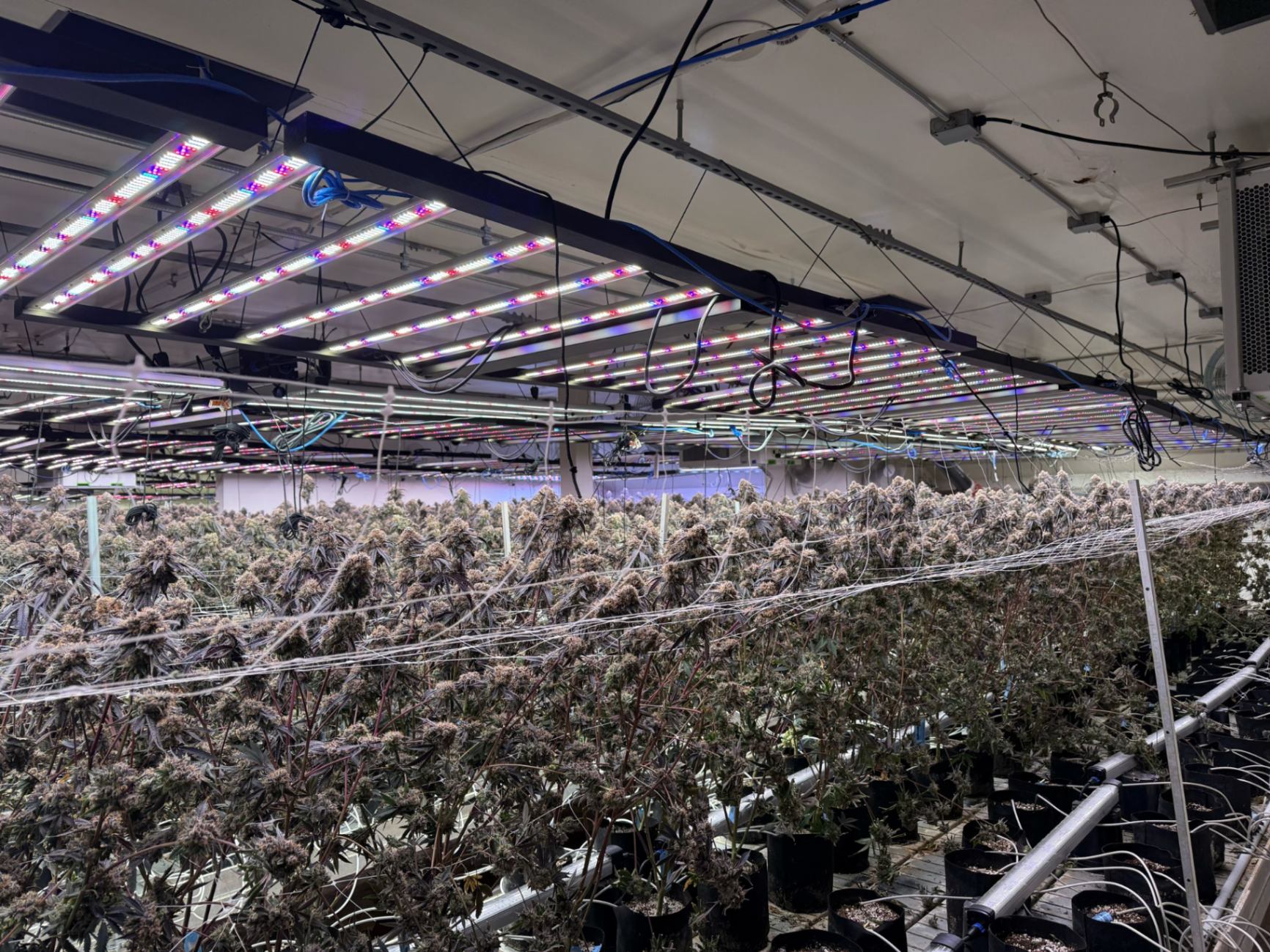
The first criterion is wall-plug efficacy, measured as micromoles of photon flux per joule at the socket rather than at the LED board. The difference between the two numbers is driver loss, and it is the number that appears on your electricity bill. Fixtures in this class now sit around 2.8 to 3.0 µmol/J at the wall for a 4x4 unit in the 600 to 1,000W range, and a fixture that quotes 3.0 at the board while delivering 2.6 at the plug is a 15 percent error in the only figure that compounds.
The second criterion is photon flux across the coverage block, not at the centre. A 1,000W fixture rated at 3,000 µmol/s is not delivering 1,000 µmol/m²/s everywhere it claims to cover. Spread over a 5 by 5 ft block, 2.32 m², that flux averages about 1,290 µmol/m²/s, which is a peak-flower figure with almost no margin. Spread over a 4 by 4 ft block, 1.49 m², it averages about 2,010, which is more than most cultivars will take without CO₂ and a very tight climate. The coverage claim and the photon flux have to be read together, because neither number means anything alone.
The third criterion is spectrum coverage across the room's two jobs: the last week of vegetative growth, when the plant is still setting its structure, and the flowering weeks, when red share earns its keep. The fourth is uniformity at high output. A room can hit its average PPFD and still lose yield at the edges, which is why the acceptance figure we use for a commercial room is a minimum-to-average ratio of 0.80 rather than an average alone. Our layout and scheduling playbook covers how to measure that ratio on a grid and where the edge losses come from.
Why One Fixture Has to Serve Vegetative and Flower
In a two-room facility the flower room receives plants that are still vegetative, and they stay vegetative for one to three weeks before the flip. During that window the room is running 18 hours at 550 to 700 µmol/m²/s, and the spectrum is doing structural work: blue share holds the internodes short, and the red-to-far-red ratio decides how much the plant stretches as it establishes. A fixture chosen purely for flowering performance can be a poor choice for that window, and the cost shows up as a stretched, floppy canopy that yields less at the end.
This is the argument for a dual-purpose spectrum in a single-channel room: a white base around 3500K with added 660 nm and a modest 730 nm component, which is competent at both jobs without being optimal at either. It is also the argument for a multi-channel fixture, which resolves the compromise by letting the room run one recipe in late vegetative growth and another after the flip without changing hardware.
What a spectrum cannot do is rescue a room that is short of photons. A better recipe at 600 µmol/m²/s will not out-yield a competent recipe at 900, because flower mass responds to the daily light integral far more strongly than to the blue-to-red ratio within the range commercial fixtures occupy. Spectrum decides shape, quality and how close the room runs to its stress ceiling. Intensity decides how much growth there is to shape.
Single Channel or Multi Channel: The Only Room Where the Question Is Real
For the seedling room the question is close to irrelevant. One spectrum, one setting, one schedule for two to five weeks, and no reason to change the recipe mid-occupancy. A single-channel fixture is simpler, cheaper, and has fewer failure points.
For the flower room the question is real, because the room runs two recipes inside one cycle. A multi-channel fixture lets a grower add far red during the stretch, pull it back once internodes are set, and shift the red share as buds fill, all without touching the fixtures. That flexibility is worth money in a room that is steered rather than run on a fixed programme, and it is worth very little in a room that runs one recipe from clone to harvest.
The honest test is whether anyone on site will actually change the recipe. A multi-channel fixture under a fixed programme is a single-channel fixture with extra cost and extra failure modes. Our comparison of multi-channel and single-channel grow lights sets out the control layer and the channel counts that earn their cost, and the decision belongs in this room rather than in the propagation room.
How Spectrum Acts at Each Stage
Spectrum influences a cannabis plant through three levers, and each one acts at a different point in the cycle. The first is the blue fraction, which is read by cryptochrome and drives compactness: more blue produces shorter internodes, thicker leaves and a plant that invests in structure rather than extension. The second is the red to far-red ratio, which is read through phytochrome and sets how strongly the plant stretches toward neighbours, a signal that matters most at the handover and during the first weeks after the flip. The third is the red share of the spectrum, which does less for shape and more for flower mass per photon, up to the point where the canopy bleaches.
The table below maps those levers onto the six stages a two-room facility actually runs, and states what each lever cannot do. The last column matters as much as the others: most disappointing spectrum purchases are not failures of the spectrum, they are expectations placed on it that belong to intensity, climate or the root zone.
| Stage | What the spectrum changes | Room | What it does not fix |
|---|---|---|---|
| Fresh cutting | little: at 100 to 200 µmol the limit is water loss, not wavelength | A | a wet cube, a cold dome or a rotting cut surface |
| Seedling | blue share holds leaves compact; a red-heavy blend stretches | A | a root zone that is too cold or too salty |
| Vegetative | blue fraction sets internode length and leaf thickness | A, then B | a daily light integral that is too low for the temperature |
| First days in the flower room | blue and the red to far-red ratio both steer extension | B | a PPFD step that is too large on day one |
| Flower, weeks 1 to 3 | red share drives bud set; far red can accelerate stretch | B | the one-third drop in daily light integral caused by 18 to 12 hours |
| Flower, weeks 4 to 8 | red share and intensity together set flower mass; excess pushes bleaching | B | a vapour pressure deficit that has closed the stomata |
Two caution notes belong with the table. Far red is a scheduling tool rather than a yield tool, and using it through the stretch in a room with limited headroom produces a taller plant and a lighting rig that has to be raised again; our UV and far-red guide covers the dose question and the R:FR ratio in detail. And UV is a stress tool with a narrow useful dose, not a spectrum upgrade to be added by default; the same guide explains when it is worth testing and when it is marketing.
The Handover: What Changes the Day a Plant Moves Rooms
The handover is the highest-risk day in the cycle, because three variables change at once. Intensity steps up from roughly 400 to 600 µmol/m²/s in the last vegetative week to 700 to 900 in the flower room. Spectrum changes if the two rooms run different recipes. And the photoperiod eventually drops from 18 hours to 12, which removes a third of the daily light integral on the day the timer changes unless the dimmer compensates.
The arithmetic is worth writing on the wall of the flower room. A canopy at 500 µmol/m²/s on 18 hours receives 32.4 mol per day, because 500 multiplied by 18 hours and by 0.0036 gives 32.4. The same 500 µmol on 12 hours receives 21.6 mol, a loss of 10.8 mol per day, which is exactly one third. Raising the canopy to 700 µmol on 12 hours returns 30.2 mol and closes most of the gap. A room that flips the timer without touching the dimmer has decided, usually without noticing, to run the first three weeks of flower on two thirds of the light the plant had the week before.
Acclimation is the second half of the handover. A plant moved from 400 to 850 µmol in one step will show light stress within two days: leaves that cup, edges that pale, and in a bad case the bleached patches described in our guide to cannabis light bleaching. The practical rule is a step of no more than about 150 to 200 µmol/m²/s per day, with the first day spent at the lower end, and a check on leaf temperature rather than on the dimmer percentage, because a room at 26 °C and 55 percent humidity can carry more light than the same room at 30 °C.
Sizing Each Room From Coverage, Not Wattage
Both rooms are sized the same way: target PPFD multiplied by canopy area gives the photon flux the room must deliver, and that number divided by the fixture's PPF gives the fixture count. Wattage never enters the calculation, which is why two fixtures of the same wattage can require different counts.
For the flower room, take a 4 ft by 8 ft bed, 3.0 m², at a target of 900 µmol/m²/s. The bed needs about 2,700 µmol/s, which is two 600W fixtures rated at 1,740 µmol/s each running at about 78 percent. Three of the same fixtures at roughly 52 percent deliver the same flux with more overlap and therefore a better minimum-to-average ratio at the edges of the bed. The three-fixture layout costs more in hardware and less in electricity per delivered photon if the drivers are more efficient mid-range, which is a calculation worth running with real datasheets rather than with assumptions.
For the seedling room, take the same 4 ft by 8 ft bench at 250 µmol/m²/s, which is 750 µmol/s. Two 240W bars at roughly 650 µmol/s each run at about 58 percent and leave headroom into the last vegetative week. A single 320W bar at 900 µmol/s covers the same bench at 83 percent with no headroom and no dimming flexibility, which is cheaper to buy and worse to operate, because the week before handover is exactly when the room needs to go past its baseline.
The figure that ties the two rooms together is throughput. If Room A can turn a bench in five weeks and Room B needs nine weeks plus a week of late vegetative growth, the flower room needs roughly twice the canopy area of the propagation room to keep the pipeline full. Sizing the rooms in the wrong ratio is the most common layout error we see in a new facility, and no fixture choice fixes it.
Three Reference Configurations
The configurations below are the ones we quote most often for two-room facilities. They are reference points, not prescriptions: the correct fixture count always comes from the room dimensions and the target PPFD, and a room with a low ceiling or an unusual bench layout will change the count without changing the logic.
| Configuration | Room A | Room B | What it suits |
|---|---|---|---|
| Small two-room, one bench plus one bed | 2 x 240W bars over 4x8 ft | 2 x 600W 4x4 over 4x8 ft | a first commercial room, and a cultivar trial |
| Commercial two-room, 24 lights | 4 x 320W over two 4x8 benches | 24 x 1,000W 4x4 in four rows of six | a harvest every two to three weeks |
| Three-room variant | propagation separated at 240W; a 600W vegetative room | the same 600 to 1,000W flower room | facilities that steer vegetative structure hard |
Two details separate a configuration that works from one that merely fits. The first is mounting height and beam angle, which decide whether the fixture's rated coverage is real in your room; a wide bar at 30 cm above the canopy and the same bar at 90 cm are two different light distributions. The second is the control layer. A room that runs a schedule, a dimming curve and a sunrise transition needs a controller that speaks the protocol the fixtures use, and a smart controller in this class is a small line item compared with the fixtures it coordinates.
What the Two Rooms Cost, and Why the Delta Exists
In a two-room facility the flower room carries most of the lighting capital, for two reasons that compound. It has more canopy area, because it holds plants for longer, and its fixtures cost more per unit because they deliver two to three times the photon flux. A propagation room is usually the cheapest lighting line in the building, and it is also the one where overspending is easiest to justify and hardest to recover.
For reference, a 4x4 ft fixture in the 600 to 1,000W class with Samsung LEDs and a Sosen driver, built to a three-year warranty standard, leaves our factory at roughly 168 to 268 US dollars EXW as of November 2026, against a US shelf price of roughly 699 to 1,299 dollars for a comparable brand. A 4 ft under-canopy bar at 120W sits at 35 to 59 dollars EXW, and a smart controller at 75 to 100 dollars. Those are factory-direct bands for standard configurations; higher-output or project-specific builds are quoted per project because the variables stop being comparable in a table.
The gap between the two price levels is not a single markup but six layers, and our breakdown of what commercial grow lights actually cost works through them one at a time, including the freight and duty that a DDP quote folds in and the marketing spend that is often the largest line in a retail price. For a facility buying thirty fixtures, the difference between the two levels is a capital decision, not a shopping decision.
Seven Claims to Verify on the Datasheet
Every claim below is checkable before an order, and each one has a specific way to check it that does not depend on trusting the supplier.
Efficacy at the wall. Ask for micromoles per joule at the socket, and ask what driver and what load point the figure was measured at. A board-level number is not the number you pay for.
Photon flux, with a tolerance. A PPF figure without a stated tolerance is a rounded marketing number. Ask for the test report and the binning that produced it.
The PPFD map at your hanging height. Not at the optimal height in the lab, and not at the centre only. Ask for a grid at the height you will actually use, with the minimum and the average on it.
The dimming range and the dimming floor. Whether the range covers the 30 to 100 percent band the room actually uses, and whether it dims to off. A seedling room does not need a fixture that reaches 10 percent; it needs a fixture small enough that it never has to.
The spectral power distribution file. A plotted curve with wavelengths marked, not a photograph of a lit canopy. If the file does not exist, the full spectrum claim is a label.
Certification scope. A logo is not a scope. DLC listings come in tiers with different requirements, and the listing has to cover the specific model and wattage you are buying, not the family name.
Warranty terms and the serviceable parts. Three years on the fixture means little if the driver is sealed into a frame that has to be shipped back. Ask which parts are field-replaceable and what the response time is in your country.
What to Send for a Room-by-Room Recommendation
A recommendation that fits takes less information than most buyers expect. For each room: the internal dimensions, the ceiling height, and the bench or bed layout, because coverage and mounting height decide the fixture count before wattage does. The stage plan: how long plants stay in each room, and whether the flower room runs late vegetative growth before the flip.
Then the electrical facts: the target PPFD for each room, the supply voltage and the amperage available, and whether the room will run CO₂ enrichment, because a room at 1,200 ppm can carry 1,200 to 1,500 µmol/m²/s where an ambient room should stay closer to 900. Add the climate setpoints if they are already fixed, the destination country and port, and whether you need DDP terms.
With those inputs, the answer is a fixture count per room, a hanging height, a dimming schedule for the handover, and a quotation in the terms you asked for. Our quote request form takes the room details directly, and the top light range lists the wattage classes and coverage blocks the recommendation will draw from.
Frequently Asked Questions
What are the best full spectrum LED grow lights for cannabis?
There is no single best model, because the two rooms in a commercial facility need opposite things. The best seedling room light is sized to the room rather than dimmed down to it: a 240 to 320W class fixture over a 4x4 block, running at 50 to 90 percent of its own rating across the propagation and early vegetative weeks, spreading evenly over a tray, carrying enough blue to keep plants compact, adding little heat to a small sealed room, and dimming smoothly to off. The best flower room light delivers high wall-plug efficacy, enough photon flux across its coverage block for 700 to 1,200 µmol/m²/s, a spectrum that still works in late vegetative growth, and a minimum-to-average uniformity near 0.80. Choose per room, then choose the model that fits each room's operating point.
How do full spectrum LED grow lights influence plant growth stages?
Through three levers. The blue fraction drives compactness: more blue means shorter internodes, thicker leaves and less stretch, which matters from seedling through late vegetative growth. The red to far-red ratio is read by phytochrome and sets how strongly a plant extends toward its neighbours, which matters most at the handover and in the first weeks after the flip. The red share of output does less for shape and more for flower mass per photon, up to the point where the canopy bleaches. None of the three substitutes for the daily light integral, which is set by intensity and hours.
Do I need a separate seedling room?
Not always, but the economics usually point that way once a facility harvests more than a few times a year. A separate room lets one space stay on 18 hours while the other runs 12, which shortens the interval between harvests from a full cycle to two to four weeks. It also lets each room be specified around the output it actually runs at, instead of forcing one fixture set to cover a four- to six-fold intensity difference.
Can I use a flower room fixture in the seedling room if I dim it?
You can, and some growers do it to standardise on one model, but it is rarely the cheaper choice. A 600W fixture rated near 1,740 µmol/s has to sit near 17 percent to give a fresh cutting 100 µmol/m²/s, which is a poor operating point for the driver and leaves little resolution in the dimmer. Two 240W bars covering the same bench at about 58 percent deliver the same light with better spread, less waste heat per fixture and a lower capital cost. Standardising on one model is worth something; it is just not worth paying for twice.
Is full spectrum necessary for seedlings?
Full spectrum is useful in a seedling room, but not for the reason most buyers assume. At 100 to 300 µmol/m²/s the limitation on growth is usually water loss, root-zone temperature and the cube, not wavelength. What the spectrum does buy is shape: a higher blue share keeps the plant compact instead of reaching, which pays off at the handover. A narrow red-heavy blend can root cuttings, but it produces a stretched seedling that takes longer to fill the flower room.
How many watts per square foot do I need in each room?
Wattage per area is a weak specification because efficacy varies by about 25 percent across the commercial market. Size from photons instead: multiply the target PPFD by the canopy area in square metres to get the photon flux the room needs. A 4 ft by 8 ft bed at 900 µmol/m²/s needs about 2,700 µmol/s, which is two 600W-class fixtures at roughly 78 percent. The same bed at a 250 µmol seedling target needs about 750 µmol/s, which is two 240W bars at about 58 percent.
Does spectrum matter more than intensity?
No. Within the range commercial fixtures occupy, flower mass responds to the daily light integral more strongly than to the blue-to-red ratio. Spectrum decides shape, quality and how close a room runs to its stress ceiling; intensity decides how much growth there is to shape. A better recipe at 600 µmol/m²/s will not out-yield a competent recipe at 900. Buy efficacy and coverage first, then spend on spectrum flexibility.
Single channel or multi channel for the flower room?
Multi channel pays when the room runs two recipes in one cycle and someone on site will actually change them: more far red during the stretch, less once internodes are set, a different red share as buds fill. If the room runs one fixed programme from late vegetative growth to harvest, a multi-channel fixture is a single-channel fixture with extra cost and extra failure modes. In the seedling room the question is close to irrelevant, because the room runs one recipe for two to five weeks.
What efficacy should I require for each room?
For the flower room, 2.8 to 3.0 µmol/J at the wall for a 4x4 fixture in the 600 to 1,000W class is the current standard for a serious commercial build, and the figure should be quoted at the socket rather than at the board. For the seedling room, efficacy matters less than the wattage class and the spread across the bench, but there is no reason to accept a fixture below about 2.6 µmol/J at the wall, because a room that runs 18 hours a day pays for the difference quickly.
How do I size the two rooms so the cycle keeps flowing?
Compare the weeks each room holds a plant. If the propagation room turns a bench in five weeks and the flower room needs nine weeks plus one to three weeks of late vegetative growth, the flower room needs roughly twice the canopy area to keep the pipeline full. Most new facilities size the propagation room too large and the flower room too small, which produces a bottleneck that no fixture choice can fix. Size from the harvest interval you want, then work backwards to canopy area.
Can one light do both rooms?
One model can, one unit cannot, unless the facility is very small. A single fixture cannot be in the propagation room at 250 µmol/m²/s on 18 hours and in the flower room at 900 on 12 hours at the same time. What can be standardised is the product family and the control protocol, which reduces spares and simplifies the controller. Our guide to whether one grow light can cover every stage covers the small-facility cases where a single fixture genuinely works.
What is the price difference between the two room setups?
The flower room dominates the lighting budget, because it has more canopy area and its fixtures cost more per unit. A 4x4 fixture in the 600 to 1,000W class leaves the factory at roughly 168 to 268 US dollars EXW as of November 2026 for a standard three-year build, while a 4 ft 120W under-canopy bar sits at 35 to 59 dollars and a smart controller at 75 to 100 dollars. Propagation-room fixtures in the 240 to 320W class are quoted per project. The full six-layer breakdown of why retail prices sit several times higher is in our cost guide.