Open a commercial grow light catalogue from 2019 and the spectrum story was simple: white phosphor packages, an optional deep-red boost, and a running argument over how little green each side could defend. Open a 2026 catalogue and something has shifted. Component makers are releasing dedicated green and mint diode packages, fixture brands are adding green channels to flagship grow light models, and the word green has moved from a punchline back into the specification sheet. For a cannabis grow light buyer, the useful question is not whether the trend exists but what actually changed, because the plant science has not moved much in two years. The components did.
This guide covers the engineering and procurement side of the green LED trend: why fixture makers left green out for a decade, what the green gap meant at the diode level, what changed in component releases from 2025 onward, how to read the new ratio figures appearing on datasheets, what adding a green channel costs inside a fixture, and the specific questions to ask before paying for a green-enriched fixture. The plant physiology behind green light is a separate subject with its own evidence base, and it is covered in full in our guide to how different wavelengths affect cannabis flowering; this page links to it wherever the growing side of the story begins.
Grow light makers skipped dedicated green for roughly a decade for three engineering reasons, not one. Direct-emission green diodes sat at the weakest point of LED efficiency, a problem the industry calls the green gap. Phosphor-converted white packages already deliver a broad green shoulder, so a dedicated green channel looked redundant on paper. And the fixture market was running an efficacy arms race, measured in µmol/J, in which every photon spent on a contested band was a photon a competitor could claim to deliver more cheaply.
What changed is sitting at the component level. Diode makers have started releasing horticultural green and mint packages with usable efficiency in standard footprints, and with them a way to specify the green share of a spectrum as a number instead of a mood. Cree LED's October 2026 introduction of a mint LED with a target green-to-blue ratio of 1.6, footprint-compatible with the white packages already on most boards, is the clearest public example: green stopped being a bespoke engineering project and became a bill-of-materials option. When a component becomes an option, fixtures follow.
For a buyer, the practical consequences are simple. Green on a datasheet is now a legitimate conversation rather than marketing noise, and it is also a place where lazy marketing collects. The rest of this page gives you the engineering background to tell the difference, and the specific questions that separate a designed green channel from a sprinkle of diodes.
The fixture market did not so much skip green as inherit a story about it. In the blurple era, when grow lights were built from red and blue diodes with nothing between, the justification was a popular reading of plant physiology: leaves look green because they reflect green light, so green must be wasted on the plant. That reading made a tidy marketing line, and it held up well enough while fixtures were built from discrete red and blue emitters anyway, because there was no efficient green package to argue about.
Then white phosphor fixtures took over the market, and the story quietly contradicted itself. A phosphor-converted white grow light delivers a broad spectral shoulder through the green region; by the reflectance argument, a large share of its output would be waste, which was awkward for the same brands now selling white as the premium option. The industry resolved the contradiction in the usual way, by talking less about it. The result was a decade in which white fixtures carried green passively, dedicated green channels carried a stigma, and the leaf-optics research that eventually rehabilitated green stayed inside journals rather than catalogues.
Two traces of that era still matter to a buyer today. First, some legacy assumptions about green persist in older buying guidance, and the terms that came out of it are unpacked in our guide to legacy grow light terms. Second, because green spent ten years as a marketing punchline, the current wave of green-enriched fixtures inherits a market that never learned how to evaluate the claim, which is exactly the gap this guide is meant to close.
The reason green diodes lagged is physical, and the industry has a name for it. LED efficiency falls off as the emission wavelength moves from blue toward the green region, a phenomenon known across the LED industry as the green gap. Red and deep-red packages convert electrical input into photons with impressive efficiency, and blue packages are close behind. Direct green emission, produced by the same indium gallium nitride material system pushed to longer wavelengths, has historically delivered fewer photons per joule than its neighbors, and the gap has narrowed slowly over decades rather than disappearing.
For a fixture engineer, the green gap showed up as an unfriendly trade. A dedicated green channel built from the packages available through most of the 2010s cost real efficacy at the fixture level: every green diode on the board displaced white or red diodes that produced more usable photons per watt. In a market where the headline number was fixture efficacy in µmol/J, and where a few tenths separated the products buyers shortlisted, a channel that dragged the headline down needed a justification the market was not ready to hear. The arithmetic is the same one described in our guide to fixture efficacy, applied to one band instead of the whole spectrum.
Cost and thermal design pushed the same direction. Early green packages were not just inefficient relative to their output; they were also the expensive line item on a board built around commodity white and red diodes, and their thermal behavior was less characterized. A channel with a weak efficiency story, an unclear agronomic story and an unfavorable cost story had three strikes, and fixture roadmaps reflected all three.
| Why green sat out a decade | The mechanism | What it cost the channel |
|---|---|---|
| The green gap | direct-emission green diodes convert input to photons less efficiently than red or blue packages from the same material system | every green diode on a board displaced packages that produced more photons per watt |
| White already carried green | phosphor-converted white delivers a broad shoulder through the green region without a dedicated channel | a green channel looked redundant on paper, and the argument stayed unresolved for years |
| The efficacy arms race | the market ranked fixtures on µmol/J, and a few tenths decided shortlists | a channel with a visible efficiency penalty had no story a purchase order would reward |
None of this means green diodes were unusable, only that the market never saw a version of green that beat the alternatives on the numbers that decided purchase orders. What changed first was the components, and the fixtures followed once the component math allowed a green channel without a visible efficacy sacrifice.
A fair objection at this point is that white grow lights never actually lacked green. A phosphor-converted white package works by pumping a blue-emitting die through a phosphor blend that re-emits across a broad range, and the resulting spectrum carries a substantial shoulder through the 500 to 600 nm region. Every white grow light on the market delivers green photons; the disagreement was never about whether plants receive green, but about whether a dedicated, controllable green channel adds anything a fixed phosphor blend cannot.
That distinction matters when you read the current marketing, because some of it blurs the two. A fixture described as green-enriched is making a claim about dedicated green emission added on top of the phosphor blend, at a share the manufacturer chose, and in the better products alongside a published ratio that tells you how much. A fixture described simply as full spectrum white is making no green claim at all beyond what the phosphor delivers. Both can be sound products; they are different engineering positions, and the datasheet questions in the evaluation section below are how you tell them apart.
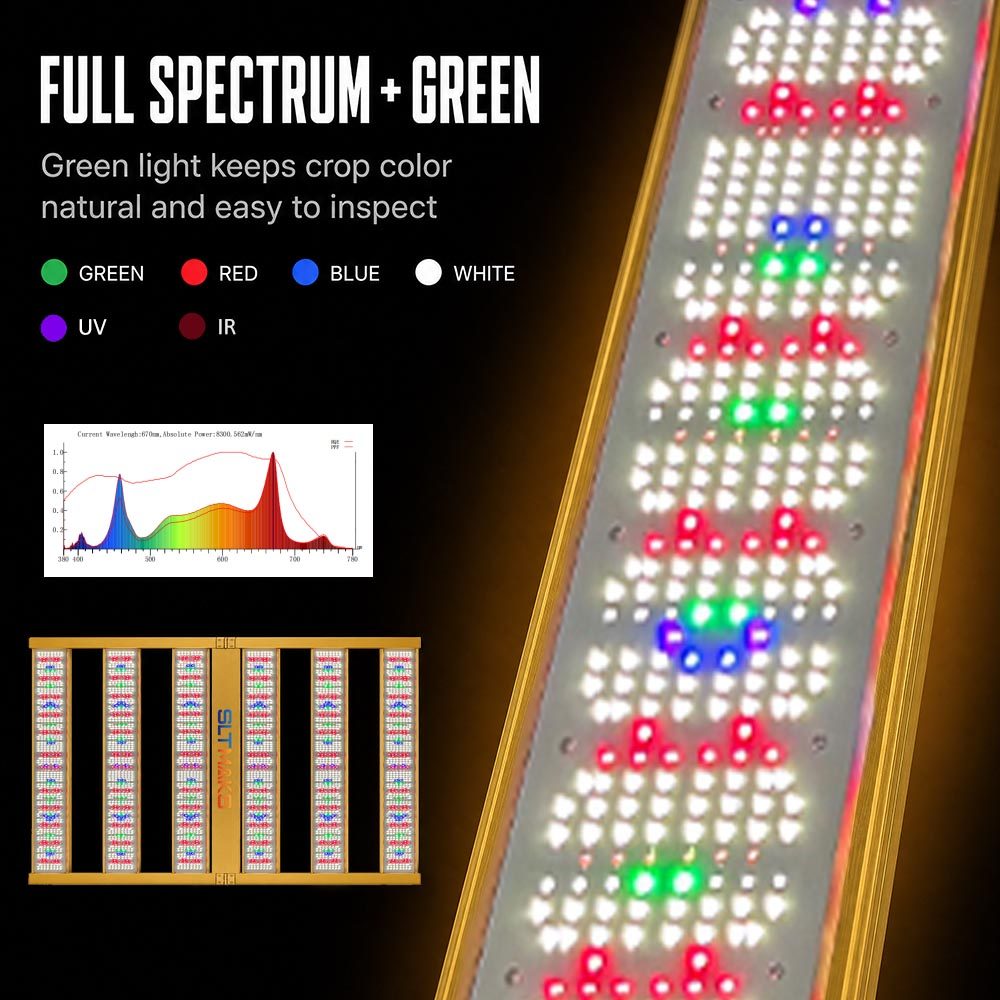
Whether the added green is worth having is a plant-science question, and the honest summary is that the evidence is real but narrower than current marketing implies. Green photons are photosynthetically active, they behave differently inside leaves than red or blue, and a measurable green share supports the human side of the room too, because natural crop color makes deficiency and pest inspection dramatically easier under twelve-hour exposure. The full treatment, including the measurement debate and the species-dependent signaling story, lives in the wavelengths guide; this page stays on the engineering side and treats the agronomics as a link rather than a re-argument.
The concrete shift is visible in component announcements. In October 2026, Cree LED introduced a mint LED for horticultural two-channel luminaires: a package engineered for the green region with a target green-to-blue ratio of 1.6, built in the industry-standard 3030 footprint so it sits alongside the white packages already populating most grow light boards. The significance is less the individual part than the packaging of the idea. A diode maker is now selling green as a drop-in companion to existing white and deep-red platforms, which is a different proposition from asking a fixture maker to develop a bespoke green channel and defend its efficacy penalty alone.
Footprint compatibility is the part with real consequences. Because the mint package occupies the same footprint as the common white packages, a board designer can mix green into an existing layout without redesigning the mechanical platform, the optics or the mounting. That converts green from a fixture-generation decision into a board-population decision, which is cheaper to make and cheaper to reverse. It also means the barrier to adding green is now engineering judgment rather than tooling, which explains why green appearances in fixture lines accelerated once the components arrived.
The second change is specifying conventions. Ratio figures such as a target green-to-blue value give datasheets a compact way to express the green share of a spectrum, and they give buyers something to compare between fixtures. Neither is a guarantee of quality, and the section on reading those numbers below covers the ways a ratio can mislead; but a specification, even an imperfect one, is what turns a trend into a product category you can procure against.
There is also a quieter supply-side change worth noting. The efficacy race that starved green of board space for a decade has cooled from its peak, because fixture efficacy has moved into a range where the remaining gains are incremental rather than headline-moving. When the marginal photon stopped being the whole marketing story, the marginal channel got its hearing. Components, market maturity and the green research base arrived at the same time, which is why the trend looks sudden even though each piece moved gradually.
GBR stands for green-to-blue ratio: the green photon share of a spectrum expressed relative to its blue photon share. A fixture with a GBR of 1.6 delivers, in round terms, sixty percent more green-region photons than blue-region photons. Component makers use it because green and blue sit at opposite ends of the design tension in a horticultural spectrum: blue drives compact morphology and carries the pump wavelength in phosphor packages, while green carries canopy delivery and the visible character of the light. A ratio compresses that balance into one comparable number.
The number is useful and also easy to over-read, for three reasons. First, a ratio describes two bands and says nothing about the rest of the spectrum; two fixtures with the same GBR can differ meaningfully in deep red, far red and UV. Second, the band edges that define green and blue are not standardized across the industry, so one manufacturer's ratio is not perfectly comparable to another's until you have seen the underlying spectral power distribution. Third, a target GBR is a component-level figure; the fixture-level spectrum after optics, mixing and channel dimming is the one your canopy receives, and the fixture datasheet is where that belongs.
The working rule for a buyer is to treat GBR as a screening number and the SPD as the evidence. A published GBR tells you the manufacturer has thought about the green balance deliberately, which already separates them from the vendors sprinkling green diodes on a board for the brochure. The spectral power distribution, ideally the same LM-79-backed measurement described in the efficacy guide, tells you what the fixture actually delivers across every band including green. Ask for both, and treat a GBR that arrives without an SPD as an unfinished answer.
Adding a green channel to a commercial fixture is a board-level and system-level decision, and the costs are real even when they are worth paying. At the board level, green packages occupy footprint that white and red packages would otherwise use, so the mixed layout has to hold the fixture's photon budget while the spectrum shifts. At the driver level, a dedicated green channel means another current string to regulate, or a place on an existing multi-channel driver, with everything that implies for dimming behavior and channel independence. The controls dimension is the same one covered in our comparison of multi-channel and single-channel fixtures: more channels mean more flexibility and more failure surface.
At the fixture level, the honest framing is that spectrum breadth and headline efficacy trade against each other. Packages optimized for the green region still convert input to photons less efficiently than the red and white packages they sit beside, so a green-enriched fixture gives up some fixture-level efficacy in exchange for the spectrum it delivers. How much it gives up is a design question with a real answer: the fixture datasheet should state fixture PPE for the exact configuration, and that number already includes the green penalty. A manufacturer confident in its green engineering publishes it; a manufacturer selling green while hiding the efficacy delta is telling you which kind of green product they built.
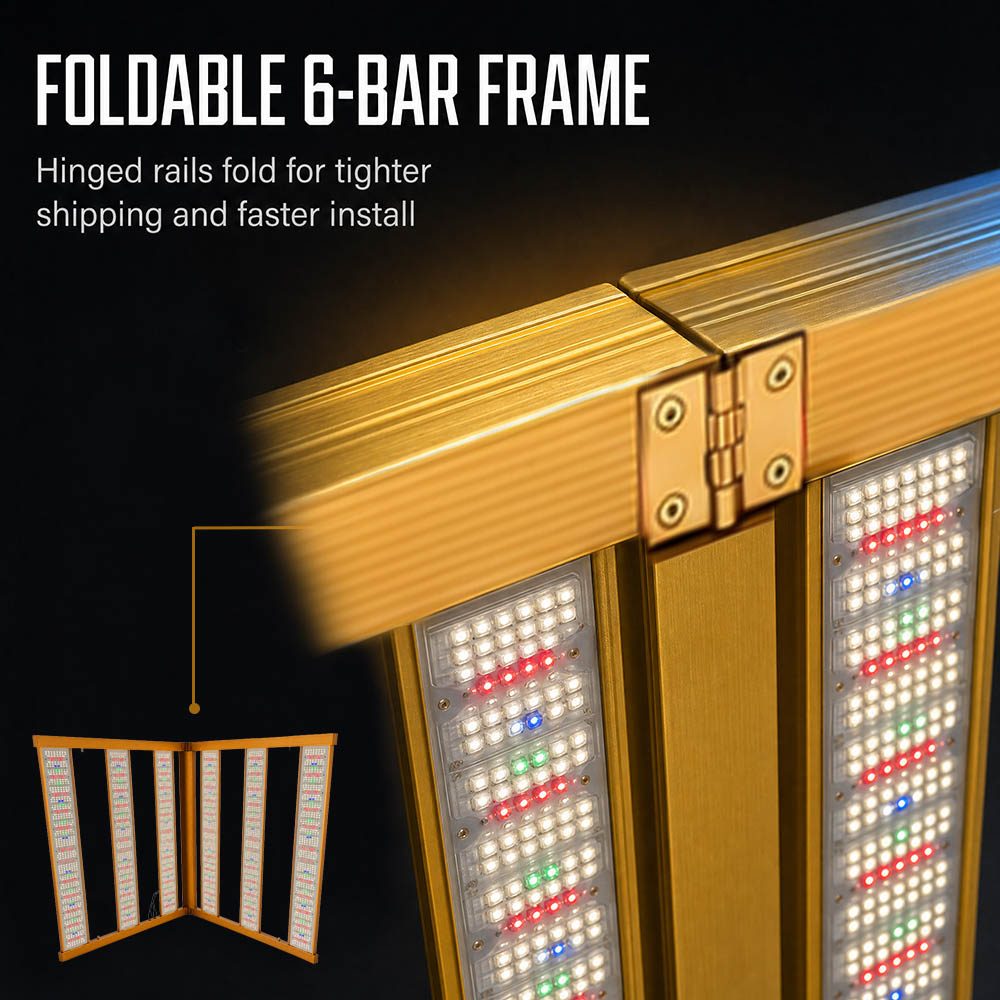
Thermal and mechanical design carry the rest. Green packages on a mixed board change the local heat distribution, and a foldable or bar-based platform has to hold its structural and service assumptions while the board population changes. This is one of the places where an established fixture platform shows its age advantage: the frame, the mounting hardware, the connector system and the thermal path were already proven, so the green revision rides on engineering that already survived its first years in the field rather than debuting all of it at once.
None of these costs is a reason against green; they are the reasons green belongs on a datasheet rather than in a slogan. A fixture that publishes its efficacy with green included, names its packages and states its channel architecture has paid the engineering cost and is letting you see the receipt. The evaluation questions in the next section exist to put exactly that receipt in front of you before the purchase order, not after the first PPFD map.
This page deliberately keeps the agronomic story short, because it belongs to a different evidence base and because re-arguing it here would just dilute it. The working summary: green photons are photosynthetically active, they interact with leaf architecture differently from red and blue in ways that affect how light is distributed through a canopy, and plant responses to green involving signaling and morphology are documented and species-dependent. For cannabis specifically, the honest position is that green is a legitimate spectral component with real documented roles and no honest basis for promising yield outcomes from its addition alone.
There is also a human-performance benefit that has nothing to do with plant physiology and matters enormously in a commercial room. Under a red-heavy or narrow-band spectrum, crop color is distorted and problems hide: the early nitrogen deficiency, the powdery mildew patch, the thrips damage on young leaves. A spectrum with a proper green and white share renders the canopy the way a healthy eye expects to see it, which makes the people walking the rows the most effective sensors in the facility. Growers who have worked under both spectrum families tend to describe this as the difference they notice first, and it is a legitimate procurement criterion even before any plant response is counted.
The full physiology, including the measurement controversy, the canopy penetration question and the species-dependence caveat, is laid out in the wavelengths guide. Read the two together: that page tells you what green does in the plant and how to think about the claims, and this page tells you what green costs in the fixture and how to procure it. Between them you have both halves of the purchase decision.
A green claim on a quotation deserves the same treatment as any other performance claim: convert it to numbers, demand the evidence behind the numbers, and compare fixtures on identical ground. The evaluation starts with the same documents described in our supplier selection guide, then adds the green-specific lines. The table below collects the questions that matter, why each one matters, and what a competent answer looks like.
| The question | Why it matters | A competent answer looks like |
|---|---|---|
| Fixture PPE of the exact green configuration | green packages trade against the white and red they displace, and the penalty lands at the fixture level | a fixture-level figure measured on the complete luminaire, with test conditions stated |
| Spectral power distribution of that configuration | the ratio and the marketing describe intent; the SPD is what the canopy receives | a full-curve file, ideally backed by the same laboratory measurement described in the efficacy guide |
| Channel architecture | a locked green share is a factory decision; an independently dimmable channel is a cultivation tool | a clear statement of which channels address, on what protocol, and how dimming changes the spectrum |
| Named diode packages | the component trend is the story, and anonymous packages cannot be checked against it | package names and footprints, stated plainly on the datasheet |
| When the green revision shipped, and on what platform | a designed green channel rides on a proven frame; a rushed one debuts everything at once | a revision date, a platform history and an honest account of what changed on the board |
Two of these questions deserve emphasis because they decide most cases in practice. The first is the efficacy question: fixture PPE for the exact green-enriched configuration, measured on the complete luminaire, with the test conditions stated. If the quoted efficacy comes from a white version of the fixture while the green version is what ships, the number is not yours to use, and the gap between the two is the real price of the green channel. The second is the channel question: whether green is independently dimmable, and what happens to the spectrum when you dim. A green channel locked at a fixed share is a spectrum decision made once by the factory; an addressable green channel is a cultivation tool. Neither is wrong, but they are different products, and your cultivation plan should decide which one you are buying.
Sample verification closes the loop the same way it does for every other claim. Run the PPFD grid described in the PPFD and DLI guide on the sample at your mounting height, and if green matters to your decision, ask the supplier for a spectral measurement of the sample as well, not only the catalogue figure. A sample that measures where its datasheet claims is worth scaling; one that does not has answered every remaining question.
Every component trend arrives with its own dialect of marketing, and green is no exception. The claims below are not always dishonest; some are just incomplete in ways that hide the engineering cost. The pattern to watch for is a green story that avoids numbers, because the manufacturers who paid the engineering cost are generally eager to show the arithmetic that justifies it.
| The claim | What it usually means | Ask instead |
|---|---|---|
| Green-enhanced, with no ratio or SPD | green diodes are on the board, but the share is a decision the vendor prefers not to publish | the spectral power distribution and the green share as a number |
| Class-leading efficacy, green included | one of the two claims is decoration unless the trade is acknowledged | fixture PPE measured on the green configuration specifically |
| A magic green fraction | a marketing number ahead of any industry standard | the reasoning behind the share, and the evidence the vendor would accept for a different one |
| Penetration claims as the headline | the popular version of the claim outruns the leaf-optics research | the agronomic evidence base, treated as a physiology question, not a datasheet one |
The deepest red flag is the compound one: a fixture that markets green aggressively while quoting an efficacy figure that could only come from a configuration without it. The physics does not allow a free green channel; if the brochure claims both abundant green and class-leading efficacy without acknowledging a trade, one of the two claims is decoration. Manufacturers doing honest green engineering talk about the trade openly, because the trade is also what makes their spectrum work defensible.
One clarification belongs here because it confuses buyers regularly: green enrichment and the old blurple approach are opposites, not stages of the same idea. Blurple fixtures omitted green and white entirely; green-enriched fixtures add green on top of a white base. If a vendor's green pitch slides into red-blue framing, the fixture behind it is probably neither, and the SPD will settle the question in one look.
For a manufacturer, the green decision lands differently at each point in a lineup, and the reasoning is worth understanding because it explains where you will and will not see green offered. In propagation and mother rooms, where fixtures run lower power and inspection density is highest, the visibility argument carries the most weight and the efficacy penalty matters least in absolute watts. In flower rooms, where the fixture fleet is the largest line item on the electrical design, green has to justify itself against the white base that already delivers a green shoulder, which is why flagship flower fixtures tend to publish the most careful green engineering rather than the most aggressive green marketing.
Our own line followed that logic. The SLTMAKS Golden 1300W is a foldable six-bar fixture built on a hinged frame that ships flat and installs without bar-by-bar assembly, and its current revision carries a green channel alongside the white, red, blue, UV and infrared packages on the board. The green share was chosen as a spectrum balance decision, published in the fixture's spectral data rather than sold as a slogan, and the foldable platform meant the revision rode on a frame whose thermal and mechanical behavior was already proven in the field. If you are evaluating green-enriched fixtures against each other, the fixture's datasheet and spectral distribution are the comparison ground, and our team will provide both on request.
The lineup logic also explains what you should be suspicious of. A vendor whose entire range suddenly claims green, from propagation bars to flagship flower fixtures in the same quarter, is describing a marketing calendar rather than an engineering program. Real green adoption tracks the component releases and lands where the justification is strongest first. Ask when the green revision shipped, what changed on the board, and whether the frame platform is new or proven; the answers separate a designed spectrum from a repackaged one.
Inside a facility, green's value concentrates where human inspection is frequent and where the base spectrum leaves gaps. Mother rooms and propagation lines earn it most directly: the plants are handled and examined constantly, the fixtures are smaller, and natural crop color under a green-and-white spectrum turns daily scouting from an effort into a glance. Veg rooms sit in the middle, where the inspection case remains strong and the morphology effects documented for green signaling can matter to the structure you are building before flower. Flower rooms are the case for careful engineering rather than enthusiasm, because the white base already carries green and the fixture fleet is the largest capital line; there, green enrichment has to arrive with published numbers to be worth its efficacy trade.
Green also interacts with the measurement culture of the facility. If your team runs the PPFD mapping and fixture logbook habits described in our replacement decision guide, add the spectrum dimension to the same discipline: note the fixture configuration including its green share, keep spectral files with the commissioning documents, and hold new samples to the same evidence standard as the datasheets. A facility that measures its spectrum once and files it will never have to argue about green again; the numbers will be in the record.
Finally, keep green in proportion within the wider plan. The decisions that move a cannabis facility's lighting outcome most are the ones covered across this guide series: the PPFD and DLI targets, the fixture count and layout, the efficacy arithmetic, the controls architecture and the electrical design. Green enrichment is a refinement of the spectrum inside that plan, worth having when the engineering is honest and priced honestly, and worth declining when it is sold as magic. The facilities that benefit from it are the ones that already have the fundamentals measured; green improves a plan, it does not replace one.
Very few commercial facilities replace every fixture at once, which means the green decision usually arrives in a room that already runs a fleet. The execution questions are the same ones covered in our guide to the first 30 days after an LED retrofit, with one spectrum-specific addition: when green-enriched fixtures share a canopy with older white fixtures, the PPFD grid will look consistent while the spectrum varies fixture by fixture. Plants integrate the mix, and in most cases the blend is perfectly workable, but the room's spectral record should say what is actually hanging over each zone rather than assuming the newest datasheet describes everything.
The practical handling is bookkeeping, not physics. Extend the fleet sheet described in the replacement decision guide with a spectrum column: configuration, green share if published, spectral file reference. When the team measures a sample or runs a commissioning grid, save the spectral measurement next to the PPFD data. None of this costs a watt, and it means the day someone asks whether the west zone canopy sees a different spectrum than the east zone, the answer is in the logbook instead of in an argument.
One sequencing note belongs here because it saves money. If a green-enriched revision is part of the reason a replacement project is moving, resist the temptation to let the spectrum choice pick the rooms. The replacement order should still follow the economics: the oldest, weakest, most failure-prone fleet first, exactly as the replacement triggers dictate. A room whose fixtures measure on their datasheet curve does not owe itself a green upgrade, and the efficacy arithmetic that decides the project does not change because the new catalogue page is more colorful. Green is a good reason to choose a fixture; it is a weak reason to retire one early.
The procurement conversation collapses to a short list. Ask for the fixture-level spectral power distribution of the exact configuration you are buying, the fixture PPE measured on that configuration, the green share expressed as a ratio and as a fraction of the fixture's photon output wherever the vendor publishes one, the channel architecture and whether green dims independently, the named diode packages behind the spectrum, and the efficacy delta between the green and non-green versions if both exist. Ask when the green revision shipped and what platform it rides on. Each question maps to an engineering decision this guide has covered, and a vendor who answers all of them without hedging has done the work the trend requires.
Then hold the sample to the same standard before the production order, the way you would for any fixture family. The green trend is real, the components behind it are real, and the fixtures it is producing are some of the most interesting spectra the commercial market has been offered. The difference between a good green purchase and a disappointing one is not the trend; it is whether the buyer asked for the numbers behind the color. Send us your room dimensions, target PPFD and the spectrum questions from this page, and we will answer with fixture configurations, spectral files and a quotation from our Dongguan plant.
Yes. Phosphor-converted white packages deliver a broad spectral shoulder through the green region, so every white grow light supplies green photons. The current trend is about dedicated green channels added on top of the phosphor blend, at a share the manufacturer controls and publishes.
Three reasons stacked up: direct green diodes were the least efficient packages in the LED family, a problem the industry calls the green gap; white phosphor already carried green passively; and the fixture market's efficacy race punished every photon spent off the headline number. The components, the market and the research changed at the same time, which is why the trend looks sudden.
Green-to-blue ratio: the green photon share of the spectrum expressed relative to the blue share. A GBR of 1.6 means roughly sixty percent more green-region photons than blue-region photons. Treat it as a screening number and ask for the full spectral power distribution, because band edges are not standardized and a ratio says nothing about the rest of the spectrum.
There is no honest basis for promising a yield increase from adding green alone. Green photons are photosynthetically active and have documented roles in how light distributes through a canopy, but yield outcomes depend on the whole lighting plan. The physiology evidence and its limits are covered in our wavelengths guide.
Green interacts with leaf structure differently from red and blue, and part of that behavior involves how green photons are handled inside leaves. The popular penetration claim is often stated more strongly than the research supports. The leaf-optics evidence, including the measurement debate, is covered in our wavelengths guide rather than simplified here.
Some fixture-level efficacy is the normal price of a broader spectrum, because green packages still convert input to photons less efficiently than the red and white packages beside them. The size of the penalty is a design question with a published answer: the fixture datasheet for the exact green configuration already includes it. Ask for that number specifically, not the white version's number.
A horticultural package engineered for the green region of the spectrum. Cree LED's October 2026 mint LED, with a target green-to-blue ratio of 1.6 in the standard 3030 footprint, is the most cited example. The name describes the emission region, and the significance is that green became a drop-in option for existing board designs.
Red-blue fixtures still grow plants, and the terms that era left behind still circulate in quotations and guides. The market has moved to white and multi-channel platforms, partly because a white base carries green naturally and partly because channels give growers control. Our guide to legacy grow light terms unpacks the vocabulary you will still meet.
Not necessarily. A quality white base already delivers a green shoulder, and flower rooms carry the largest fixture fleets, so the efficacy trade deserves the closest scrutiny there. Green enrichment earns its place in a flower room when the engineering is published and the efficacy delta is acceptable; it earns it most easily in mother and propagation rooms where inspection is constant and fixtures are smaller.
There is no industry-standard green share, and a vendor quoting a magic fraction is ahead of the evidence. Evaluate the whole spectral power distribution rather than one number, and weigh the green share against the fixture's efficacy, your room type and your inspection practices. The ratio figures appearing on component datasheets are a starting point for comparison, not a target to hit.
Yes, and it is one of the most practical benefits. A spectrum with a proper green and white share renders crop color naturally, so deficiencies, pests and stress patterns show up the way they would under daylight rather than hiding under a narrow-band spectrum. In rooms where staff inspect plants for hours every day, that visibility is a real operational gain.
Yes. The SLTMAKS Golden 1300W is a foldable six-bar fixture whose current revision carries a green channel alongside white, red, blue, UV and infrared packages, on a hinged frame platform already proven in the field. We provide the fixture's spectral distribution and efficacy data for the exact configuration on request, together with a quotation from our Dongguan plant.
Send the room dimensions, target PPFD, the spectral questions from this page, and we will answer with fixture configurations, the spectral files and efficacy data for the exact green revision, and a quotation from our Dongguan plant.
