Ripe and unripe marijuana buds can sit on the same plant a week apart, and under a strong grow light they look deceptively alike. The resin that settles the question sits on the cannabis bud itself, it changes daily in the final two weeks, and the difference between cutting on the right day and the wrong one lands directly on the scale and on the grade sheet. This guide walks the signals in order of reliability, then explains why a commercial room never ripens all at once, and what the light map has to do with it.
Ripeness is read on the trichomes, the resin glands that cover the buds. Under 30x to 60x magnification the heads run from clear, to cloudy or milky, to amber. Most commercial flower is cut when the heads are mostly cloudy with a small amber share, because that is where cannabinoid and terpene development peak together. Pistils that have darkened and curled, swollen calyxes and a fading fan-leaf cover all support the call, but none of them settles it alone.
The part most guides leave out is spatial. Top colas ripen days before lower bud sites, so the honest answer to the ripeness question is always relative to where you sampled. A room that meters evenly gives you a narrow window and one clean cut. A room with a steep light gradient gives you a spread, and the spread is a layout finding before it is a patience problem.
Growers lean on four signals, and they are not equally trustworthy. Trichomes sit closest to the chemistry, because the cannabinoids and terpenes the market pays for are produced inside those gland heads. Pistils are a visible proxy that works as a rough guide. The calendar is a planning tool, not a signal. Smell and bud swelling are supporting clues that the window is near. The table below ranks them the way a commercial room should weight them:
| Signal | What to look for | How reliable | What misleads it |
|---|---|---|---|
| Trichome heads on the buds | Clear to cloudy to amber under 30x to 60x magnification | Best single signal | Sugar leaves mature first; LED color distorts the read |
| Pistils | 70 to 90 percent darkened and curled in | Rough guide | Heat spikes darken them early; some cultivars hold white hairs late |
| Calendar (days since flip) | The cultivar's published flower range | Planning tool | The range is a spread, not a date; conditions shift it by days |
| Smell and swelling | Strong terpene nose, fat calyxes, receding pistils | Supporting clue | Subjective; the nose arrives days before the loupe agrees |
Use them in that order. The calendar tells you when to start looking, the pistils tell you the window is close, and the trichomes tell you where inside the window you stand. Rooms that cut on the calendar alone inherit whatever the cultivar's range spread turns out to be that cycle.
The gland head is the part that matters. On the bud's calyxes the heads progress through three visible states, and each one says something specific about what the plant is doing:
| Stage | What the heads look like | What the plant is doing | How commercial rooms read it |
|---|---|---|---|
| Clear | Glassy, translucent heads | Cannabinoid precursors still forming | Not ready; cutting now trades potency for days |
| Cloudy (milky) | Heads turn opaque white | Resin near its peak output | The window is opening; start sampling daily |
| Cloudy with a small amber share | Roughly 5 to 15 percent of heads amber in commercial practice | Maturity with the profile most rooms target | Where most flower is cut |
| Mostly amber | 30 percent or more amber | THC running down, effect shifting heavier | Only for a deliberate late profile; mold risk grows |
Two honest notes belong next to this table. First, the common claim that amber trichomes mean THC has simply converted into CBN is overstated: measured CBN in fresh flower stays low, and the heavier effect growers report at high amber shares owes more to THC degradation and shifting terpene proportions than to CBN alone. Second, the amber share is a target you choose, not a universal truth. A room cutting for a daytime, effect-forward profile stops earlier than a room finishing for a heavy late profile, and both are correct.
Most misreads come from where and how you look, not from the plant. The first rule is to sample the buds themselves, not the sugar leaves poking out of them. Sugar-leaf trichomes mature days earlier than calyx trichomes, so a glance at a resin-coated leaf makes the whole plant look further along than it is. The second rule is light: judge color under a neutral white light source, because saturated LED spectra and the purple cast of some fixtures make a cloudy head read as clear. Switch off the fixture or step the sample into white light before you call it.
The third rule is magnification and repetition. The naked eye cannot split clear from early cloudy; a 30x to 60x loupe or an inexpensive USB microscope can. Photograph the same bud site under the same white light every day through the final two weeks, because a trend across three photos is worth more than one glance under pressure. And sample more than one site per plant: the top cola is the most advanced point in the room, which makes it the worst single place to take the whole answer from.
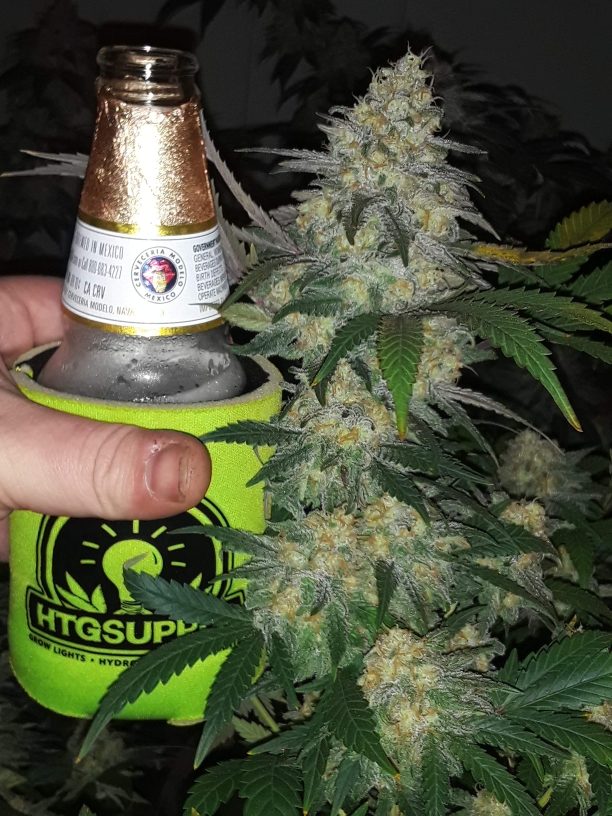
The pistil method survives because it needs no tools. When 70 to 90 percent of the hairs have darkened to orange or brown and curled inward against the bud, the window is close, and for most photoperiod cultivars that observation lands within days of the trichome verdict. It fails often enough to keep the loupe in the job: heat spikes darken pistils early, some cultivars hold fresh white hairs well into week ten, and stressed plants can throw new pistils late in flower.
Calyx swelling and the fade belong to the same supporting cast. Buds put on their final density in the last two weeks as calyxes pack out, and the fan leaves yellow or purple as the plant draws down stored nitrogen. The fade confirms the plant is finishing on schedule, and it is the same senescence pattern described in our yellow-leaf diagnostic guide. Read these signs together with the trichomes, never instead of them.
Seed catalogs publish flowering ranges because buyers need to plan rooms, and the published number is honest about being a range: the same cultivar run under different conditions finishes at different points inside it. The clock that matters is developmental, as our seed-to-harvest timeline explains, and the ripening sequence itself runs on genotype and internal scheduling rather than on photosynthesis rate. Autoflowers compress the same logic, which is why the autoflower guide treats the calendar as a fixed frame around a biological process you cannot hurry.
Use the calendar for what it is good at: scheduling labor, booking dry rooms and staggering turns. Then let the loupe decide the day. A room that cuts at week eight because week eight arrived will either leave grams on the table or take flower that needed another week of resin.
Walk a late-flower room with a loupe and a map, and the ripeness spread becomes visible as a pattern: the tops under the brightest overlap zones are cloudy with the first amber, while the bud sites in the dimmer cells, lower on the plant and between fixtures, are still mostly clear. The upper canopy intercepts most of the photons, so the plant sends resources there first, and those colas cross the finish line days ahead of the rest.
That gradient is normal physics, and the cross-section below shows how it forms. What is not mandatory is its width. How far the lower sites lag behind the tops is a function of how even the light map is, and that is a number a room can design for:
Light does not set the ripening clock. The sequence from clear to cloudy to amber is developmental, and no intensity or spectrum setting advances the plant's internal schedule in any reliable way. Pushing intensity in the final week to hurry a room adds heat and stress, not days. The honest summary from our DLI guide applies: light buys biomass and quality across the whole cycle, not a faster calendar at the end.
What light does control is the quality of what ripens and how evenly the room gets there. The DLI the canopy receives through late flower drives resin output and bud density at every site. Spectrum choices shape the expression the market grades, which is the territory of our flower spectrum guide, and the UV question is handled separately in the UV and far-red review. Overdoing any of it backfires: a fixture pushed past the canopy's use hits the photoinhibition territory covered in the light bleaching guide, and bleached tops do not read as ripe no matter what the calendar says.
Commercial lighting practice gives the evenness targets a number. A canopy that meters within roughly ±15 percent of the room mean lands near a minimum-to-average ratio of 0.85, comfortably above the 0.75 redesign floor in the ASABE S640 horticultural lighting standard, and adjacent fixtures overlap 10 to 20 percent to hold that line. Those are the same numbers used in the fixture count arithmetic and the setup sequence in the grow space setup guide, and they buy something specific at harvest: a ripeness spread narrow enough that one cut date serves the whole canopy.
A room that meters below that line pays for it in window width. Where the mean hides a hot zone, the tops under it finish first and hold at peak while the rest catches up, and resin quality at the peak does not wait politely. Where dim cells lag, those sites need days the schedule did not plan. The harvest window, in other words, is as wide as the light map made it.
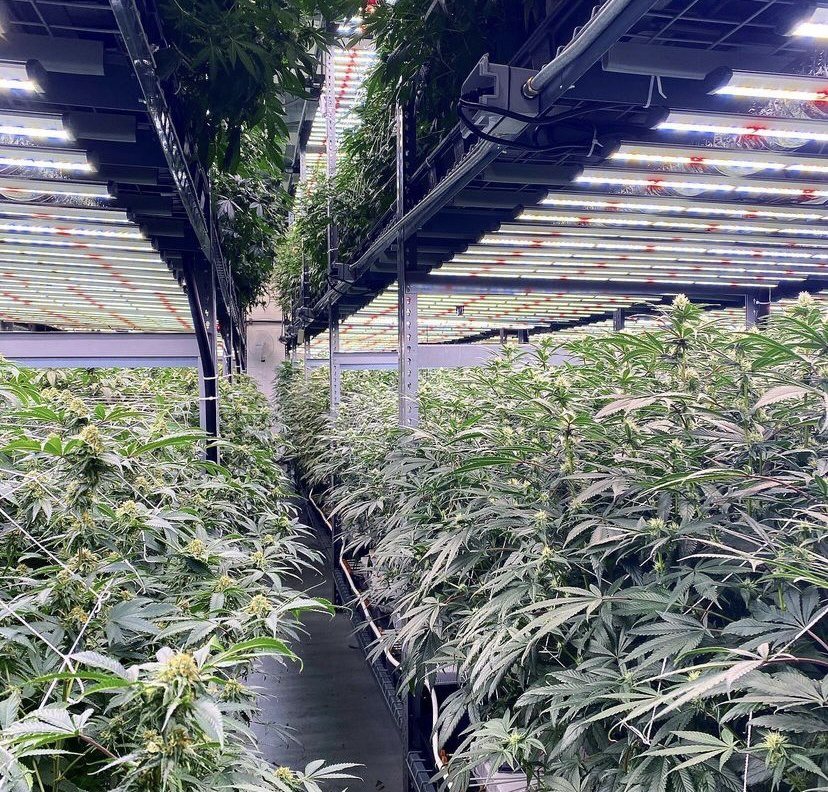
The bud sites that lag hardest sit in the lower third of the canopy, where the top layer has already spent the photons. Under-canopy bars attack exactly that deficit: sealed strips mounted below the canopy line push light into the lower bud sites, sized in dense canopies at roughly 25 percent of top-light power. Rooms running a second layer flatten the ripeness gradient from below, because the sites furthest from the ceiling stop depending on whatever drips through the top canopy.
The engineering constraints are different from any top light, and they are catalogued in the under-canopy deployment guide: IP65 sealing for humid air, passive cooling at close proximity to tissue, and dimming so the layer ramps as the canopy closes. A dirty lens down there converts watts into heat at 20 centimeters from flower, so the cleaning schedule is part of the design, not an afterthought.
Home-grow advice says check the trichomes. A commercial room needs a sampling plan, because the decision it supports, a cut date for thousands of plants, is worth more than one glance can carry. The protocol below fits on a clipboard and takes one person fifteen minutes a day in the final two weeks:
| Step | Action | Why it matters |
|---|---|---|
| 1. Fix the sample points | Mark 8 to 12 sites per room: top, mid and lower bud sites across the grid | One loupe on one top cola reads the brightest cell, not the room |
| 2. Use white light | Check each sample under a neutral white flashlight, not the fixture | LED spectra tint resin and hide the clear-to-cloudy line |
| 3. Magnify 30x to 60x | A loupe or a USB microscope on the calyxes | Sugar-leaf heads amber days earlier and fake an early window |
| 4. Photograph and compare | Same sites, same white light, daily through the final two weeks | A trend across three photos beats one glance under pressure |
| 5. Log against the light map | Note which sample points lag and where they sit in the grid | Laggards clustering in dim cells is a uniformity finding |
| 6. Set the cut by the slowest site you keep | Decide block or two-pass from the spread, not the average | The window is as wide as your slowest sample point |
The last step is the one that turns a ripeness check into a lighting audit. If the lagging sample points cluster in the same grid cells cycle after cycle, the room is telling you where its light map thins out, and that finding belongs in the layout conversation, not the fertilizer order.
When the spread between the top sites and the lower sites runs wider than a few days, the room can be cut in two passes: take the tops at their peak, leave the lower bud sites to finish under the same light for several more days, and cut them at theirs. Two-pass harvest is standard practice in uneven rooms precisely because the alternative, one cut for everything, means the tops hold past peak while the lowers come in early, and the batch averages both losses.
The trade is labor and planning. Two passes through the room cost crew days, and the dry room holds material at two stages at once. A room with a narrow ripeness spread makes that trade unnecessary, which is why the uniformity project and the harvest schedule are the same conversation held two months apart.
Cut early and the resin never finished: heads still clear or barely cloudy mean cannabinoid and terpene development short of what the cultivar had budgeted, and the flower reads lighter and greener on the bench. Cut late and the decline starts: the heaviest amber shares trade the top of the profile for a heavier, sleepier one, terpenes fade with them, and in humid rooms the overripe window is also where mold risk concentrates. Neither error announces itself at the trim tray; both show up in the grade and the price.
The honest framing for a commercial room is that the errors are asymmetric. A day early costs less than a week late, because the early side of the window loses a slice of the peak while the late side loses the peak itself and starts paying mold risk on top. That asymmetry is why the sampling protocol leans daily in the final stretch, and why the cut decision belongs to the loupe and the log, not to the calendar page.
A wide ripeness spread this cycle is a design brief for the next one. The fixes run in cost order. First, meter the canopy on the grid at final height and find the thin cells; the fix may be as cheap as overlap, because adjacent fixtures set 10 to 20 percent into each other's footprints is what flattens the gradient. Second, give the lower third its own layer where the canopy is dense, sized at roughly a quarter of top-light power. Third, hold the DLI at target through late flower rather than pushing intensity in the final week, and keep the environment steady, because heat spikes darken pistils and stress the finish.
Fourth, schedule around the biology instead of against it: stagger rooms rather than stretching a single room's window, and book labor from the sampling log rather than the calendar page. None of these fixes touches the ripening clock, because nothing does. They narrow the spread so that when the clock runs out, the room crosses the line together.
Under magnification the resin heads on the buds read mostly cloudy with a small amber share, the pistils have darkened and curled inward across most of the bud, the calyxes are swollen and dense, and the fan leaves are fading. Confirm it on the buds themselves, not on the sugar leaves, which mature first and fake an early window.
Amber means the resin is oxidizing past its peak, but a small amber share is the target in most commercial rooms, not a defect. A dominant amber share is past the balanced profile and drifts heavier, with terpenes fading alongside. The share you stop at is a choice of effect, made deliberately.
Close, not conclusively. Darkened, curled pistils and swollen calyxes put the window within days, but the naked eye cannot split a clear head from an early cloudy one. A 30x to 60x loupe is a small purchase that settles the call, and a USB microscope adds the photo log for a few dollars more.
The upper canopy intercepts most of the light, so the top colas receive the most resources and finish first, while the shaded lower sites lag by days. The size of the lag tracks how steep the light gradient is, which is why uniformity work narrows it and under-canopy lighting attacks it directly.
No. Ripening is plant development and it stops at the cut. Drying and curing change moisture, texture, chlorophyll character and aroma, sometimes dramatically, but the maturity of the resin is fixed on harvest day. Nothing in the dry room adds potency the plant did not make.
For a given bud site the useful window runs several days, and published grower guidance puts the full cultivar spread at roughly 5 to 14 days depending on genetics. What the room adds is geometry: an even canopy compresses the spread toward one date, an uneven one stretches it across two weeks.
When top and lower sites sit more than a few days apart, two passes let each tier cut at its own peak and usually beats one averaged cut. The cost is crew days and a dry room holding two stages at once. Narrow the spread and the second pass stops paying for itself.
Flushing changes what the root zone delivers, not the developmental clock the plant runs on. The ripening sequence keeps its own schedule, which is why the flush decision belongs to feed planning and taste targets, as covered in the autoflower guide's flush section, and not to harvest urgency.
No. The ripening sequence is developmental, so added intensity does not advance it. Light across the full cycle drives the resin and density the market grades, but pushing the fixture hard in the final week adds heat and photoinhibition risk instead of days. Hold the target, keep the read on the loupe.
Commercial practice centers on mostly cloudy heads with roughly 5 to 15 percent amber, which is where cannabinoid and terpene development meet most market profiles. Rooms finishing for a heavier, later effect run the amber share up deliberately. Set the target before the final week, then sample against it.
Yes. Saturated blue, purple or warm spectra tint the resin and can make a cloudy head look clear, or hide amber entirely. Read the sample under a neutral white light source with the fixture off, and keep the white light identical between daily checks so the photo log stays comparable.
A room-wide spread is a uniformity symptom. Sample by grid cell and log which points lag: if the laggards cluster in the same dim cells cycle after cycle, the light map is the cause, and overlap, fixture count or an under-canopy layer is the fix. Patience is not the only tool on the list.
Send the room dimensions, ceiling height and the fixtures you run today. We answer with the layout that narrows the ripeness spread, the under-canopy share for the lower third, and a fixture quote that holds uniformity at your target PPFD.
