Male vs female cannabis plants is a question with a clock attached to it. A female plant left next to a male does not get a little seedy: it gets a crop's worth of seeds, because one opening pollen sac can pollinate an entire flower room through the air handlers. The sex of a cannabis plant is written at the nodes, it becomes readable weeks before any sac opens, and the discipline that protects a room is a scheduled node scan backed by a grow light schedule that never leaks into the dark period. This guide assumes you operate where cultivation is legal and licensed. It covers what each sex actually looks like, the pre-flower window where identification happens, what a male plant flowering means for your calendar, what to do with males once found, and the seed question that comes up every purchase cycle. It closes with the environment side of the problem, because the fastest way to meet males you never bought is a dark period that leaks, which makes this as much a grow light question as a genetics question.
Cannabis is a dioecious species, which means most plants carry either male or female organs, not both. The sex is set by genetics, the same way it is in mammals: an X chromosome from the mother and either an X or a Y from the father. Plants that inherit two X chromosomes become females, the ones that carry resin-heavy flowers. Plants that inherit an X and a Y become males, the ones that make pollen. There is no environmental dial that flips a healthy X/Y seedling into the other sex, and there is no visual difference at germination, at seedling stage, or through the first weeks of vegetative growth.
What the environment can do is destabilize a plant near the boundary. A female under heavy stress can grow male flowers and pollinate her own room, a condition called hermaphroditism, and a male can express a few pistils under the same pressures. That matters for one reason this article keeps returning to: sex identification is not a one-time check in week four, it is a running scan that continues into flower, because the exception cases arrive late.
The commercial stakes are simple. Sinsemilla, the seedless flower that the legal market grades and pays for, only exists if no pollen reaches the female flowers. A pollinated female redirects her energy from resin to seed production, and the flower loses its grade in the market that buys on appearance and lab data. Growers who run regular seeds accept this risk knowingly, and growers who run feminized seed or clones reduce it, but no room is exempt from the weekly walk. For the earlier stages of the crop, the seed to harvest timeline shows where the sexing window sits in the full crop cycle.
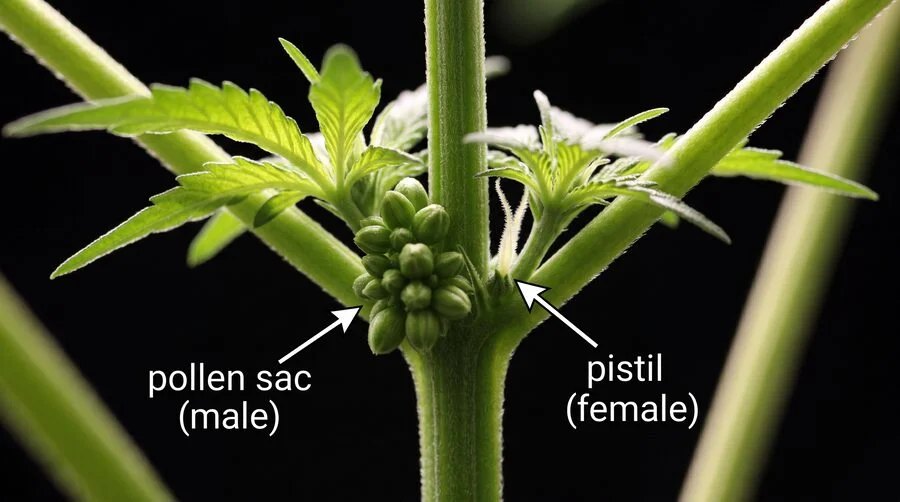
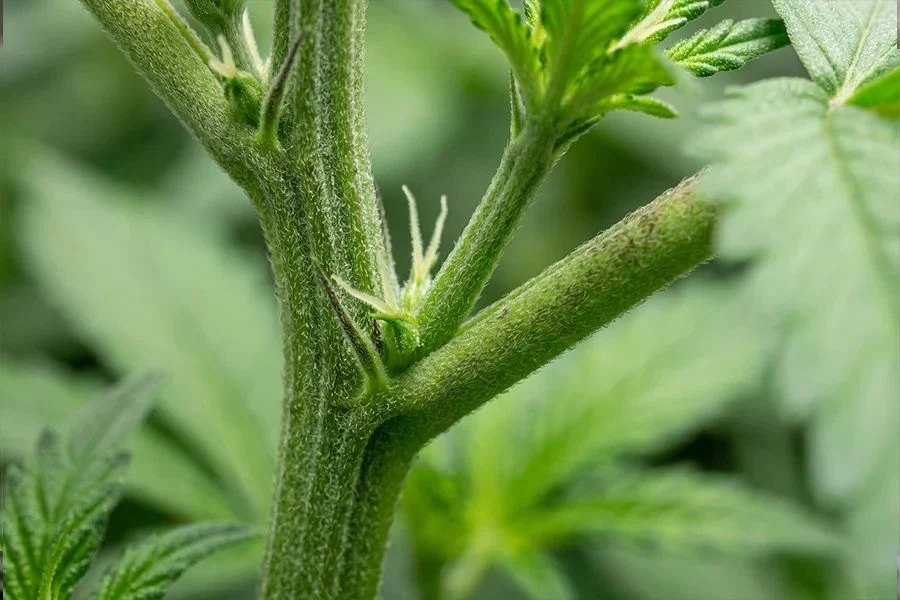
The female flower announces itself with hair. At a node where branches meet the main stem, a female plant grows a small teardrop-shaped calyx, and from its tip emerge two pistils, thin hair-like structures that start white and darken to orange or amber as the plant matures. The two hairs point upward in a shallow V, and they are the single most reliable marker in cannabis sexing: if you see paired white hairs coming out of a green calyx, that node is female.
Through vegetative growth under an 18 hour photoperiod, a female shows these pre-flowers quietly. She keeps growing branches and leaves, the pistils stay small, and nothing dramatic happens at the top. Once the room flips to 12/12, the same calyxes stack and swell into the flower clusters that the market buys. The pistils multiply and reach out to catch pollen, which is their function: each one is a landing pad for a pollen grain and the start of a seed.
Two useful habits on the female side. First, look at the nodes, and start near the top; the earliest pre-flowers tend to show in the upper third of the plant, where growth is most active, and a bare lower node does not clear the plant. Second, learn the calyx and the pistil as separate structures, because in week five the difference between a pistil and a small leaflet at a node is the whole test. A loupe helps, and the diagram below shows both sexes at the same node so the contrast is unambiguous.
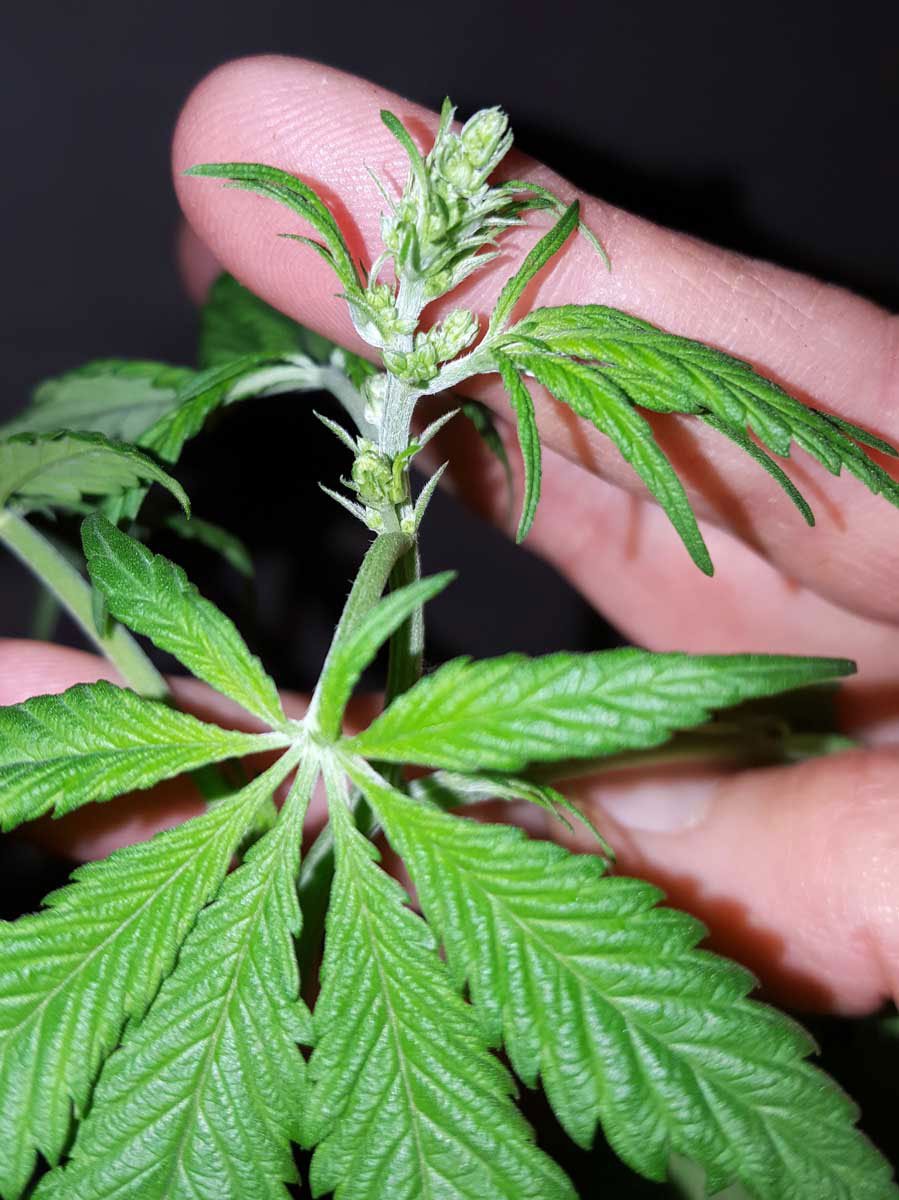
What do male weed plants look like? The male answer to the calyx is a pollen sac: a small, smooth, ball-shaped structure that hangs from a thin stalk at the node. Males do not produce hairs. They produce clusters of these sacs, grouped like tiny bunches of grapes, and the cluster hangs down or sits at an angle rather than pointing up. Early on, a single sac looks like a pale green ball the size of a pinhead, and the most common misreading is to call it a new growth tip. The difference is the stalk: a pollen sac sits on its own little stem, a leaf tip does not.
Before the sacs are obvious, males give secondary hints, and every one of them is a tendency rather than a rule. Males often stretch earlier and taller in vegetative growth, which is why experienced growers walk the back rows first, where the tall plants are. They often carry thicker main stems and fewer branches and leaves than sisters from the same seed lot. Some rooms report that males show sex first by a few days, and the gap is commonly cited at up to two weeks in vegetative growth, which is convenient: the early sexers are disproportionately the plants you are about to remove. None of these signs decides anything by itself. A tall plant is not a male plant. Odor belongs on the same list: both sexes carry mild scent in veg, and the aromatic display belongs to flowering females, so smell settles nothing either. The sacs decide, and everything else only tells you where to look first.
| Feature | Male | Female | When it shows |
|---|---|---|---|
| Node structure | Round pollen sacs on thin stalks, hanging alone then in clusters | Teardrop calyx with two pistils pointing up in a V | Weeks 4 to 6 in veg, 1 to 2 weeks after flip |
| Hairs | None | Paired white hairs, orange later | With the pre-flower |
| Stature | Tends to stretch earlier and taller | Bushier through veg | Weeks 3 to 6; a tendency, never a verdict |
| Branches and leaves | Often fewer | Often more | Late veg |
| Flower form | Sacs split along a seam and shed pollen | Calyxes stack into resin-bearing clusters | Weeks 2 to 4 of flower |
| Room role | Pollination or breeding input | The crop | Fixed at the pre-flower |
One more habit worth building. When a plant under 18/6 shows a structure you cannot call either way, tag it with a dated label and come back in three days. Pollen sac clusters and female calyxes both grow fast enough that three days resolves almost every ambiguous node, and a dated tag turns a vague suspicion into a decision with an audit trail.
How to tell female weed plants from males, and when? The honest answer is that sex becomes readable at the pre-flower stage, which for a photoperiod plant under an 18 hour photoperiod lands somewhere in weeks 4 to 6 from germination. Some cultivars show earlier and some later, and plants from the same seed lot can be a week apart. After a room flips to 12/12, the remaining ambiguities resolve within the first two weeks of flower, which is why the first three weeks of the flower schedule are the busiest sexing window in the whole crop.
| Week from germination | What to look at | What you see | Action |
|---|---|---|---|
| 1 to 3 | Nothing yet | Seedlings, no readable sex | No scan needed; keep records by lot |
| 4 | Upper nodes first, two or three per plant | First pre-flowers on early plants | First walk; loupe, tag roll, second pass |
| 5 | Same nodes, plus any green tags | Sacs or pistils readable on most plants | Confirm or clear tags after three days |
| 6 | Everything still ambiguous | Nearly every plant resolved | Remove confirmed males, log the lot |
| Flip week | Nodes that stayed bare | Late readers resolve in flower | Second pass on unsexed arrivals |
| Flower weeks 1 to 3 | Whole canopy | Bananas on stressed females possible | Banana watch; same-day removal |
The identification itself takes minutes once you know the landmarks. Work node by node, starting with the upper third of the plant, where pre-flowers tend to show first, then confirm across the lower nodes before calling it. A female node shows the calyx with its two upward hairs. A male node shows the round sacs on their stalks, first singly, then in small clusters. If the node shows nothing yet, move on and return next week; pre-flowers arrive on their own schedule and forcing an answer from a bare node is how misidentifications happen. A 30x to 60x loupe turns the whole exercise from guesswork into reading, because at that magnification the difference between a hair and a ball is not subtle. Learn the stipules as well, the narrow green spikes at every node: they sit on both sexes from an early age, they carry no pistil, and they are the most common false identification in the room.
Rooms running regular seeds plan for roughly a 50/50 split, and the walk exists because the split never lands exactly there. Rooms running clones from tested mothers can skip most of this work, which is the quiet commercial argument for the front end of the building covered in the mother room and propagation guide. Every clone from a female mother is female. Every seed is a question, and the walk is how the room collects its answers before the pollen flies.
Two faster routes exist for rooms that cannot wait. The clone test is the standard one for large regular-seed populations: take one cutting per unsexed seedling, label cutting and mother identically, and put the cuttings straight under 12/12 while the mothers stay in veg. A cutting shows sex seven to fourteen days after entering the schedule, and with rooting running in parallel the answer arrives two to three weeks after the cut, which turns the sex question from wait and watch into a scheduled, parallel process. The cutting work itself is the subject of the cloning guide. The third route is genetic tissue testing, which screens a leaf sample for the Y chromosome and works on seedlings too young to show pre-flowers; the per-sample price keeps it mostly in breeding work.
The identification problem is not only male versus female. It is also female versus herself under stress. A hermaphrodite is a genetic female that grows male flowers, and the tell is distinctive: instead of separate sacs on stalks, yellow anthers emerge directly from an otherwise normal female calyx, like small bananas. Growers call them exactly that. A room can pass every weekly node scan and still meet bananas in week six of flower, because hermaphroditism is usually triggered by the environment rather than announced by the seed lot.
| Trigger | Mechanism | The fix that addresses it |
|---|---|---|
| Light leaks in the dark period | Broken darkness reads as a broken season and destabilizes sex expression | Night audit: pinholes, indicator LEDs, door discipline, fixture and driver light output when off |
| Photoperiod instability | Timer drift and schedule changes stress the plant's clock | Hardware that holds 12/12 without drift; one schedule owner per room |
| Heat in flower | Sustained high temperatures push susceptible plants over | Hold flower nights in the low 20s C; treat setpoints as fixed, not negotiable |
| Physical stress late in flower | Heavy defoliation, root damage, transplanting in flower | Schedule invasive work in veg, keep flower hands off |
| Age and long runs | Old plants lose the reserve that keeps sex expression stable | Retire mothers on a schedule; take clones young |
| Genetics | Some lots carry hermaphroditism as a trait | Keep the find log; make the record part of the supplier conversation |
The trigger that deserves its own paragraph is the dark period. Photoperiod cannabis measures the length of uninterrupted darkness to time flowering, and a dark period broken by light tells the plant that something has gone wrong with the season. Repeated interruptions push susceptible plants toward hermaphroditism, and the doses involved are smaller than most growers expect: a pinhole at a duct penetration, an indicator LED on a driver, a door cracked during the night cycle. Our guide on light leaks and green light covers the audit that finds these, and the habit that prevents most of them is fixture and controller hardware that holds a schedule without drift. Heat does the same damage by a different route: rooms that hold flower nights above the mid-20s in Celsius see more bananas than rooms that do not, which is one more reason the environmental setpoints belong to one person, not to whoever is closest to the thermostat.
What to do with a hermaphrodite is a colder decision than the male question, because the bananas carry pollen the day you find them. A plant with one or two anthers low on the canopy, caught early, can be trimmed of the affected flowers and watched, and some rooms do exactly that. A plant throwing anthers across the canopy is finished: it has been shedding pollen since the first banana opened, and the honest move is to remove it the same day. Rooms that keep the plant because it is big are buying seeds in every jar downstream.
Male marijuana plant flowering is the part of the calendar that turns a discovery into a deadline. A male does not wait for 12/12 to do anything important. Under vegetative light he matures pollen sacs slowly, but once flower is triggered, the countdown compresses: clusters that are easy to see in week one or two of flower typically begin to open around ten to fourteen days later, and warm, dry rooms run faster than cool ones. An opened sac looks like it split along a seam and curls back, and the pollen inside is viable in the air long enough to reach plants you did not think it could.
| Stage | Typical timing after flip | Risk | Action |
|---|---|---|---|
| Pre-flowers readable | Week 1 to 2 | None yet; sacs closed | Weekly walk continues, tag and confirm |
| Clusters easy to see | Week 2 to 3 | Opening possible in 10 to 14 days | Confirm on a second look, then same-day removal |
| First sacs open | Week 3 to 5 | Airborne pollen reaches the whole room | Fans around the plant off first; wet, bag, cut, carry out |
| Pollen in the room | Hours after opening | Seeded flower across the footprint | Damp-clean surfaces; change clothing; log the footprint |
| Hermaphrodite found | Any week of flower | Bananas carry pollen the day they appear | One or two anthers: trim and watch; canopy-wide: remove today |
Two containment facts change how rooms handle the countdown. The first is that pollen is heavy in still air and light in moving air: a room with fans and air handlers moves an opening sac across the whole flower footprint, so the response to a found male is to kill the air movement around him first and remove him second. The second is that pollen sticks and settles, which is why rooms that handle male plants on purpose wet the floor before the work and wear dedicated clothing after it. A damp surface catches pollen that a dry one re-entrains for days.
For the removal itself, the least dramatic method is the best one. Water the plant down gently, bag the whole canopy in a large plastic bag, cut the stem at the base, close the bag, and carry it out. Do not shake the plant, do not carry it bare through the veg room, and do not compost an open-sac male where the compost pile shares air with the intake. A male cut two weeks before his sacs open carries none of this risk, which is the strongest argument for the weekly walk in the first place.
What to do with male cannabis plants depends on what kind of room you run, and the honest answer for most licensed flower operations is: almost nothing. Males are the input side of a breeding program, not a product. Their flowers carry far less resin than female flowers, their leaves carry some cannabinoids but not enough to justify canopy space in a room that sells flower, and a male kept past week six of flower is a risk with a negative yield. That said, there are four legitimate destinations for a male, and which one applies depends on the seed lot and the plan behind it.
| Goal | What to do with the male | How | Watch out |
|---|---|---|---|
| Protect the crop (default) | Remove him the day he is confirmed | Wet the plant, bag the canopy, cut at the base, carry out closed | No shaking, no bare carry through veg, no open compost |
| Breed your own seed | Collect pollen before the sacs open | Harvest sacs as they begin to separate, dry on paper, store dry and cold | Containment; a breeding male lives separated, never in the flower room |
| Hash line | Process foliage after removal | Male leaves carry some resin; run them through the existing hash workflow | Yield is a rounding error; never worth keeping him alive a week for |
| Fibre or compost | Bag and remove first | Compost only after the plant is dead and bagged away from intakes | Open-sac males in compost share air with the intake |
Breeding is the serious use. A male with proven vigour, pest resistance and structure is half of a cross, and growers who make their own seed collect his pollen before it opens: sacs are harvested just as they begin to separate, dried briefly on paper, and stored dry in the cold, where pollen stays viable for months. The breeding space itself needs less light than buyers expect: a flowering photoperiod at moderate intensity, which a dimmed fixture covers, and there is no reason to buy a second flowering-grade fixture for a short working life. Rooms that only buy seed and never make it have no reason to keep a male alive past identification, and for them the decision tree collapses to one branch: tag it, confirm it, remove it on the schedule in the section above.
The one use that surprises new growers is hash from male foliage. Male leaves and stems carry some resin, and traditional hash makers have used them for generations. In a licensed flower room this is a rounding error against the labour, and most rooms skip it. The honest framing: a male is worth processing only if the room already runs a hash line and the material is already in the building, not if it requires keeping the male alive an extra week.
Can you tell male from female cannabis seeds by looking? No, and the seed itself is the proof. Sex in cannabis is carried on chromosomes that express at the pre-flower stage, weeks after germination. A seed's size, colour, pattern and hardness reflect maturity and storage conditions, not the sex of the plant it would become. Every claim to the contrary, from striped seeds to dark seeds to seeds that float, fails the same way: no measurable feature of a dry seed correlates with X versus Y. Growers who pay a premium for presorted seeds are paying for the sorting, not the genetics.
This is why the seed question and the sexing walk are the same question with different deadlines. A buyer who cannot know the sex of a seed buys the sex of the population instead: regular seed lots run roughly half male, feminized seed lots run almost all female with a small known exception rate, and clones from tested mothers are female by construction. The procurement decision sits in that sentence. Regular seed is cheaper per unit and costs a sexing program. Feminized seed costs more per unit and still deserves the walk, because the exception rate is small, not absent. Clones cost the most per plant and close the question, provided the mother was tested and the propagation room is clean.
Feminized seed exists because a female plant can be forced to make viable pollen. A solution of silver thiosulfate, or colloidal silver, sprayed on a chosen female during early flower interferes with ethylene signalling in the flowers it touches, and the genetically female plant grows male anthers carrying only X chromosomes. Cross that pollen with a normal female and every offspring inherits two X chromosomes: the lot is female by construction, in the high 90s percent range as breeders report it, which is why feminized seed became the default for rooms that cannot spare the labour a regular seed lot demands.
The catch is that the same mechanism narrows the genetic distance between the plant's female machinery and her male machinery. Feminized lines carry less reserve against stress-induced hermaphroditism, and the stressors that matter most are the ones already covered above: broken dark periods, heat, and physical stress late in flower. This is not an argument against feminized seed, which has earned its place in commercial procurement. It is an argument that feminized seed changes the job of the weekly walk from finding males to finding bananas, and the rooms that fail this test usually fail it on the environment, not on the genetics.
Autoflower seed lots complicate the picture slightly, because autos flower by age rather than by photoperiod and cannot be held in veg while a sexing program catches up. Sex identification in an autoflower room happens against a hard clock, which makes the early pre-flower window even more valuable there: pre-flowers on autos typically land around weeks 3 to 5 from sprout, and there is no flip to hold while a sexing program catches up. The training side of that crop is covered in the autoflower topping guide, and the sexing habits are the same ones, just faster.
A sexing program that holds up commercially is a schedule, not a skill. It needs a calendar owner, a fixed weekly walk, a defined tool, and a rule for what happens between discovery and removal. The version that works in most rooms takes one person twenty minutes per hundred plants, once a week, and it starts in week 4 from germination for regular seed, or the day the room flips for anything that arrived from unsexed stock.
The walk itself works the nodes in order. Enter the room with the loupe and the tag roll, start at the back or the tall end, and check two or three nodes per plant, upper third first, then the lower nodes. Green-tag anything ambiguous with the date, red-tag anything confirmed male, and never remove a plant during the first pass; confirmations happen on a second look at least a day later, because a node that is bare on Monday is often readable on Thursday. Return to every green tag after three days. Clear it or promote it to red. Red tags get bagged and removed on the same day they are confirmed, with the containment steps from the pollen countdown section.
Between walks, the protocol lives in the room's habits. Plants that came in as unsexed seedlings from outside stock sit in a quarantine shelf until their first confirmed pre-flower, not in the main rows. Tools that touch a suspect plant get wiped before they touch the next one. The room log records what was found, where, and when, because a seed lot that throws males twice gets a different conversation with the supplier than one that never does. None of this is complicated. All of it is the difference between a sexing program and a sexing hope.
Most sexing failures are not knowledge failures. They are timing and confirmation failures, and they repeat across rooms often enough that the same handful show up every audit. The table below lists the expensive ones with what they actually cost a flower room.
| Mistake | What it costs | The correct move |
|---|---|---|
| Identifying from across the room | Females removed, males kept | Loupe at the node; stature is a routing hint, never a verdict |
| Single-visit confirmation | A confirmed male is a deadline, not a done task | Second look at least a day later; nodes resolve in days |
| The walk that stops after week 5 | Late readers and bananas seed the room in flower | Weekly through flower week 3, banana watch all flower long |
| Shaking or bare-carrying a male out | Pollen released across the footprint | Wet, bag, cut, carry out closed; fans off first |
| Keeping the beautiful male in flower | Every jar downstream carries seeds | Vigour belongs in a pollen program, not in the flower rows |
| Trusting the seed lot instead of the log | The supplier conversation never improves | Record every find by lot and date; repeat offenders get replaced |
Two of these deserve a closing note. The first is the beautiful-male exception, the plant that is too good to remove, because it is the mistake that costs the most and carries the best cover story. Vigour and structure are real breeding traits, and the way to use them is pollen collection under containment, not an open male in a flower room. The second is the single-visit check, the walk that happens once in week five and never again. Sex is settled at the pre-flower, but exceptions ripen late, and the rooms that stay seedless are the rooms that kept walking after they thought the question was answered.
The program compresses to one card. Post it at the door of the veg room and the flower room alike, because the walk that saves a crop is the one that happens on schedule whether or not anyone is worried.
No. A cannabis seed carries its sex on chromosomes that only express at the pre-flower stage weeks after germination, and no visible seed feature tracks X versus Y. Size, colour and pattern reflect maturity and storage, not sex. The practical answers are regular seed with a sexing program, feminized seed with a known small exception rate, or clones from tested mothers, which are female by construction.
They look like cannabis seeds, because seed appearance does not carry sex information. Claims about striped, dark, glossy or heavy seeds being female do not survive testing; those traits track maturity and storage conditions. A buyer who needs females buys feminized seed or clones, and still runs the weekly node walk from week 4, because the exception rate on any seed lot is small but not absent.
The reliable difference sits at the nodes. A female grows a teardrop calyx with two white hairs, the pistils, pointing up in a shallow V. A male grows round pollen sacs on thin stalks that hang alone or in grape-like clusters, with no hairs. From across the room, early stretch and taller stature suggest males, but only the node decides, and a 30x to 60x loupe settles it in seconds.
For a photoperiod plant under an 18 hour veg photoperiod, pre-flowers become readable somewhere in weeks 4 to 6 from germination, with cultivars running a week early or late. After a flip to 12/12, the remaining ambiguities resolve in the first two weeks of flower. Plan the first walk for week 4 and keep the walks weekly through the early flower weeks, because the calendar matters more than the technique.
A flowering male develops dense clusters of pollen sacs at the nodes, each sac a pale green ball on its own thin stalk, grouped like bunches of grapes. Around ten to fourteen days after the clusters are easy to see, the sacs split along a seam and release pollen, faster in warm dry rooms. The plant otherwise looks vigorous and unremarkable, which is exactly why the weekly node scan, not the eye test, is what protects a flower room.
Plan on ten to fourteen days between a clearly visible cluster and the first opened sac, and treat the shorter end as the real number in warm rooms. The response is not a rush to the plant, it is order of operations: air movement around the plant goes off first, then the plant gets wetted, bagged, cut and removed. A male found with his sacs still closed and handled the same day carries essentially no pollen risk to the room.
For most licensed flower rooms, remove it: wet the plant, bag the canopy, cut at the base and carry it out closed. Keep a male only if the room runs a breeding program, in which case collect and freeze his pollen before the sacs open and keep him contained and labelled until then. Male foliage can be run through a hash line, but the yield rarely justifies keeping the plant alive in a room that sells flower.
A female cannot become a true genetic male, but a stressed female can grow male flowers and release pollen, which is hermaphroditism. The tell is yellow anthers emerging straight from a female calyx, the structure growers call bananas. Common triggers are broken dark periods, heat, and heavy physical stress late in flower. Watch for bananas all the way through flower, because a hermaphrodite passes every early node scan and still seeds a room late.
Three normal reasons. Feminized lots run female in the high 90s percent range as breeders report them, so a rare male or intersex plant is inside the expected distribution, not a scam. Stress can push a genetic female into hermaphroditism, which reads as a male arriving late. And mislabelled or mixed lots exist at the bottom of the supplier market. Keep the walk, keep the log, and let the record, not the memory, drive the next purchase.
Often, yes, in a way that is useful but never decisive. Males from the same seed lot tend to stretch earlier and taller in veg, and many show their pre-flowers ahead of their sisters by a few days to as much as two weeks. Experienced growers use the tendency to plan the route of the walk, starting at the tall plants, and then ignore it for the actual identification, because a tall female costs the same to misidentify as a short male.
Not back to sinsemilla grade. Once a flower is pollinated the plant commits resources to seed development in those calyxes, and no treatment reverses it. Rooms that catch pollen early sometimes harvest early or cull the affected zone, and the honest accounting is that the market grades seeded flower below seedless. The saving move happens before pollination: the weekly walk, the containment order of operations, and a dark period that holds.
No. Sex changes what the plant produces, not the photons it can use, and a male and a female side by side take the same PPFD and the same photoperiod. Where lighting does enter the question is stability: a photoperiod room needs an unbroken dark period and a schedule that does not drift, because light leaks and timer faults push susceptible plants toward hermaphroditism. Fix that at the hardware and controller layer, not by walking the room with tape.
Send the room dimensions, fixture list and controller model. We answer with the schedule discipline that keeps a photoperiod room stable, the controller setup that holds 12/12 without drift, and the fixture choices that stay dark when the schedule says dark.
