Type "are grow lights safe for humans" into a search box and you get two kinds of answer, neither of them useful to a commercial operator. The first is a flat yes from a retailer, the second is a flat no from a wellness blog. Both skip the thing that actually decides the question: a cannabis grow light is an optical radiation source, and optical radiation from any lamp is characterised by a standard, measured at a stated distance, and assigned a risk group with a label attached to it. This guide is written from the fixture maker's side of that measurement. It explains what a horticultural luminaire emits, which standards assess the exposure, how to read the risk group on the paperwork, and what a twelve-hour shift in a commercial flower room changes about the answer.
The short version is that a properly installed LED grow light, used inside the exposure limits that the standards set, is an ordinary piece of industrial equipment rather than a health hazard. That sentence has three conditions embedded in it, and the conditions are the whole article: properly installed, inside the limits, and assessed as a complete luminaire rather than as a bag of diodes. The rest of this page works through each condition. Where the evidence does not support a claim, including some very popular claims about vitamin D and about light causing cancer, we say so plainly. Where a question belongs to an electrician or a physician rather than a lighting manufacturer, we point to it and stop. For the plant side of the spectrum, including why green light is not the waste product older guides called it, see our guide to how wavelengths affect cannabis flowering.
The standards do not ask whether a light is safe in the abstract. They ask how much optical radiation reaches a person, in which wavelength band, for how long, and from what distance. IEC 62471, the horizontal standard for the photobiological safety of lamps and lamp systems, assesses broadband non-coherent sources across 200 to 3000 nm and sorts them into four risk groups according to the exposure duration at which a hazard appears. UL 8800, the North American safety standard written specifically for horticultural lighting equipment, adopts that assessment in its Section 15 and applies it to the finished luminaire across 280 to 1400 nm at a measurement distance of 20 cm. A risk group is therefore a property of a specific product, measured in a specific geometry, not a property of "LED" as a technology.
For a buyer, that reframes the question completely. "Are LED grow lights safe for humans" has no single answer, but "which risk group does this model carry, at what distance, and what does the label require of my staff" has a precise one, and it is written in the documentation the manufacturer is obliged to supply. Most horticultural luminaires land in the exempt or low-risk groups and carry no special labelling obligation. Where a fixture is assessed at a moderate risk group, the standard requires a cautionary marking and a statement about viewing distance, and the operator's job becomes an exposure-management job: mounting height, task scheduling, eye protection and signage. A fixture assessed at the highest risk group is not permitted under UL 8800 at all.
The practical answer for a commercial room is therefore procedural rather than emotional. Obtain the photobiological safety assessment for the exact model you are buying, read the risk group and the distance it was measured at, check the marking and installation instructions that come with it, and build the room's staff procedures around those three facts. The rest of this page gives you the vocabulary to do that, and separates the real hazards from the ones that belong to other products entirely.
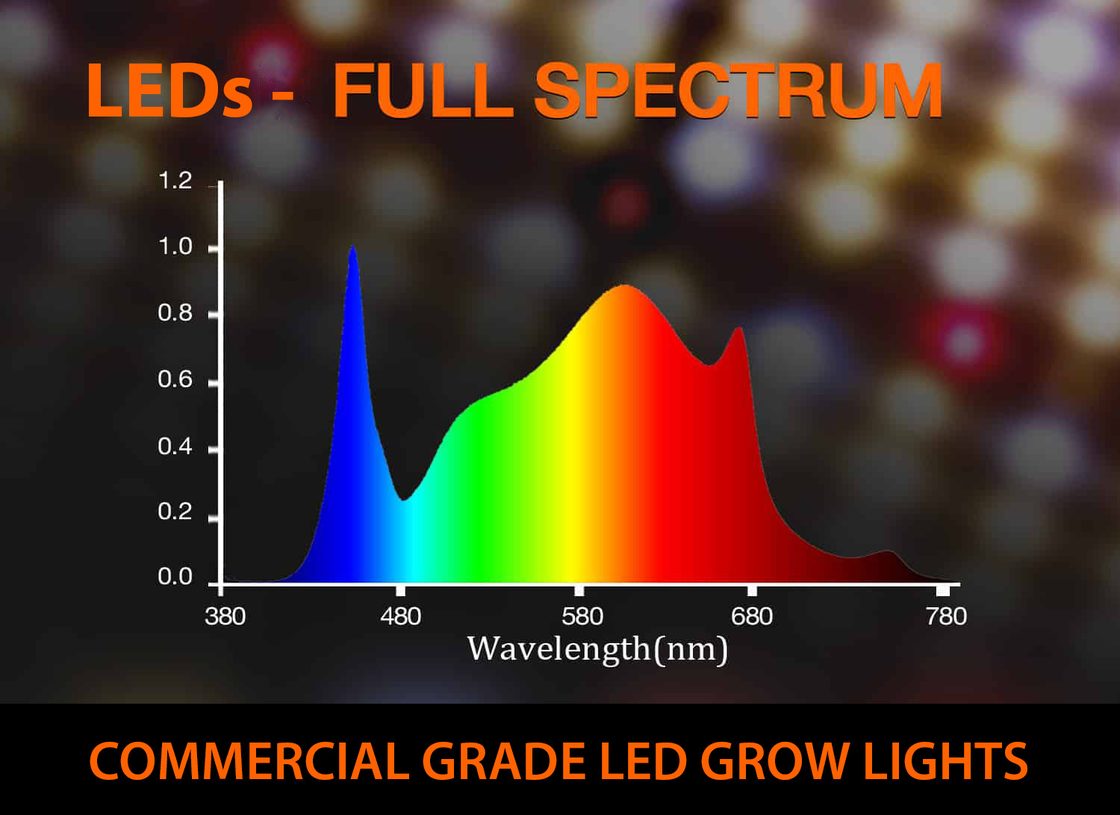
A horticultural LED is engineered around photosynthetically active radiation, the 400 to 700 nm band a plant can use, and that design choice determines almost everything about human exposure. A typical commercial fixture combines a blue pump diode near 450 nm with phosphor-converted white, adds deep red near 660 nm, and may add far-red near 730 nm. Some models add a small ultraviolet channel in the UVA range and a little infrared. What a standard fixture does not add, in any meaningful quantity, is UVB or UVC, because those bands damage plant tissue, degrade the polymers inside the luminaire, and contribute nothing to photosynthesis. The spectrum is built for a canopy, not for human skin, and the two are not the same target.
That distinction is worth holding onto, because the phrase "full spectrum" causes more confusion in this question than any other term in the catalogue. In horticulture, full spectrum is a marketing description meaning the fixture covers the photosynthetically active band reasonably continuously rather than relying only on red and blue peaks. It does not mean the fixture reproduces daylight. It does not mean the output extends into the ultraviolet the way sunlight does. It does not mean the light has any particular benefit for a person standing under it. Our guide to legacy grow light terms unpacks how that wording drifted into the market; the short version is that a horticultural spectrum is a crop recipe, not a sunlamp.
Three consequences follow for the safety question. First, the visible output is bright, and brightness is what drives eye discomfort and glare in a room where people work for hours. Second, the blue content sits close to the peak of the retinal blue-light hazard weighting function, so the eye question is about a real band with a real weighting rather than a vague fear of "blue light". Third, the ultraviolet that people correctly associate with skin damage and with vitamin D is largely absent by design, which resolves several of the most common search questions before they reach a laboratory. The table below maps the bands a commercial fixture actually produces against the hazards the standards assess.
| Band | What a commercial fixture emits | Hazard the standards assess | Practical reading |
|---|---|---|---|
| UVB and UVC, 200-315 nm | largely absent by design; not a photosynthetic driver | actinic ultraviolet hazard for skin, cornea and lens | the band behind sunburn and the established cancer evidence is mostly not there |
| UVA, 315-400 nm | an optional channel on some models, often 365-405 nm | near-ultraviolet hazard for the eye; actinic ultraviolet for skin | if the channel exists, the assessment must match that configuration with it on |
| Blue, 400-500 nm | a phosphor pump diode near 450 nm in most white-based fixtures | retinal blue-light hazard, weighted from 300-700 nm | the weighting function peaks at 435-440 nm, so this band carries the eye question |
| PAR, 400-700 nm | the core output, with red near 660 nm and a white and green base | retinal thermal and skin thermal terms from 380 nm upward | bright, and a discomfort and glare question, with red weighted almost to nothing |
| Far-red and infrared, 700-1400 nm | far-red near 730 nm on some models; little deliberate infrared | retinal thermal, corneal and lens infrared hazard | assessed under UL 8800 section 15 but rarely the limiting term |
IEC 62471 covers all electrically powered incoherent broadband optical sources from 200 to 3000 nm, and it does not issue a pass or a fail. It characterises six families of hazard: actinic ultraviolet for the skin, cornea and lens from 200 to 400 nm; near-ultraviolet for the eye from 315 to 400 nm; retinal blue-light hazard from 300 to 700 nm; retinal thermal hazard from 380 to 1400 nm; infrared radiation for the cornea and lens from 780 to 3000 nm; and skin thermal hazard from 380 to 3000 nm. Each is evaluated with its own weighting function and its own exposure limit, and the shortest permissible exposure time across all of them sets the risk group printed on the label. An assessment is a spectral measurement with a spectroradiometer, not a visual judgement about how bright a light looks.
UL 8800 is where the general standard becomes specific to our industry. Published in 2017 to address horticultural equipment that general luminaire standards such as UL 1598 were never written for, its Section 15 requires a photobiological safety assessment across 280 to 1400 nm at a 20 cm measuring distance, the geometry IEC 62471 recommends for a non-general-lighting source. The distance is not arbitrary: it models the closest plausible view of a bright source, which matters in a grow room where a worker can stand with a face near a low-hung bar. The same section requires that a fixture assessed at the highest risk group not be used, and that a fixture at a moderate group carry the risk group and the appropriate cautionary wording on the product and in the installation instructions. UL 8800 also evaluates what UV does to the luminaire's own polymeric parts, a materials question that general lighting never had to ask.
Two further points from the standards matter commercially. The assessment belongs to the finished luminaire, because optics, reflectors and diffusers change the radiance that reaches an eye; a risk group quoted on a diode datasheet is an input to the calculation, not the conclusion. And the assessment is a characterisation rather than a verdict, which means the useful question is always "which group, measured at what distance, for how long, and by whom". When a supplier answers a safety question with a marketing adjective instead of a test report, that is the moment to ask for the documentation described in our guide to choosing a grow light supplier.
The four groups are defined by exposure duration. The exempt group represents a source that produces no photobiological hazard even under the extreme viewing conditions the standard defines, with a blue-light boundary set at 10,000 seconds, a little under three hours. The low-risk group sits at 100 seconds and is bounded by normal behavioural limits: a person does not stare into a bright source for that long. The moderate group sits at 0.25 seconds and relies on the blink and aversion response, which is why it triggers a warning label and a distance statement. The high-risk group is hazardous even for a momentary glance and is not permitted for horticultural lighting equipment under UL 8800.
That time element is the part most often lost in popular articles. Below 10,000 seconds the criterion is a dose, a weighted radiance multiplied by exposure time; above it, the criterion becomes a steady radiance ceiling. For a commercial grow room, where a head grower may be in the room for a twelve-hour shift on and off across weeks, the steady-state ceiling is the relevant one, and the assessment is effectively about whether someone can look toward a source for an extended period. This is why the same fixture can be unremarkable in a home tent used for ten minutes a day and worth a formal procedure in a production facility. The hardware did not change; the exposure duration did.
| Risk group | Exposure boundary | What the label requires | What it means in a commercial room |
|---|---|---|---|
| Exempt (RG0) | no hazard within 10,000 s for the blue-light term | no special marking in most jurisdictions | ordinary installation practice; keep bright bars out of the normal sight line |
| Low risk (RG1) | 100 s boundary, set by normal aversion behaviour | no special marking in most jurisdictions | procedures still matter for long shifts; avoid sustained viewing of a bright source |
| Moderate risk (RG2) | 0.25 s boundary, relies on the blink and aversion response | risk group and cautionary wording on the product and in the instructions | formal exposure management: distance, task scheduling, signage, eyewear |
| High risk (RG3) | hazardous even for a momentary glance | not permitted for horticultural lighting equipment under UL 8800 | the fixture should not be specified for a grow room |
Read the label as an operating instruction, not as a certificate to file away. A low-risk or moderate-risk marking tells you the manufacturer measured a real hazard at a stated distance and is required to tell you about it. Where that marking appears, the installation instructions should say what the manufacturer expects: mounting height, whether sustained viewing is to be avoided, and what protective equipment is specified for service work. If a quotation arrives with no assessment at all, the honest reading is not that the product is dangerous but that the supplier has not characterised it, which for a commercial purchase is its own kind of answer. Our certifications page lists the documentation we provide with a fixture, and the assessment is part of that pack.
The retinal blue-light hazard is the hazard that dominates a visible-band LED assessment, and the shape of its weighting function explains why a horticultural spectrum deserves a specific answer. The function, tabulated in IEC 62471 and derived from CIE work on photochemical retinal injury, rises steeply through the violet and reaches its peak value of 1.00 at 435 to 440 nm. A 450 nm blue pump diode sits at 0.94, essentially on that peak. Deep red at 660 nm is weighted at 0.001, close to nothing. The same fixture therefore contains one band that the hazard function treats as significant and another that it almost ignores, and a discussion of "LED light" that treats all wavelengths alike misses the physics entirely.
The second piece of physics is geometry. Retinal hazards are evaluated as radiance, and radiance does not fall with viewing distance: step closer to a bright source and the retinal image grows while the dose per unit of retinal area stays constant. Ultraviolet, corneal and skin hazards are evaluated as irradiance, which does fall with the square of distance, so halving a 20 cm reference distance quadruples those values. In practice this means that "stand further back" is a genuine control for UV and skin exposure and a weak control for the blue-light retinal dose; the effective controls there are not staring into the source, keeping bright bars out of the normal sight line, and using eyewear matched to the band when work requires a face near an operating fixture.
What this does not mean is that ordinary work in a properly specified room is an injury risk. Exempt and low-risk sources cannot build a hazard within the exposure a working day allows, which is why those groups carry no labelling obligation in most jurisdictions. What it does mean is that the questions worth asking are specific ones: the risk group of the finished luminaire, the distance it was measured at, whether the fixture has an independently driven blue or UV channel that changes the assessment when it is switched on, and what eyewear the manufacturer names for service work. Grow glasses are not a fashion item; they are a filter specified against a band, and a pair tinted for comfort may do very little at 450 nm. If a room runs high blue content during a long inspection shift, that is a procurement question about spectrum and a procedure question about eyewear, and both belong in the specification rather than in a blog comment.
Sunburn is an erythemal response driven chiefly by UVB, roughly 290 to 315 nm, with some contribution from UVA at high doses. Standard horticultural LED fixtures are built around the photosynthetically active band and largely exclude UVB, because UVB is not a photosynthetic driver and it damages crop tissue, so a conventional grow light does not deliver the erythemal dose that produces a sunburn. Where a fixture does include an ultraviolet channel, it is normally UVA in the 365 to 405 nm region, used for secondary metabolite and morphology work rather than for photosynthesis. That is a real exposure and the standards assess it, under the actinic ultraviolet and near-ultraviolet hazard functions, but it is not the same band and not the same effect.
The skin question therefore splits into two. For a conventional full-spectrum horticultural fixture, the ultraviolet terms in the assessment are small and the practical skin concern is comfort and heat rather than erythema. For a fixture with a deliberate UVA channel, or for any product with a UVB module, the risk group and the label become the controlling documents, and the operator needs to know which channel is on, at what setting, and for how long people are in the room. UL 8800 explicitly accounts for this by requiring the UV exposure of polymeric parts in the luminaire to be evaluated, which is a good hint that a UV channel is an engineering decision with consequences beyond the plant. The plant-side reasoning for adding UV belongs in our guide to UV and far-red lighting, not in a safety paragraph.
One honest boundary: this page describes optical radiation and the standards that characterise it, and it is not medical advice. Anyone with a diagnosed photosensitivity, a condition affected by light exposure, or a concern about a specific skin symptom should put that question to a clinician who knows their history. What a fixture maker can supply is the spectral power distribution of the exact configuration, the photobiological safety assessment with its risk group, and the marking that came with the product. Those three items are what a physician or an occupational health specialist would need in order to answer a person-specific question, and they are also what a serious buyer should already have in the file.
The question "do LED lights cause cancer" appears in every cluster of search terms around this topic, and it deserves a careful answer rather than a reassuring one. Ultraviolet radiation is an established carcinogen, and the band with the strongest evidence is UVB together with UVC, the short wavelengths that the atmosphere filters from sunlight and that germicidal lamps deliberately produce. That is a statement about ultraviolet, not about visible light. Standard horticultural LED fixtures emit in the photosynthetically active band and largely exclude UVB and UVC by design, so the exposure pathway that underpins the established ultraviolet evidence is largely absent from the product.
What we will not do is turn that into an absolute claim. "Safe" in this context means within the exposure limits and risk groups that the standards define for the finished luminaire, measured at a stated distance, with the channels and settings declared. It does not mean a manufacturer can make a medical pronouncement about long-term health outcomes, and any supplier who does is going past their competence. The defensible position is narrower and more useful: the hazard that the oncology evidence is about is ultraviolet; the product in question is designed to omit that ultraviolet; the standards require the remaining optical radiation to be characterised and labelled; and the documentation for the exact model is where the answer lives.
For a commercial operator this has a practical consequence worth stating. When a fixture includes a UV channel, the configuration that was assessed matters. Adding a UV module, changing its drive level, or swapping a LED board for a different spectral revision changes the emitted spectrum, and the assessment should be re-read against the configuration actually installed. This is the same discipline that applies to efficacy claims, and it is covered in our guide to fixture efficacy and measurement. Ask for the assessment that matches the model and the revision on the quotation, and treat a generic group quoted for a different configuration as an incomplete answer.
This is the question where the honest answer is the most useful one, and it is a plain no. Human skin synthesises vitamin D3 when ultraviolet B in roughly the 290 to 315 nm range, with peak efficiency near 297 nm, converts 7-dehydrocholesterol into previtamin D3. UVA does not do it, visible light does not do it, and bright red and blue horticultural light does not do it. A conventional LED grow light is engineered to deliver photons in the 400 to 700 nm photosynthetically active band and to leave UVB out, so sitting under one, however long the shift, does not provide the wavelength that starts the reaction.
The confusion is understandable, because grow lights are marketed as sunlight substitutes and sunlight is the primary natural source of vitamin D. But the substitution is a photosynthetic one, not a physiological one: a fixture replaces the wavelengths a leaf uses, not the ultraviolet that a person's skin uses. Dedicated UVB lamps and medical phototherapy devices exist, and they are engineered, rated and dosed for human exposure under completely different rules; a handful of specialised research fixtures now add low-dose UVB modules, and those are a distinct product category with their own safety case. A horticultural fixture is not one of them, and treating it as one is both ineffective and a good way to exceed an exposure limit designed for a different purpose.
If a worker in a windowless facility is concerned about vitamin D, the honest route is diet, supplementation or a clinician's advice, not the room lighting. We mention this not to be dismissive but because an article that answers the question with "maybe, depending on the spectrum" would be doing the reader a disservice. The same clarity applies to seasonal affective disorder: a bright horticultural fixture is not a light-therapy lamp, and the two products are specified against different standards for different purposes. A manufacturer who knows where its product stops is more useful than one who claims every benefit in the search results.
"Is LED radiation dangerous" is another question that resolves as soon as the vocabulary is pinned down. In IEC 62471 the word is optical radiation: ultraviolet, visible and infrared electromagnetic energy from a non-coherent broadband source. It is non-ionising, which means a photon in this range does not carry enough energy to ionise tissue the way X-rays or gamma rays do. The hazards the standard quantifies are photochemical and thermal, driven by wavelength, radiance and duration, and they are the ones this page has been describing. Nothing about a grow light involves ionising radiation, and conflating the two uses of the word is the source of most of the alarm in popular answers.
The standards are careful about this for a reason, and the care shows in how the limits are written. Each hazard has an action spectrum, a weighting function describing how effective each wavelength is at producing that specific effect, and an exposure limit expressed as a dose or a radiance ceiling. That is a quantitative framework for a real but bounded phenomenon, not a blanket statement that light is harmful. A buyer who understands that framing can read a test report and see exactly which band was assessed, what the limiting value was, and how much margin the product has. A buyer who only sees the word "radiation" has no way to tell the difference between a UVC germicidal lamp, a UVB phototherapy device, and a 660 nm red horticultural bar, three products with entirely different safety profiles.
The same discipline settles a related question about electricity. "What measures how much electricity a UV or LED bulb consumes and emits" has two halves: a wattmeter or the fixture's input rating for what it consumes, and a spectroradiometer or an integrating sphere report for what it emits. Photometric lux meters are calibrated to human vision and are the wrong instrument for a plant fixture, which is why PPFD and spectral measurements exist as separate quantities. Those measurement conventions are set out in our guide to PPFD and DLI, and the input side of the ledger, including what a large room draws over a flowering cycle, belongs in our commercial lighting cost guide.
"Full spectrum light bulbs for humans" is a search phrase built on a category error, and it is worth taking apart because it drives a lot of purchases that disappoint. In horticulture, as noted above, full spectrum describes coverage of the photosynthetically active band with a reasonable white base, so that the crop renders in natural colour and the light penetrates the canopy. In consumer lighting, the same phrase is used for lamps marketed against mood, circadian comfort or colour rendering, which are human visual and non-visual responses measured on entirely different scales. One product is specified in µmol/J and PPFD; the other is specified in lumens, correlated colour temperature and colour rendering index. A horticultural datasheet is not a health claim, and a wellness lamp will not flower a cannabis crop.
The confusion has a real practical edge in a commercial room. A spectrum with a proper white and green base makes crop colour read naturally, so deficiencies, pest stippling and stress patterns show up the way they would in daylight during a long inspection shift. That is an operational benefit for the people working in the room, and it is one of the reasons the industry moved from narrow red-and-blue fixtures toward white-based spectra, a shift covered in our best full spectrum guide. But the benefit is visibility, not therapy. A white-based horticultural spectrum is easier to work under; it does not become a sunlamp, it does not deliver UVB, and it does not carry a claim about human wellbeing.
For a facilities manager, the useful conclusion is to specify for the task. If the room needs good colour discrimination for scouting, ask for the spectral power distribution and the white share, and check it against the efficacy figure on the same configuration. If the room needs a UV channel for a crop protocol, specify the channel, its control and its documentation explicitly. If a person in the building wants a light-therapy product, that is a separate purchase from a separate supplier. Keeping those three lines separate is cheaper than discovering a category error after the fixtures are hung. The component-side story of how white and green packages ended up on the same board is in our green LED article.
Three products get folded into this question and none of them is the same as a modern white-based horticultural LED. The purple "blurple" fixture, built from discrete red and blue diodes with little between them, produces a spectrum with a strong 450 nm peak and a strong 660 nm peak. Its blue-light-weighted radiance can be high relative to its visual brightness, and its colour rendering is poor enough that scouting is genuinely harder. It is not automatically more hazardous than a white fixture, because the risk group is a measurement rather than a colour, but it concentrates output near the peak of the blue-light weighting function and it makes long inspection work unpleasant. The terminology and the era that produced it are covered in our legacy terms guide.
A black light is a UVA source, typically around 365 to 400 nm, sold for fluorescence and inspection effects. It is not a grow light and a grow light is not a black light, even though both can look violet to a camera. The exposure questions are different, the assessment band is different, and the labelling is different. High-pressure sodium, the fixture that dominated commercial cannabis rooms before LED, is a third case again: a high-intensity discharge lamp with a hot envelope, high ballast voltage, mercury content and some ultraviolet output, with handling and disposal rules that LEDs do not share. Our LED versus HPS comparison covers the engineering and operating differences; the safety point is that a question about HPS exposure should be answered about HPS, not inherited by a different technology.
This matters for anyone assembling a safety file for a mixed room. A facility that still runs some HPS bays alongside a newer LED installation has two exposure profiles, two sets of handling instructions and two maintenance procedures, and a single generic "grow lights are safe" line covers none of them. List what is actually installed, by model and revision, and keep the documentation for each. That habit also makes the replacement decision easier when the older bays reach the end of their service life, a trigger we examine in our guide to when to replace grow lights.
Not every complaint about working under grow lights is a photobiological hazard, and the honest article says so. Flicker and glare are comfort and performance issues with their own measurement conventions, and in a production room they matter because a head grower may spend a long shift under the fixtures. Flicker is characterised by modulation depth and frequency rather than by whether a person can consciously see it; dimming drivers and pulse-width modulation are where it originates, and a well-designed constant-current driver keeps it low. If a room shows visible banding on a phone camera or staff report headaches and eye strain, the first checks are the driver and the dimming setting, not the risk group. Our dimming buyer's guide covers what to look for in the specification.
Glare is more straightforward and more often underestimated. A commercial top light is a large, very bright surface mounted above the working plane, and an installation that puts bright bars into the normal sight line will produce discomfort regardless of its risk group. Mounting height, the angle of the fixture, the reflectance of the room surfaces and the layout of the aisles all change what a worker actually sees. These are installation decisions, and they are the same ones that determine how evenly the canopy is lit, which is why they belong in the layout conversation rather than in a safety footnote. A room designed so that staff look at leaves rather than at diodes is both more comfortable and easier to scout.
The shift length is the thread that ties this section to the standards. A home grower who checks a tent for ten minutes a day and a commercial operator who walks a flower room across a twelve-hour shift have very different exposure durations, and the assessment's 10,000 second boundary is where that difference becomes quantitative. It is also why the commercial answer is a procedure: schedule the tasks that require close viewing of an operating fixture, keep those tasks short, specify eyewear for them, and put the bright sources out of the ordinary line of sight. The mathematics of the lighting plan itself, including how fixture count and spacing set the PPFD at the canopy, lives in our guide to calculating fixture count.
Search results about grow light safety mix two entirely different subjects. The first half, optical radiation, is what this page has covered. The second half is electrical and thermal: service capacity, circuit protection, inrush current, driver heat, ingress protection in a wet room, mounting hardware, and what happens when a controller fails. A fixture can carry an unremarkable risk group and still be installed into a circuit that is wrong for it, and in a commercial facility the electrical half is where the serious incidents originate. We are not going to compress that subject into a paragraph, because doing it justice requires a single-line diagram and a load schedule.
The full treatment is in our guide to grow room safety and energy, which works from the service entrance through protection devices, IP zoning, thermal derating and a pre-season walkdown. The short version for this page is that the two halves should be assessed together at specification time: the electrical file tells you whether the installation is sound, and the photobiological assessment tells you what the light does to people in the room. Heat, similarly, is mostly an engineering and HVAC question rather than a skin hazard one under normal mounting, but a driver running outside its thermal envelope is both a reliability problem and a reason to review the installation.
Energy use belongs in the same conversation. "Do LED grow lights use a lot of electricity" has a different answer at 100 W in a tent and at a room full of high-output fixtures running a flowering photoperiod, and the quantity that matters is the fixture's input power multiplied by hours and count, not the technology label. The cost side, including demand charges and what a continuous lighting load does to a bill, is covered in our cost guide and in our demand charges article. None of that changes the risk group, but a buyer who has both files has actually specified the room.
Everything above converges on a short, boring document, and in a commercial facility that document is the answer. A worker protection procedure for a lit grow room is not a medical policy; it is a list of controls tied to the equipment that is actually installed, with an owner and a review interval for each line. It starts with the procurement file: the photobiological safety assessment for the exact model and spectral revision, the risk group and the distance at which it was measured, the marking and installation instructions, and the spectral power distribution of the configuration including any UV channel. A room whose documentation stops at a catalogue screenshot has no procedure, only an assumption.
From there the controls stack in the usual industrial order. Engineering controls come first: mounting height and aim that keep bright bars out of the ordinary sight line, shielding or interlocks on any UV channel, and driver and dimming settings that keep flicker low. Administrative controls follow: which tasks require a face near an operating fixture, how long those tasks may take, who may switch a UV channel on, what the signage says at the room entry, and how a new hire is trained before their first scouting shift. Personal protective equipment comes last, specified against the band in question rather than chosen for tint, and issued for the tasks that need it. The review interval matters as much as the list, because a spectral revision, a driver swap or a change in shift pattern can invalidate a procedure that was correct on the day it was written.
| Control | What it fixes | Owner | Re-check when |
|---|---|---|---|
| Assessment file for the exact model and revision | which risk group applies, and at what measurement distance | procurement, with the supplier | a spectral revision, a driver swap or a new model |
| Mounting height, aim and shielding | bright sources in the ordinary sight line; close viewing distance | installer and facilities | a room layout change, a rack change or a re-hang |
| UV channel interlock and switching rules | exposure that only exists when an optional channel is on | head grower | a channel is added, retuned or enabled in a new recipe |
| Task scheduling, training and entry signage | how long a face stays near an operating fixture, and who may be there | room manager | a shift pattern change, a new hire or a new procedure |
| Band-rated eyewear for close service work | the residual blue and UVA dose during maintenance and inspection | room manager, with the safety supplier | eyewear is replaced, or the spectrum changes |
One last point on scope. This page is written for the people specifying and operating commercial cannabis rooms, and the conditions it describes, twelve-hour shifts, high-output fixtures, UV channels and mixed fleets, are the conditions where a procedure earns its keep. A single small fixture in a home tent is a different exposure case with the same physics, and the same three questions still apply: which risk group, at what distance, for how long. Answer those from the documentation rather than from a search result, and the general question dissolves into a set of concrete ones that a supplier can be held to. That is the difference between a reassuring article and a specification.
A properly installed LED grow light, used within the exposure limits set by IEC 62471 and UL 8800, is ordinary industrial equipment rather than a health hazard. The answer is not a property of LED technology in general: it depends on the risk group of the finished luminaire, the distance at which it was assessed and the length of exposure. Ask for the photobiological safety assessment for the exact model, read the marking and installation instructions that accompany it, and build the room's staff procedure around those three facts.
The relevant hazard is retinal blue light, whose weighting function in IEC 62471 peaks at 435 to 440 nm. A 450 nm blue pump diode sits near that peak, while 660 nm deep red is weighted almost to nothing. Exempt and low-risk luminaires cannot build a hazard within a working day of exposure. Where a moderate risk group applies, the controls are avoiding sustained viewing of a bright source, keeping bars out of the normal sight line, and using eyewear specified against the blue band for close service work.
The established carcinogenic evidence concerns ultraviolet radiation, chiefly UVB and UVC, the bands that germicidal and phototherapy lamps deliberately produce. Standard horticultural LED fixtures are built around the 400 to 700 nm photosynthetically active band and largely exclude UVB and UVC by design, so that exposure pathway is largely absent. We do not make medical pronouncements about long-term outcomes; the defensible statement is that the remaining optical radiation is characterised and labelled by the standards, and the assessment for the exact model is where the answer lives.
No. Vitamin D3 synthesis in skin requires ultraviolet B at roughly 290 to 315 nm, with peak efficiency near 297 nm. UVA does not trigger it and visible light does not trigger it. A conventional LED grow light is engineered to deliver photosynthetically active photons and to leave UVB out, so no length of time under one supplies the wavelength that starts the reaction. Dedicated UVB devices are a separate, rated product category; for a personal concern, the route is diet, supplementation or a clinician's advice.
Some models add a deliberate UVA channel, typically 365 to 405 nm, for secondary metabolite and morphology work, and the standards assess that output under the actinic and near-ultraviolet hazard functions. Conventional white-based horticultural fixtures emit very little UVB and essentially no UVC, because those bands damage crop tissue and luminaire polymers and contribute nothing to photosynthesis. The way to know is the spectral power distribution of the exact configuration, plus the risk group of that configuration with the UV channel on.
Sunburn is an erythemal response driven mainly by UVB, which standard horticultural LED fixtures largely exclude. For a conventional full-spectrum fixture the ultraviolet terms in the assessment are small, and the practical concerns are comfort, glare and heat. Where a fixture carries a UVA or UVB channel, the risk group, the label and the installation instructions become the controlling documents, and the operator needs to know which channel is on, at what setting, and for how long people are in the room.
That is an electrical and installation question rather than a photobiological one, and in a commercial facility it is where the serious incidents originate: service capacity, circuit protection, inrush current, driver heat, ingress protection in a wet room and mounting hardware. A fixture with an unremarkable risk group can still be installed into a circuit that is wrong for it. The full treatment, including a single-line diagram and a pre-season walkdown, is in our guide to grow room safety and energy.
It depends on fixture input power, count and photoperiod, not on the technology label. A small tent fixture and a room of high-output top lights running a flowering cycle are different loads by orders of magnitude. The honest figure is input watts multiplied by hours and count, and the utility-side consequences, including demand charges on a continuous load, are covered in our commercial lighting cost guide and our demand charges article.
In IEC 62471 the word means optical radiation, ultraviolet through visible to infrared, from a non-coherent broadband source. It is non-ionising, and the hazards it quantifies are photochemical and thermal, governed by wavelength, radiance and duration, with an exposure limit for each. Nothing about a grow light involves ionising radiation. Conflating that word with X-rays or gamma rays is the source of most of the alarm in popular answers, and it also hides the real difference between a UVC germicidal lamp and a 660 nm horticultural bar.
"Full spectrum" in horticulture means reasonably continuous coverage of the photosynthetically active band, not daylight and not a health product. The eye question is the same blue-light question answered above: it depends on the finished luminaire's risk group, its blue content and the exposure duration. A white-based spectrum with a proper green share actually makes long inspection shifts easier, because crop colour reads naturally, but that is a visibility benefit and not a therapeutic one.
It is not, and that idea is one of the longest-lived myths in the catalogue. Leaves look green because they reflect a share of green light, but green photons are photosynthetically active and travel deeper into a dense canopy than red or blue, reaching lower leaves that the upper canopy shades. A measurable green and white share also renders crop colour naturally, which makes deficiencies and pest patterns visible during scouting. The evidence, the measurement debate and the species-dependent signalling are covered in full in our wavelengths guide.
A blurple fixture built from discrete red and blue diodes concentrates its output near 450 nm, close to the peak of the blue-light weighting function, and renders colour poorly enough that scouting is harder. That does not automatically make it a higher risk group, because the group is a measurement rather than a colour, but it is an unpleasant spectrum to work under for long shifts. Check the assessment for the exact model, and if close viewing is required, use eyewear specified against the blue band rather than a comfort tint.
Send the room dimensions, ceiling height and the fixtures you run now, and we will answer with a recommended configuration, the photobiological safety documentation for the exact model, and a quotation from our Dongguan plant.
